


Clinicopathologic and prognostic relevance of ARID1A protein loss in colorectal cancer
- PMID: 25561809
- PMCID: PMC4277979
- DOI: 10.3748/wjg.v20.i48.18404
Clinicopathologic and prognostic relevance of ARID1A protein loss in colorectal cancer
Abstract
Aim: To explore the association between AT-rich interactive domain 1A (ARID1A) protein loss by immunohistochemistry and both clinicopathologic characteristics and prognosis in patients with colorectal cancer.
Methods: We retrospectively collected clinicopathologic data and archived paraffin-embedded primary colorectal cancer samples from 209 patients, including 111 patients with colon cancer and 98 patients with rectal cancer. The tumor stage ranged from stage I to stage IV according to the 7(th) edition of the American Joint Committee on Cancer tumor-node-metastasis (TNM) staging system. All patients underwent resection of primary colorectal tumors. The expression of ARID1A protein in primary colorectal cancer tissues was examined by immunohistochemical staining. The clinicopathologic association and survival relevance of ARID1A protein loss in colorectal cancer were analyzed.
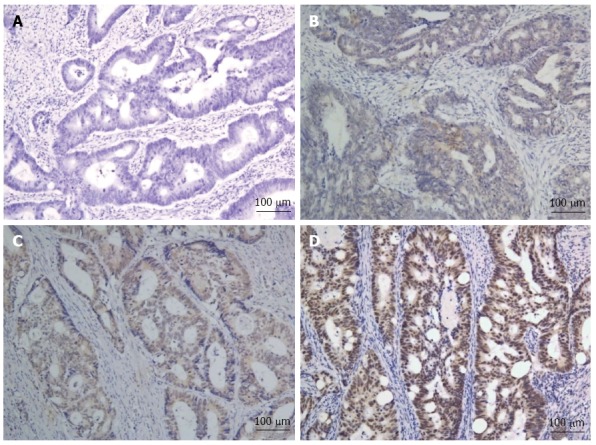
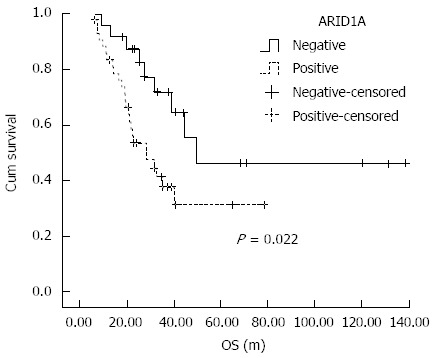
Results: ARID1A loss by immunohistochemistry was not rare in primary colorectal cancer tumors (25.8%). There were 7.4%, 24.1%, 22.2% and 46.3% of patients with ARID1A loss staged at TNM stage I, II, III and IV, respectively, compared with 20.0%, 22.6%, 27.7% and 29.7% of patients without ARID1A loss staged at TNM stage I, II, III and IV, respectively. In patients with ARID1A loss, the distant metastasis rate was 46.3%. However, only 29.7% of patients without ARID1A loss were found to have distant metastasis. In terms of pathologic differentiation, there were 25.9%, 66.7% and 7.4% with poorly, moderately and well differentiated tumors in patients with ARID1A loss, and 14.2%, 72.3% and 13.5% with poorly, moderately and well differentiated tumors in patients without ARID1A loss, respectively. ARID1A loss was associated with late TNM stage (P = 0.020), distant metastasis (P = 0.026), and poor pathological classification (P = 0.035). However, patients with positive ARID1A had worse overall survival compared to those with negative ARID1A in stage IV colorectal cancer (HR = 2.49, 95%CI: 1.13-5.51).
Conclusion: ARID1A protein loss is associated with clinicopathologic characteristics in colorectal cancer patients and with survival in stage IV patients.
Keywords: AT-rich interactive domain 1A; Clinicopathologic characteristics; Colorectal cancer; Prognosis; Switching defective/sucrose non-fermenting complexes.
Figures
References
-
- Siegel R, Naishadham D, Jemal A. Cancer statistics, 2012. CA Cancer J Clin. 2012;62:10–29. - PubMed
-
- Douillard JY, Oliner KS, Siena S, Tabernero J, Burkes R, Barugel M, Humblet Y, Bodoky G, Cunningham D, Jassem J, et al. Panitumumab-FOLFOX4 treatment and RAS mutations in colorectal cancer. N Engl J Med. 2013;369:1023–1034. - PubMed
-
- Liang JT, Huang KC, Lai HS, Lee PH, Cheng YM, Hsu HC, Cheng AL, Hsu CH, Yeh KH, Wang SM, et al. High-frequency microsatellite instability predicts better chemosensitivity to high-dose 5-fluorouracil plus leucovorin chemotherapy for stage IV sporadic colorectal cancer after palliative bowel resection. Int J Cancer. 2002;101:519–525. - PubMed
Publication types
MeSH terms
Substances
LinkOut - more resources
Full Text Sources
Other Literature Sources
Medical
