. 2015 Jan 6:6:5921.
doi: 10.1038/ncomms6921.

Antibiotics in ingested human blood affect the mosquito microbiota and capacity to transmit malaria

Affiliations

Antibiotics in ingested human blood affect the mosquito microbiota and capacity to transmit malaria

Mathilde Gendrin et al. Nat Commun. .

Abstract

Malaria reduction is most efficiently achieved by vector control whereby human populations at high risk of contracting and transmitting the disease are protected from mosquito bites. Here, we identify the presence of antibiotics in the blood of malaria-infected people as a new risk of increasing disease transmission. We show that antibiotics in ingested blood enhance the susceptibility of Anopheles gambiae mosquitoes to malaria infection by disturbing their gut microbiota. This effect is confirmed in a semi-natural setting by feeding mosquitoes with blood of children naturally infected with Plasmodium falciparum. Antibiotic exposure additionally increases mosquito survival and fecundity, which are known to augment vectorial capacity. These findings suggest that malaria transmission may be exacerbated in areas of high antibiotic usage, and that regions targeted by mass drug administration programs against communicable diseases may necessitate increased vector control.


Figures
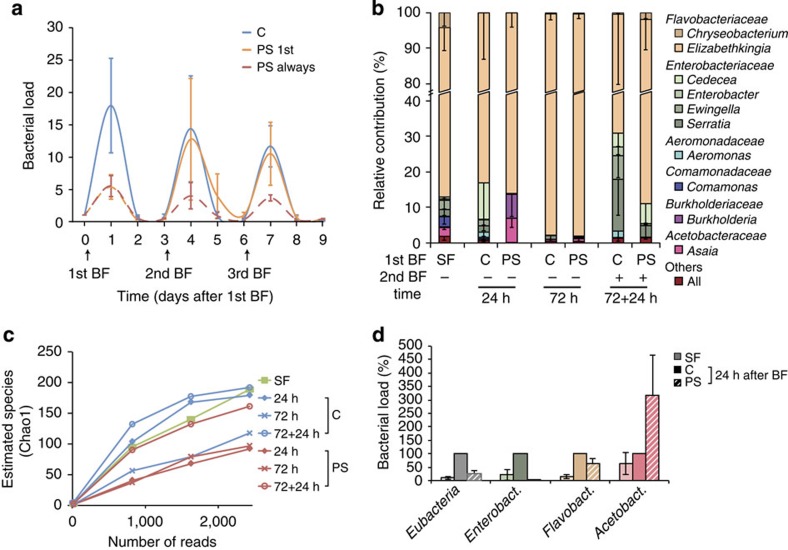
Figure 1
Figure 1. Blood meal antibiotics affect mosquito microbiota.
(a) qPCR quantification of midgut bacterial 16S rDNA every 24 h during a three blood-feed (‘BF’) course. Blood was supplemented with penicillin/streptomycin (‘PS always’), water (control, ‘C’) or PS in the first blood meal and water thereafter (‘PS 1st’). (b) 16S rDNA 454-pyrosequencing analysis of mosquito gut microbiota before blood meal (sugar fed, ‘SF’), 24 and 72 h after PS-treated or untreated blood meal and 24 h after an untreated second blood meal. Main bacterial genera (>5% in at least one sample) and families are indicated. (c) Rarefaction curve of the estimated number of species using the Chao1 method. (d) qPCR microbiota analysis using generic or taxon-specific 16S rDNA primers. Data show average from three (ac) to six (d) independent experiments, error bars show s.e.m., n=15–25 mosquitoes per sample and per replicate. qPCR data show fold versus day 0 (a) and % of control BF. (d) Enterobact.—Enterobacteriaceae; Flavobact.—Flavobacteriaceae; Acetobact.Acetobacteraceae.
Figure 2
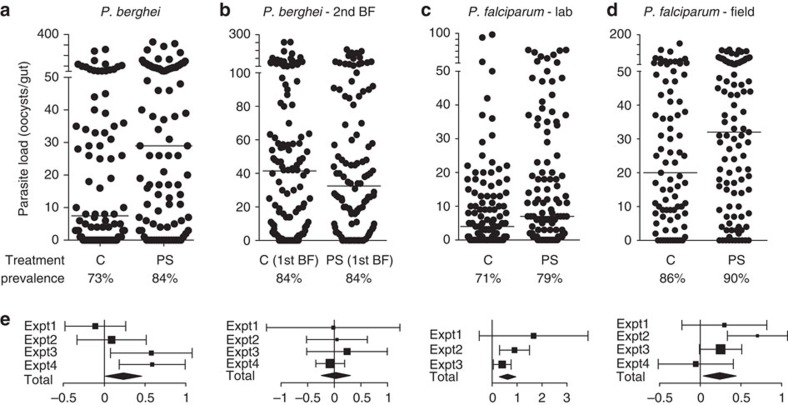
Figure 2. Antibiotics increase mosquito susceptibility to infection by Plasmodium ingested in the same blood meal.
(ad) Oocyst counts after PS-treated or control (‘C’) blood meal on P. berghei-infected mice (a), naive mice, followed with a 2nd blood meal on untreated P. berghei-infected mice 3 days later (b), P. falciparum gametocyte cultures (c) and naturally infected P. falciparum blood samples (d). Medians and oocyst distributions of representative experiments are shown. (e) Forest plots showing the effect of PS treatment on Plasmodium infection intensities in each replicate as determined by GLMM analysis. The variation of the fixed effect estimate in each (squares) and all (diamonds) replicates are shown (±95% confidence interval, glmmADMB). Within each chart, the square size is proportional to the mosquito number. From left to right, charts show the effect on P. berghei - 2nd BF, P. falciparum—lab and P. falciparum—field respectively. Mosquitoes (n=18–205) per experiment and per condition (average 86 (±8 s.e.m.)).
Figure 3
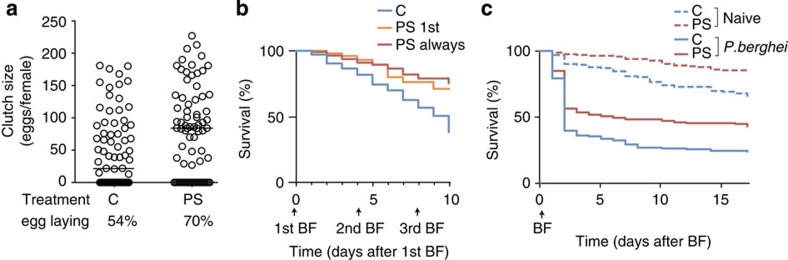
Figure 3. Blood meal antibiotics increase mosquito survival and fecundity.
(a) Mosquito clutch size and percentage of females that laid eggs (‘Egg laying’) following PS-treated or control blood meal. Medians and distributions of egg numbers per female of one representative experiment of three are shown. (b and c) Kaplan–Maier survival plots of mosquitoes fed on human blood (b) or mice (c). In b, mosquitoes were offered three control blood meals (‘C’), three PS-treated blood meals (‘PS always’), or a PS-treated first blood meal and two control blood meals (‘PS 1st’). In c, mosquitoes were fed once on P. berghei-infected (solid lines) or naive (dashed lines) mice. Data are pooled from three (b) to four (c) independent experiments. Mosquitoes (n=50) per experiment and per condition.

References

    1. Vlachou D., Schlegelmilch T., Runn E., Mendes A. & Kafatos F. C. The developmental migration of Plasmodium in mosquitoes. Curr. Opin. Genet. Dev. 16, 384–391 (2006). - PubMed
    1. Pumpuni C. B., Demaio J., Kent M., Davis J. R. & Beier J. C. Bacterial population dynamics in three anopheline species: the impact on Plasmodium sporogonic development. Am. J. Trop. Med. Hyg. 54, 214–218 (1996). - PubMed
    1. Kumar S., Molina-Cruz A., Gupta L., Rodrigues J. & Barillas-Mury C. A peroxidase/dual oxidase system modulates midgut epithelial immunity in Anopheles gambiae. Science 327, 1644–1648 (2010). - PMC - PubMed
    1. Gendrin M. & Christophides G. K. inAnopheles mosquitoes - New insights into malaria vectors ed Manguin S. 10.5772/55107InTech (2013).
    1. Meister S. et al. Anopheles gambiae PGRPLC-mediated defense against bacteria modulates infections with malaria parasites. PLoS Pathog. 5, e1000542 (2009). - PMC - PubMed

Publication types