


Infectious Disease Management through Point-of-Care Personalized Medicine Molecular Diagnostic Technologies
- PMID: 25562799
- PMCID: PMC4251365
- DOI: 10.3390/jpm2020050
Infectious Disease Management through Point-of-Care Personalized Medicine Molecular Diagnostic Technologies
Abstract
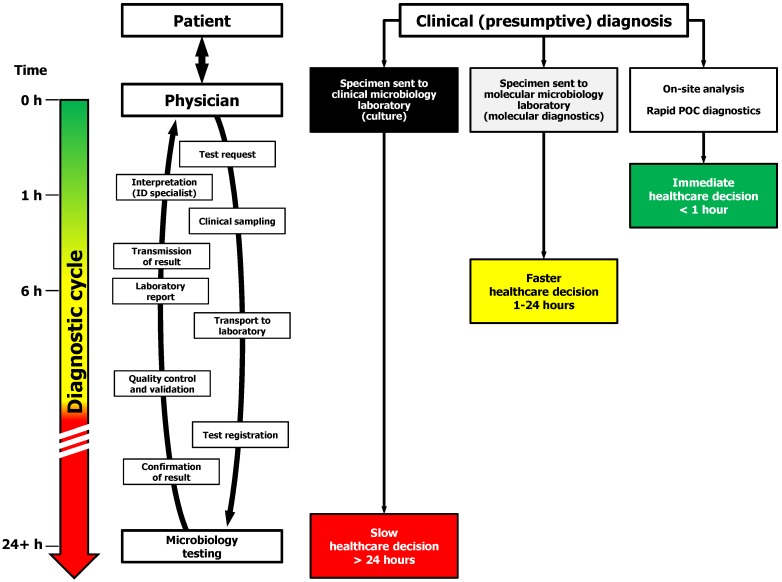
Infectious disease management essentially consists in identifying the microbial cause(s) of an infection, initiating if necessary antimicrobial therapy against microbes, and controlling host reactions to infection. In clinical microbiology, the turnaround time of the diagnostic cycle (>24 hours) often leads to unnecessary suffering and deaths; approaches to relieve this burden include rapid diagnostic procedures and more efficient transmission or interpretation of molecular microbiology results. Although rapid nucleic acid-based diagnostic testing has demonstrated that it can impact on the transmission of hospital-acquired infections, we believe that such life-saving procedures should be performed closer to the patient, in dedicated 24/7 laboratories of healthcare institutions, or ideally at point of care. While personalized medicine generally aims at interrogating the genomic information of a patient, drug metabolism polymorphisms, for example, to guide drug choice and dosage, personalized medicine concepts are applicable in infectious diseases for the (rapid) identification of a disease-causing microbe and determination of its antimicrobial resistance profile, to guide an appropriate antimicrobial treatment for the proper management of the patient. The implementation of point-of-care testing for infectious diseases will require acceptance by medical authorities, new technological and communication platforms, as well as reimbursement practices such that time- and life-saving procedures become available to the largest number of patients.
Figures
References
-
- Arnold A., Brouse S.D., Pitcher W.D., Hall R.G., II. Empiric Therapy for Gram-Negative Pathogens in Nosocomial and Health Care-Associated Pneumonia: Starting with the End in Mind. J. Intensive Care Med. 2010;25:259–270. - PubMed
-
- Jabes D. The Antibiotic R&D Pipeline: An Update. Curr. Opin. Microbiol. 2011;14:564–569. - PubMed
-
- Micek S.T., Welch E.C., Khan J., Pervez M., Doherty J.A., Reichley R.M., Hoppe-Bauer J., Dunne W.M., Kollef M.H. Resistance to Empiric Antimicrobial Treatment Predicts Outcome in Severe Sepsis Associated with Gram-Negative Bacteremia. J. Hosp. Med. 2011;6:405–410. - PubMed
-
- Nicolau D.P. Current Challenges in the Management of the Infected Patient. Curr. Opin. Infect. Dis. . 2011;24(suppl. 1):S1–S10. - PubMed
-
- Pogue J.M., Marchaim D., Kaye D., Kaye K.S. Revisiting "Older" Antimicrobials in the Era of Multidrug Resistance. Pharmacotherapy. 2011;31:912–921. - PubMed
Publication types
LinkOut - more resources
Full Text Sources
Other Literature Sources
