


Structural connectivity of neural reward networks in youth at risk for substance use disorders
- PMID: 25563237
- PMCID: PMC4465865
- DOI: 10.1007/s00213-014-3857-y
Structural connectivity of neural reward networks in youth at risk for substance use disorders
Abstract
Background: Having a positive family history of alcohol use disorders (FHP), as well as aberrant reward circuitry, has been implicated in the initiation of substance use during adolescence. This study explored the relationship between FHP status and reward circuitry in substance naïve youth to better understand future risky behaviors.
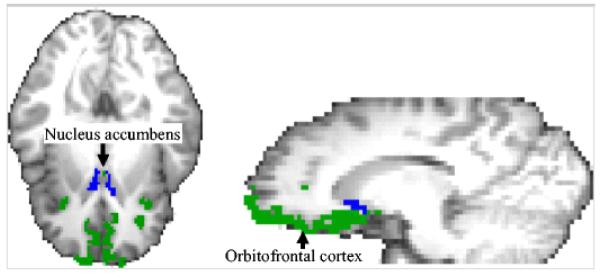
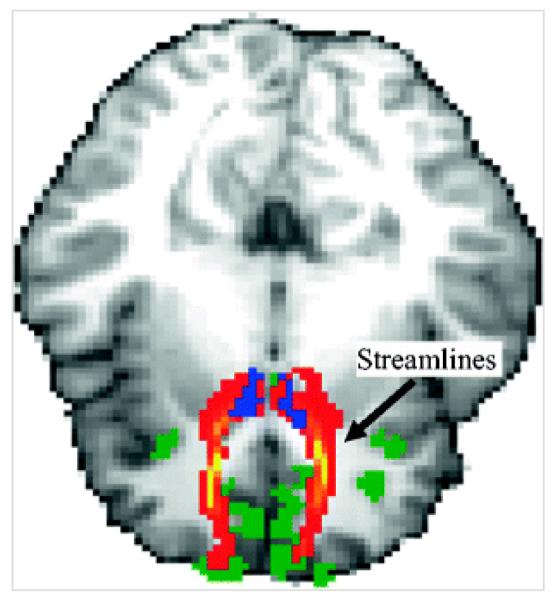
Methods: Participants were 49 FHP and 45 demographically matched family history negative (FHN) substance-naïve 12-14 year-olds (54 % female). Subjects underwent structural magnetic resonance imaging, including diffusion tensor imaging. Nucleus accumbens and orbitofrontal cortex volumes were derived using FreeSurfer, and FSL probabilistic tractography probed structural connectivity and differences in white matter diffusivity estimates (e.g. fractional anisotropy, and mean, radial, and axial diffusivity) between fiber tracts connecting these regions.
Result: FHP and FHN youth did not differ on nucleus accumbens or orbitofrontal cortex volumes, white matter tract volumes, or percentages of streamlines (a proxy for fiber tract count) connecting these regions. However, within white matter tracts connecting the nucleus accumbens to the orbitofrontal cortex, FHP youth had significantly lower mean and radial diffusivity (ps < 0.03) than FHN youth.
Discussion: While white matter macrostructure between salience and reward regions did not differ between FHP and FHN youth, FHP youth showed greater white matter coherence within these tracts than FHN youth. Aberrant connectivity between reward regions in FHP youth could be linked to an increased risk for substance use initiation.
Keywords: Adolescence; Cognitive control; Diffusion tensor imaging (DTI); Family history of alcohol use disorders; Nucleus accumbens; Orbitofrontal cortex; Probabilistic tractography; Reward circuitry; Structural connectivity; Substance use disorders; White matter integrity.
Figures
References
-
- Achenbach TM, Rescorla LA. Manual for the ASEBA School-Age Forms & Profiles. University of Vermont, Research Center for Children, Youth, & Families; Burlington, VT: 2001.
-
- American Psychiatric Association . Diagnostic and statistical manual of mental disorders. 4th edition. American Psychiatric Association; Washington, DC: 1994. (DSM-IV)
-
- Andersson JL, Skare S. A model-based method for retrospective correction of geometric distortions in diffusion-weighted EPI. Neuroimage. 2002;16:177–199. - PubMed
-
- Andreasen NC, Rice J, Endicott J, Reich T, Coryell W. The family history approach to diagnosis. How useful is it?. Arch Gen Psychiatry. 1986;43:421–429. - PubMed
-
- Basser PJ, Pierpaoli C. Microstructural and physiological features of tissues elucidated by quantitative-diffusion-tensor MRI. J Magn Reson B. 1996;111:209–219. - PubMed
Publication types
MeSH terms
Grants and funding
LinkOut - more resources
Full Text Sources
Other Literature Sources
