


Comment
doi: 10.1073/pnas.1419351112.
Epub 2015 Jan 6.
Reply to Tan et al.: Differences between real and simulated proteins in multiple sequence alignments
Affiliations
- PMID: 25564671
- PMCID: PMC4299201
- DOI: 10.1073/pnas.1419351112
Item in Clipboard
Comment
Reply to Tan et al.: Differences between real and simulated proteins in multiple sequence alignments
Proc Natl Acad Sci U S A.
.
No abstract available
Conflict of interest statement
The authors declare no conflict of interest.
Figures
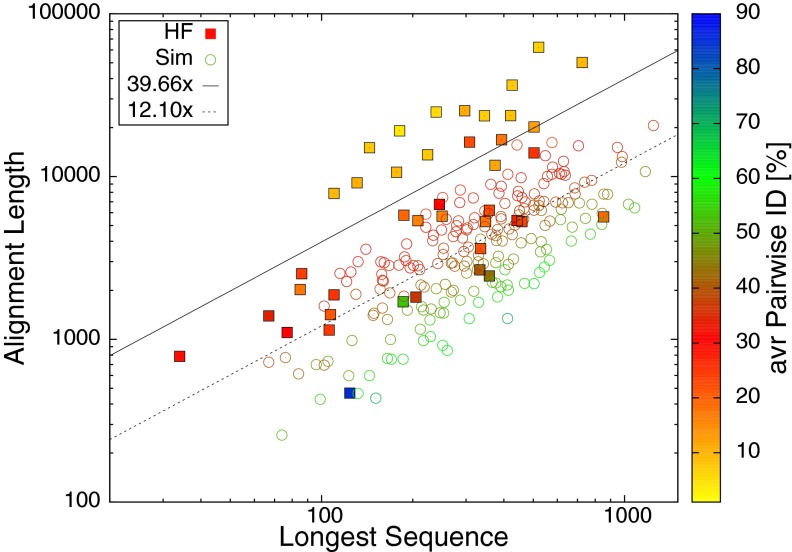
The length of the longest sequence in a protein family is given along the x axis; length of the final alignment is along the y axis. The alignments were produced using the phylogeny-aware program PAGAN. The 41 HomFam datasets (HF), as used in figure 5 of Boyce et al. (2), are rendered as solid squares; the 200 simulated datasets (Sim), as used in Tan et al. (1), are shown as open circles. The average pairwise identity in the alignments is rendered with color (blue/green, high identity; red/yellow, low identity). Lines represent average “inflation” of the alignments because of the alignment process: solid line 40-fold inflation for HomFam, dotted line 12-fold inflation for the simulated data.
Comment on
-
Simple chained guide trees give high-quality protein multiple sequence alignments.Proc Natl Acad Sci U S A. 2014 Jul 22;111(29):10556-61. doi: 10.1073/pnas.1405628111. Epub 2014 Jul 7. Proc Natl Acad Sci U S A. 2014. PMID: 25002495 Free PMC article.
-
Simple chained guide trees give poorer multiple sequence alignments than inferred trees in simulation and phylogenetic benchmarks.Proc Natl Acad Sci U S A. 2015 Jan 13;112(2):E99-100. doi: 10.1073/pnas.1417526112. Epub 2015 Jan 6. Proc Natl Acad Sci U S A. 2015. PMID: 25564672 Free PMC article. No abstract available.
References
-
- Pascarella S, Argos P. Analysis of insertions/deletions in protein structures. J Mol Biol. 1992;224(2):461–471. - PubMed
-
- Chang MSS, Benner SA. Empirical analysis of protein insertions and deletions determining parameters for the correct placement of gaps in protein sequence alignments. J Mol Biol. 2004;341(2):617–631. - PubMed
Publication types
MeSH terms
Substances
LinkOut - more resources
Full Text Sources
Other Literature Sources
