. 2014 Dec 15;9 Suppl 2(Suppl 2):109-26.
doi: 10.2147/IJN.S57928. eCollection 2014.

Toxicity of 100 nm zinc oxide nanoparticles: a report of 90-day repeated oral administration in Sprague Dawley rats

Affiliations

Toxicity of 100 nm zinc oxide nanoparticles: a report of 90-day repeated oral administration in Sprague Dawley rats

Yu-Ri Kim et al. Int J Nanomedicine. .

Abstract

Nanoparticles (NPs) are used commercially in health and fitness fields, but information about the toxicity and mechanisms underlying the toxic effects of NPs is still very limited. The aim of this study is to investigate the toxic effect(s) of 100 nm negatively (ZnO(AE100[-])) or positively (ZnO(AE100[+])) charged zinc oxide (ZnO) NPs administered by gavage in Sprague Dawley rats, to establish a no observed adverse effect level, and to identify target organ(s). After verification of the primary particle size, morphology, hydrodynamic size, and zeta potential of each test article, we performed a 90-day study according to Organisation for Economic Co-operation and Development test guideline 408. For the 90-day study, the high dose was set at 500 mg/kg and the middle and low doses were set at 125 mg/kg and 31.25 mg/kg, respectively. Both ZnO NPs had significant changes in hematological and blood biochemical analysis, which could correlate with anemia-related parameters, in the 500 mg/kg groups of both sexes. Histopathological examination showed significant adverse effects (by both test articles) in the stomach, pancreas, eye, and prostate gland tissues, but the particle charge did not affect the tendency or the degree of the lesions. We speculate that this inflammatory damage might result from continuous irritation caused by both test articles. Therefore, the target organs for both ZnO(AE100(-)) and ZnO(AE100(+)) are considered to be the stomach, pancreas, eye, and prostate gland. Also, the no observed adverse effect level for both test articles was identified as 31.25 mg/kg for both sexes, because the adverse effects were observed at all doses greater than 125 mg/kg.

Keywords: 90-day oral dose toxicity; no observed adverse effect level; surface charge; zinc oxide nanoparticles.


Figures
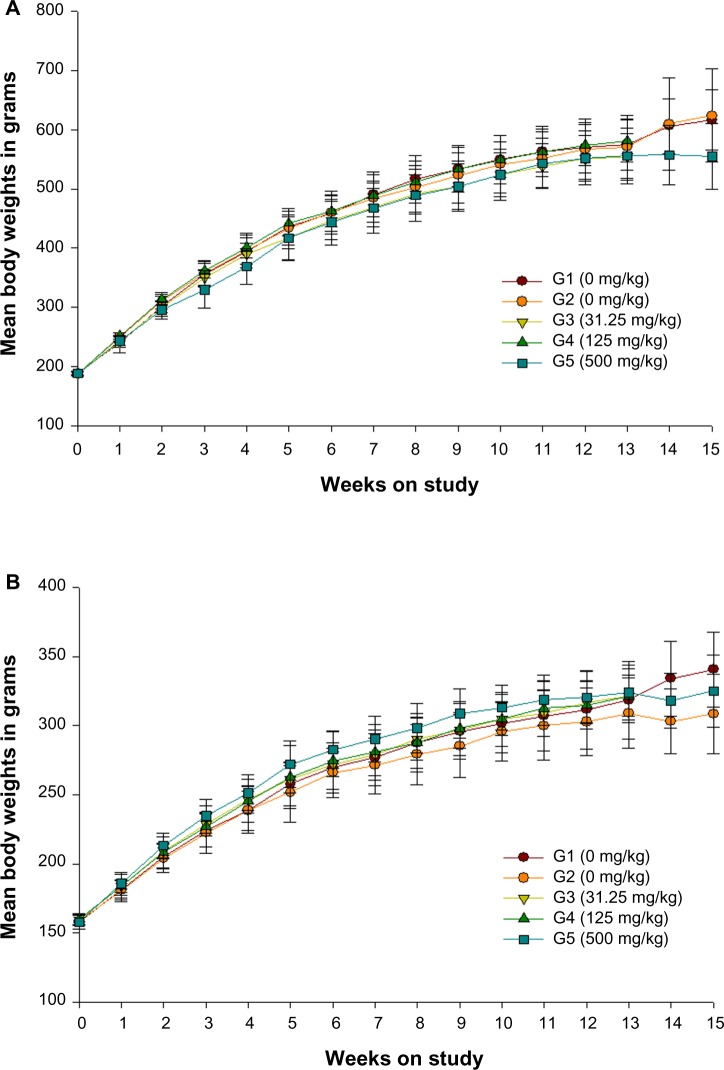
Figure 1
Figure 1
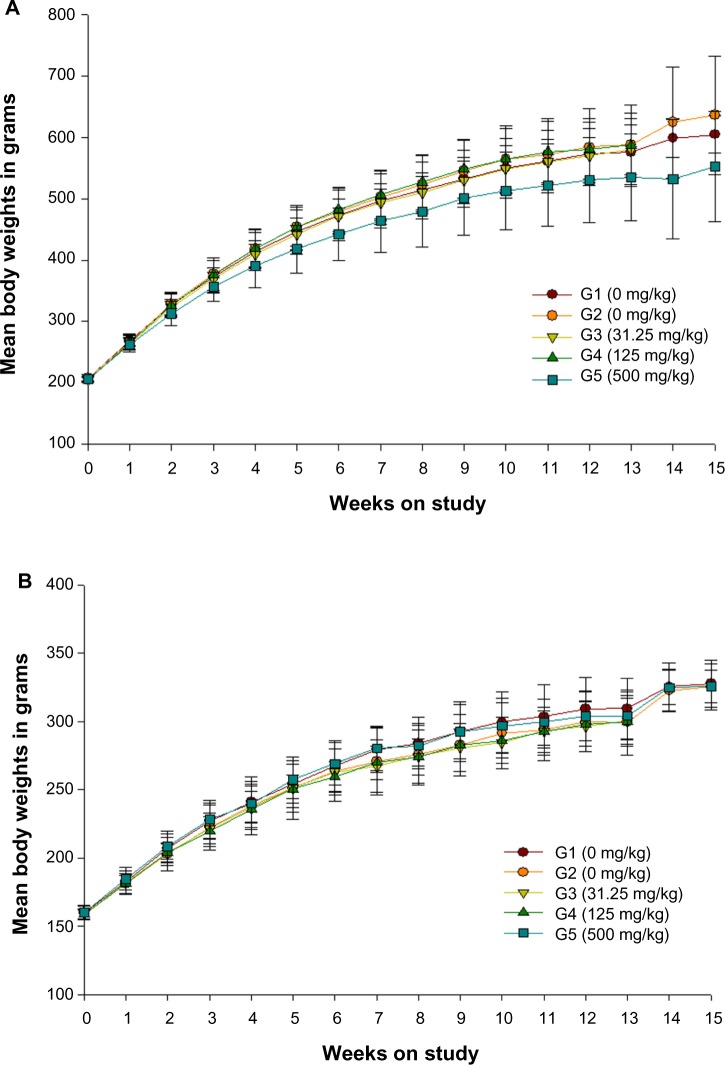
Growth curves for (A) male and (B) female rats administered ZnOAE100(−) by gavage for 90 days.a Notes: aZnOAE100(−) was orally administered to Sprague Dawley rats at doses of 31.25 mg/kg, 125 mg/kg, and 500 mg/kg for 90 days. The results are presented as mean ± standard deviation. Abbreviations: G1, negative control; G2, vehicle control, G3, 31.25 mg/kg treatment group; G4, 125 mg/kg treatment group; G5, 500 mg/kg treatment group; ZnO, zinc oxide; ZnOAE100(−), 100 nm negatively charged ZnO.
Figure 2
Figure 2
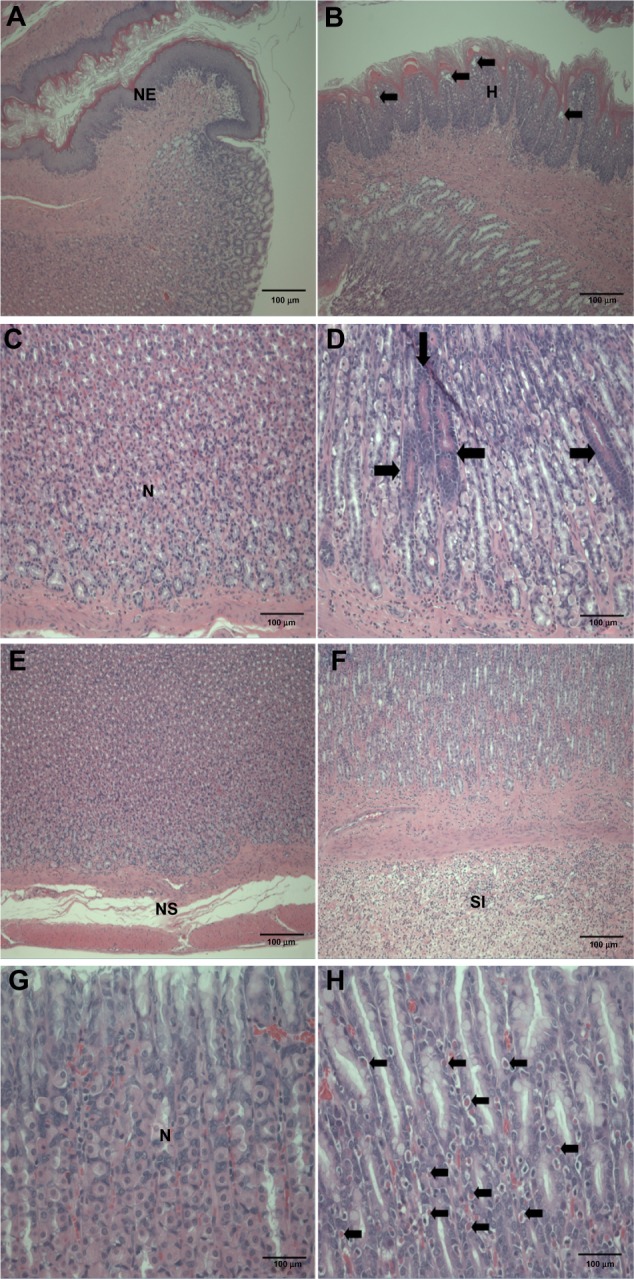
Growth curves for (A) male and (B) female rats administered ZnOAE100(+) by gavage for 90 days.a Notes: aZnOAE100(+) was orally administered to Sprague Dawley rats at doses of 31.25 mg/kg, 125 mg/kg, and 500 mg/kg for 90 days. The results are presented as mean ± standard deviation. Abbreviations: G1, negative control; G2, vehicle control, G3, 31.25 mg/kg treatment group; G4, 125 mg/kg treatment group; G5, 500 mg/kg treatment group; ZnO, zinc oxide; ZnOAE100(+), 100 nm positively charged ZnO.
Figure 3
Figure 3
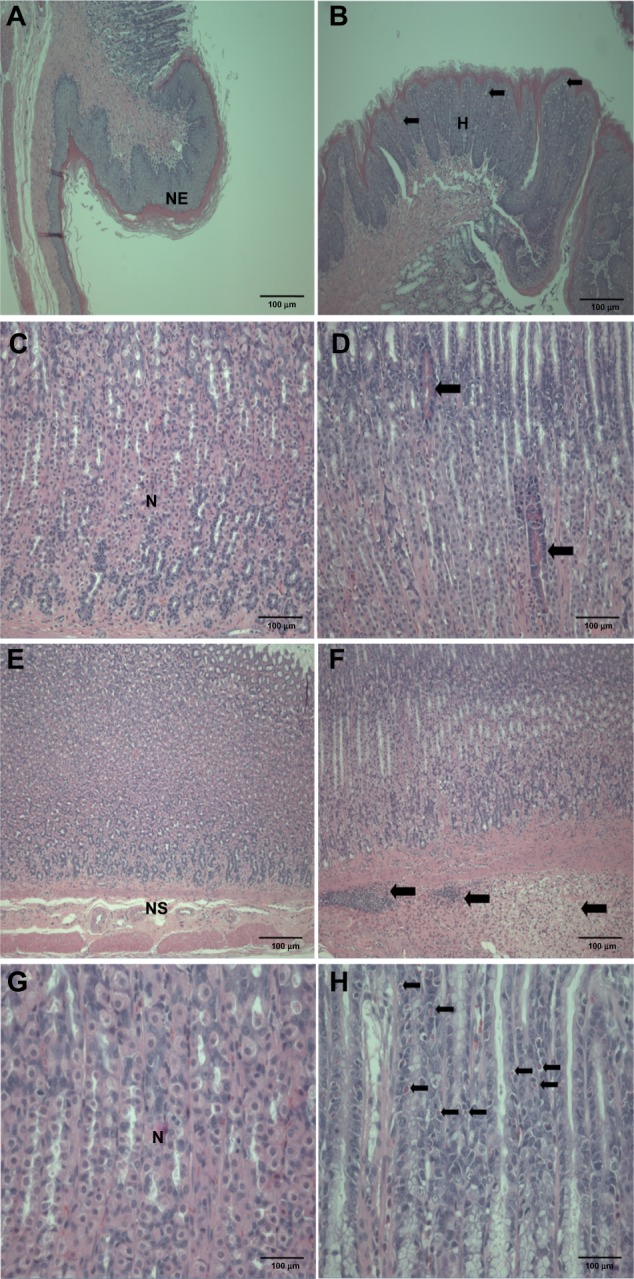
Histopathological changes in the stomach after treatment with ZnOAE100(−) at a dose of 500 mg/kg for 90 days. Stomach sections were stained with hematoxylin and eosin. (A) Control for limiting ridge. (C, E and G) Control for mucosa in glandular stomach. (B, D, F and H) 500 mg/kg treatment groups.a Notes: aArrows in (B) represent squamous cell vacuolation, in (D) show eosinophilic chief cells, in (F) indicate acinar cell apoptosis, and in (H) represent intracytoplasmic hyaline droplets. Abbreviations: H, squamous cell hyperplasia; N, normal mucosa; NE, normal epithelium; NS, normal submucosa; SI, submucosal edema and inflammatory cell infiltration; ZnO, zinc oxide, ZnOAE100(−), 100 nm negatively charged ZnO.
Figure 4
Figure 4
Histopathological changes in the stomach after treatment with ZnOAE100(+) at a dose of 500 mg/kg for 90 days. Stomach sections were stained with hematoxylin and eosin. (A) Control for limiting ridge. (C, E and G) Control for mucosa in glandular stomach. (B, D, F and H) 500 mg/kg treatment groups.a Note: aArrows in (B) represent squamous cell vacuolation, in (D) show eosinophilic chief cells, in (F) indicate submucosal edema and inflammatory cell infiltration, and in (H) represent intracytoplasmic hyaline droplets. Abbreviations: H, squamous cell hyperplasia; N, normal mucosa; NE, normal epithelium; NS, normal submucosa; ZnO, zinc oxide; ZnOAE100(+), 100 nm positively charged ZnO.
Figure 5
Figure 5
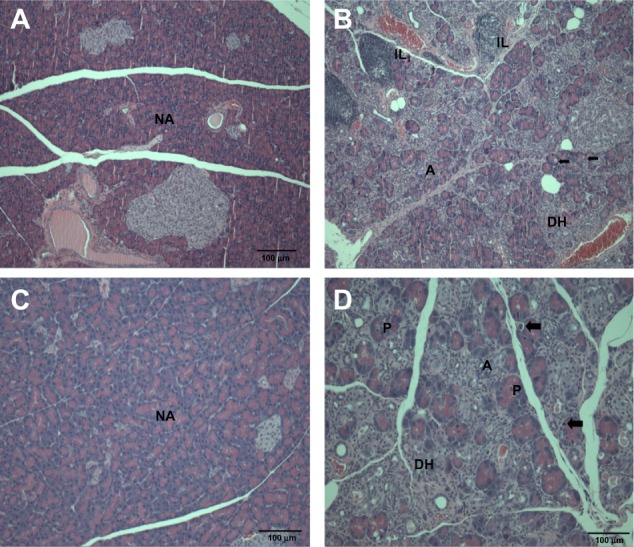
Histopathological changes in the pancreas after treatment with (A and B) ZnOAE100(−) and (C and D) ZnOAE100(+) at a dose of 500 mg/kg for 90 days. The pancreas sections were stained with hematoxylin and eosin. (A and C) Control for acinar cell. (B and D) 500 mg/kg treatment groups.a Notes: aArrows in (B and D) represent acinar cell apoptosis in the pancreas. Abbreviations: A, chronic inflammation; DH, ductular hyperplasia; IL, interstitial lymphoid cell infiltration; NA, normal acinar cell; P, prominent acinar cell; ZnO, zinc oxide; ZnOAE100(−), 100 nm negatively charged ZnO; ZnOAE100(+), 100 nm positively charged ZnO.
Figure 6
Figure 6
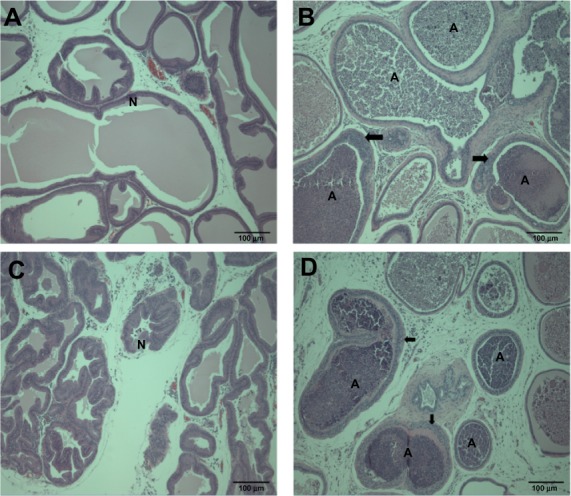
Histopathological changes in the prostate gland after treatment with (A and B) ZnOAE100(−) and (C and D) ZnOAE100(+) at a dose of 500 mg/kg for 90 days. Prostate gland sections were stained with hematoxylin and eosin. (A and C) Control for the prostate gland tubule. (B and D) 500 mg/kg treatment groups.a Note: aArrows in (B and D) show tubular hyperplasia in the prostate gland. Abbreviations: A, suppurative inflammation, N, normal tubule; ZnO, zinc oxide; ZnOAE100(−), 100 nm negatively charged ZnO; ZnOAE100(+), 100 nm positively charged ZnO.
Figure 7
Figure 7
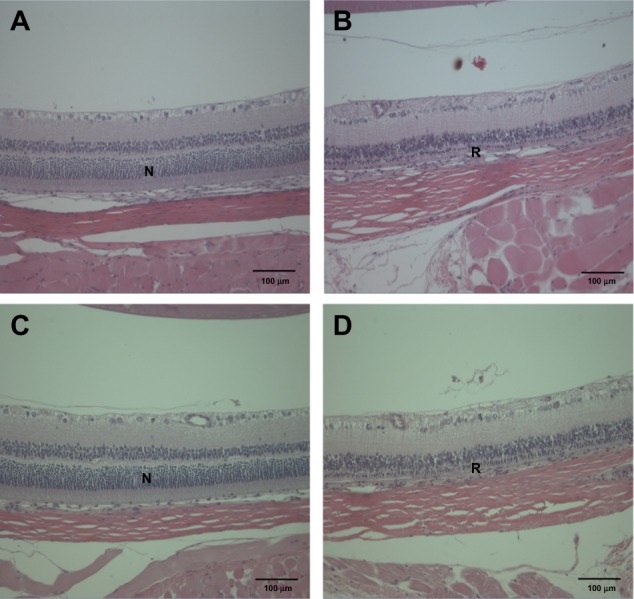
Histopathological changes in the eye after treatment with (A and B) ZnOAE100(−) and (C and D) ZnOAE100(+) at a dose of 500 mg/kg for 90 days. Eye sections were stained with hematoxylin and eosin. (A and C) Control for the eye. (B and D) 500 mg/kg treatment groups. Abbreviations: N, normal eye; R, retinal atrophy; ZnO, zinc oxide; ZnOAE100(−), 100 nm negatively charged ZnO; ZnOAE100(+), 100 nm positively charged ZnO.

References

    1. Osmond MJ, McCall MJ. Zinc oxide nanoparticles in modern sunscreens: an analysis of potential exposure and hazard. Nanotoxicology. 2010;4(1):15–41. - PubMed
    1. Osman IF, Baumgartner A, Cemeli E, Fletcher JN, Anderson D. Genotoxicity and cytotoxicity of zinc oxide and titanium dioxide in HEp-2 cells. Nanomedicine (Lond) 2010;5(8):1193–1203. - PubMed
    1. Becheri A, Dürr M, Lo Nostro P, Baglioni P. Synthesis and characterization of zinc oxide nanoparticles: application to textiles as UV-absorbers. J Nanopart Res. 2008;10(4):679–689.
    1. Lin CC, Lin WH, Li YY. Synthesis of ZnO nanowires and their applications as an ultraviolet photodetector. J Nanosci Nanotechnol. 2009;9(5):2813–2819. - PubMed
    1. Jin Y, Wang J, Sun B, Blakesley JC, Greenham NC. Solution-processed ultraviolet photodetectors based on colloidal ZnO nanoparticles. Nano Lett. 2008;8(6):1649–1653. - PubMed

Publication types

LinkOut - more resources