Review
. 2014 Dec 16:8:416.
doi: 10.3389/fnins.2014.00416. eCollection 2014.

Cytokine variations and mood disorders: influence of social stressors and social support

Affiliations
Review

Cytokine variations and mood disorders: influence of social stressors and social support

Marie-Claude Audet et al. Front Neurosci. .

Abstract

Stressful events have been implicated in the evolution of mood disorders. In addition to brain neurotransmitters and growth factors, the view has been offered that these disorders might be provoked by the activation of the inflammatory immune system as well as by de novo changes of inflammatory cytokines within the brain. The present review describes the impact of social stressors in animals and in humans on behavioral changes reminiscent of depressive states as well as on cytokine functioning. Social stressors increase pro-inflammatory cytokines in circulation as well as in brain regions that have been associated with depression, varying with the animal's social status and/or behavioral methods used to contend with social challenges. Likewise, in humans, social stressors that favor the development of depression are accompanied by elevated circulating cytokine levels and conversely, conditions that limit the cytokine elevations correlated with symptom attenuation or reversal. The implications of these findings are discussed in relation to the potentially powerful effects of social support, social identity, and connectedness in maintaining well-being and in diminishing symptoms of depression.

Keywords: IL - 6; aggression; depression; pro-inflammatory cytokines; social status; social stressors; social support; trauma.


Figures
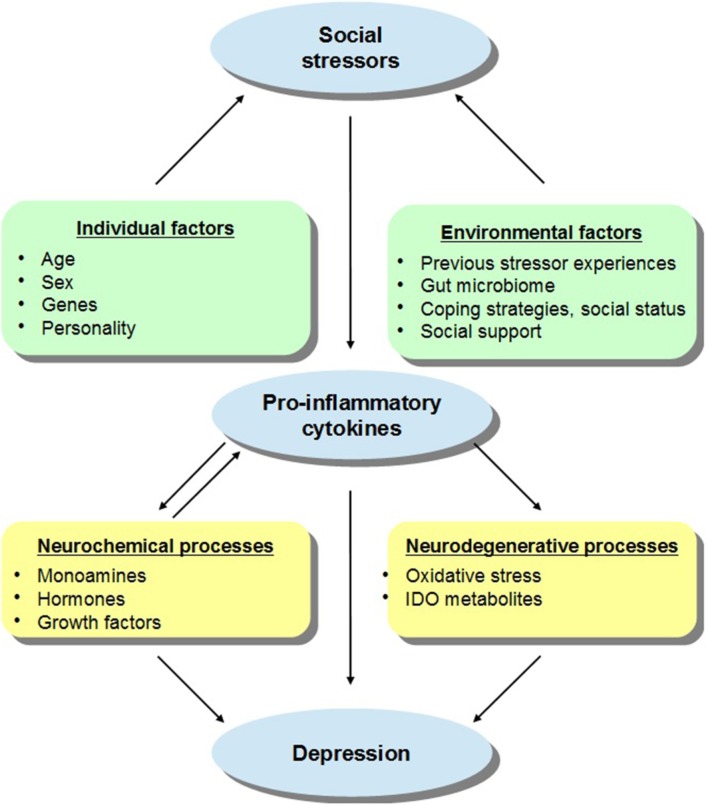
Figure 1
Figure 1
A schematic representation of the relations between social stressors, pro-inflammatory cytokines, and depressive states, with a particular focus on the individual and environmental factors that may moderate these effects. It is suggested that in addition to sex and age, the capacity of social stressors to promote inflammatory variations that might lead to depression may be influenced by the presence of genetic and personality factors. For instance, individuals carrying specific gene combinations or polymorphisms (e.g., variants of IL-6, IL-1β, TNF-α) may be more vulnerable to the depressive effects of inflammatory activation provided that they also encounter social stressors. In addition, it is proposed that environmental factors may also impact on stress-related cytokine responses and thus on depressive symptoms. For example, previous stressor experiences in the form of prenatal or early-life adversity or immunological challenges as well as gut bacterial disturbances may influence inflammatory processes and sensitize immune responses to subsequent stressors, thus favoring the emergence of depressive symptoms. However, in the context of adequate coping strategies, higher social status, or in the presence of effective social support, the cytokine effects of stressors may be limited thus buffering against mood disturbances. The activation of pro-inflammatory processes may directly or indirectly influence depressive states. Elevations of cytokines may influence monoamine (e.g., 5-HT, NE), hormone (e.g., CRH), and growth factor (e.g., BDNF) activity which might favor the evolution of depression (and basal hormonal and neurochemical functioning may impact cytokine processes). Alternatively, cytokine variations may stimulate the enzyme indoleamine 2,3-dioxygenase (IDO) and promote the release of neurotoxic metabolites, including kynurenic acid, quinolinic acid, or 3-hydroxykynurenine, and cause oxidative stress, culminating in depression.

References

    1. Alleva E., Cirulli F., Bianchi M., Bondiolotti G. P., Chiarotti F., De Acetis L., et al. (1998). Behavioural characterization of interleukin-6 overexpressing or deficient mice during agonistic encounters. Eur. J. Neurosci. 10, 3664–3372. 10.1046/j.1460-9568.1998.00377.x - DOI - PubMed
    1. Anisman H., Ravindran A. V., Griffiths J., Merali Z. (1999). Interleukin-1 beta production in dysthymia before and after pharmacotherapy. Biol. Psychiatry 46, 1649–1655. 10.1016/S0006-3223(99)00211-5 - DOI - PubMed
    1. Anisman H., Merali Z., Hayley S. (2008). Neurotransmitter, peptide and cytokine processes in relation to depressive disorder: comorbidity between depression and neurodegenerative disorders. Prog. Neurobiol. 85, 1–74. 10.1016/j.pneurobio.2008.01.004 - DOI - PubMed
    1. Altamura A. C., Boin F., Maes M. (1999). HPA axis and cytokines dysregulation in schizophrenia: potential implications for the antipsychotic treatment. Eur. Neuropsychopharmacol. 10, 1–4. 10.1016/S0924-977X(99)00017-6 - DOI - PubMed
    1. Arakawa K., Arakawa H., Hueston C. M., Deak T. (2014). The effects of estrous cycle and ovarian hormones on central expression of interleukin-1 evoked by stress in female rats. Neuroendocrinology. [Epub ahead of print]. 10.1159/000368606 - DOI - PubMed

LinkOut - more resources
