. 2014 Dec 23:8:1031.
doi: 10.3389/fnhum.2014.01031. eCollection 2014.

How vertical hand movements impact brain activity elicited by literally and metaphorically related words: an ERP study of embodied metaphor

Affiliations

How vertical hand movements impact brain activity elicited by literally and metaphorically related words: an ERP study of embodied metaphor

Megan Bardolph et al. Front Hum Neurosci. .

Abstract

Embodied metaphor theory suggests abstract concepts are metaphorically linked to more experientially basic ones and recruit sensorimotor cortex for their comprehension. To test whether words associated with spatial attributes reactivate traces in sensorimotor cortex, we recorded EEG from the scalp of healthy adults as they read words while performing a concurrent task involving either upward- or downward- directed arm movements. ERPs were time-locked to words associated with vertical space-either literally (ascend, descend) or metaphorically (inspire, defeat)-as participants made vertical movements that were either congruent or incongruent with the words. Congruency effects emerged 200-300 ms after word onset for literal words, but not until after 500 ms post-onset for metaphorically related words. Results argue against a strong version of embodied metaphor theory, but support a role for sensorimotor simulation in concrete language.

Keywords: LPC; N400; compatibility effects; embodiment; grounded meaning; motor resonance; semantics.


Figures
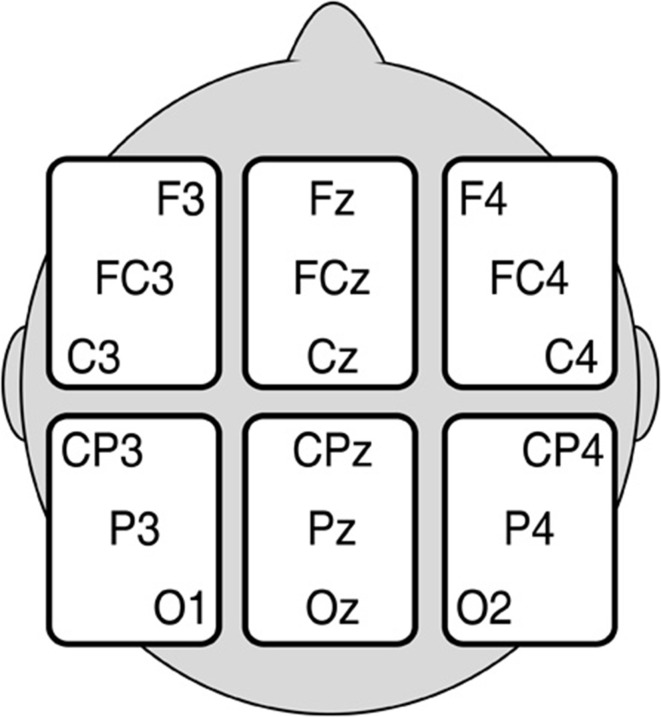
Figure 1
Figure 1
Electrode sites in each of our regions of interest (ROI).
Figure 2
Figure 2
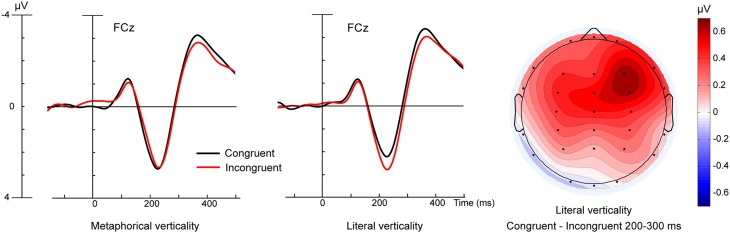
ERP data at a central electrode for Metaphorical (left) and Literal (right) verticality stimuli. ERP traces are shown for Congruent (e.g., High words viewed during Upward movement) and Incongruent (e.g., High words viewed during Downward movement) conditions. The rightmost panel depicts a topographic scalp map of the mean amplitude voltage difference for the Literal verticality condition in the 200–300 ms time window.
Figure 3
Figure 3
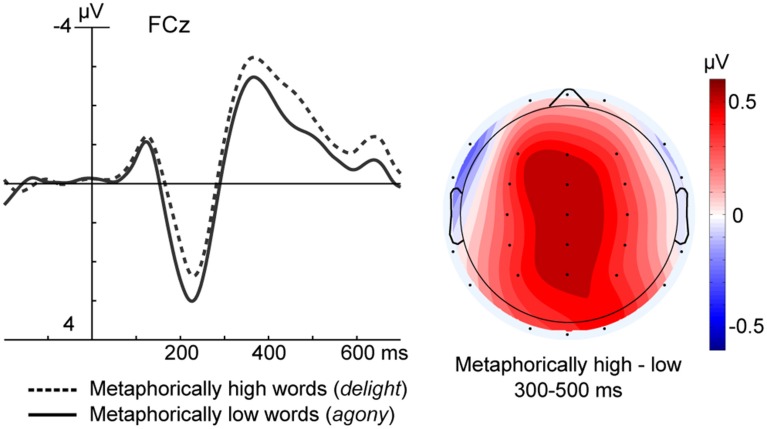
The left panel shows ERP data at a fronto-central electrode for the Metaphorically high (i.e., positively valenced) and Metaphorically low (i.e., negatively valenced) conditions collapsed across movement direction. The right panel depicts a topographic scalp map of the mean amplitude voltage difference for the Metaphorical verticality conditions in the 300–500 ms time window.
Figure 4
Figure 4
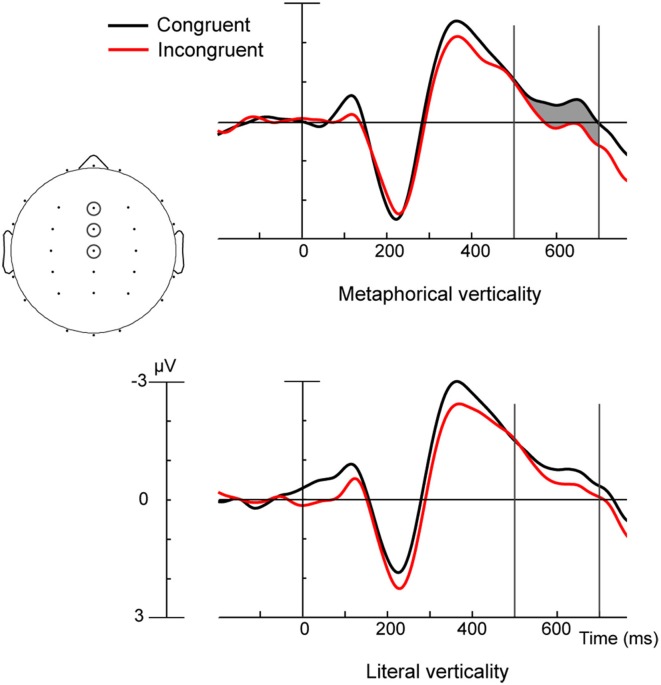
ERPs to Congruent (black) and Incongruent (red) words in the Metaphorical condition (top panel) and in the Literal condition (bottom panel). ERPs shown reflect a composite of the fronto-central ROI electrodes circled and were taken from participants using their left hand. Shaded area represents significant congruency effects 500–700 ms for Metaphorical condition only.
Figure 5
Figure 5
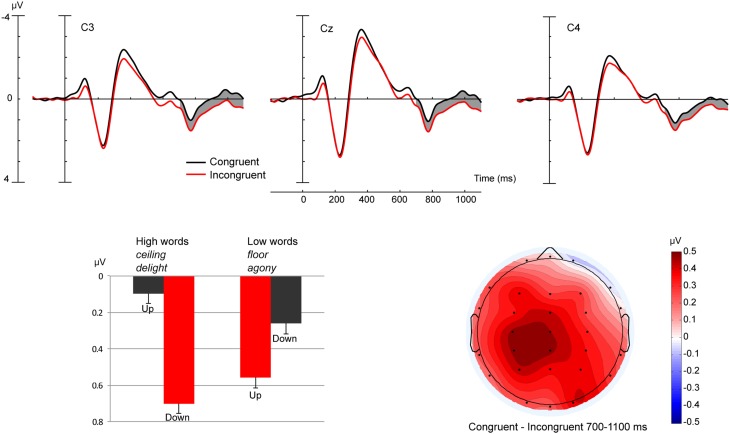
The top three panels show ERP data at three central electrodes for participants using their left hand. ERP traces are shown for Congruent and Incongruent conditions collapsed across Lit/Met. The bottom left panel shows a bar graph of ERP mean amplitudes averaged across all electrodes in the 700–1100 ms time window. Error bars indicate SEM. The bottom right panel depicts a topographic scalp map of the mean amplitude voltage difference for the collapsed Lit/Met conditions for participants using their left hand.

References

    1. Aravena P., Hurtado E., Riveros R., Cardona J. F., Manes F., Ibáñez A. (2010). Applauding with closed hands: neural signature of action-sentence compatibility effects. PLoS ONE 5:e11751. 10.1371/journal.pone.0011751 - DOI - PMC - PubMed
    1. Barsalou L. W. (2008). Grounded cognition. Annu. Rev. Psychol. 59, 617–645. 10.1146/annurev.psych.59.103006.093639 - DOI - PubMed
    1. Barsalou L. W. (2010). Grounded cognition: past, present, and future. Top. Cogn. Sci. 2, 716–724. 10.1111/j.1756-8765.2010.01115.x - DOI - PubMed
    1. Borghi A. M., Glenberg A. M., Kaschak M. P. (2004). Putting words in perspective. Mem. Cognit. 32, 863–873. 10.3758/BF03196865 - DOI - PubMed
    1. Boroditsky L. (2011). How languages construct time, in Space, Time and Number in the Brain: Searching for the Foundations of Mathematical Thought, eds Dehaene S., Brannon E. (London: Elsevier; ), 333–341.