. 2014 Dec 19:6:336.
doi: 10.3389/fnagi.2014.00336. eCollection 2014.

Ankle muscle strength discriminates fallers from non-fallers

Affiliations

Ankle muscle strength discriminates fallers from non-fallers

Thomas Cattagni et al. Front Aging Neurosci. .

Abstract

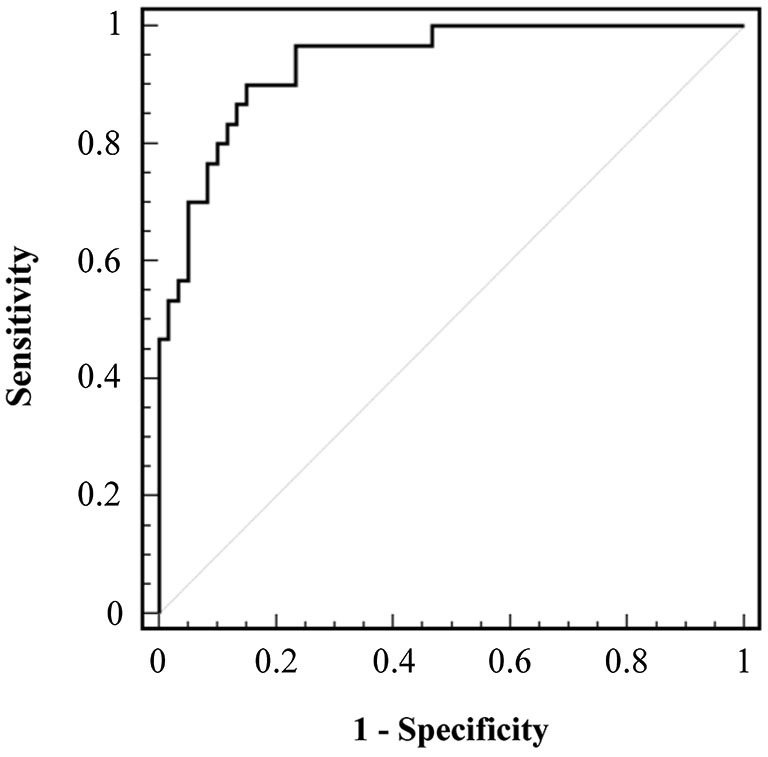
It is well known that center of pressure (CoP) displacement correlates negatively with the maximal isometric torque (MIT) of ankle muscles. This relationship has never been investigated in elderly fallers (EF). The purpose of this study was thus to analyze the relationship between the MIT of ankle muscles and CoP displacement in upright stance in a sample aged between 18 and 90 years old that included EF. The aim was to identify a threshold of torque below which balance is compromised. The MIT of Plantar flexors (PFs) and dorsal flexors (DFs) and CoP were measured in 90 volunteers: 21 healthy young adults (YA) (age: 24.1 ± 5.0), 12 healthy middle-aged adults (MAA) (age: 50.2 ± 4.5), 27 healthy elderly non-fallers (ENF) (age: 75.5 ± 7.0) and 30 EF (age: 78.8 ± 6.7). The MIT of PF and DF were summed to obtain the overall maximal ankle muscle strength. Body weight and height were used to normalize MIT (nMIT) and CoP (nCoP), respectively. nCoP correlated negatively with nMIT. 90% of EF generated an nMIT <3.1 N·m·kg(-1), whereas 85% of non-fallers generated an nMIT >3.1 N·m·kg(-1). The relationship between nMIT and nCoP implies that ankle muscle weakness contributes to increased postural instability and the risk of falling. We observed that below the threshold of 3.1 N·m·kg(-1), postural stability was dramatically diminished and balance was compromised. Our results suggest that measuring ankle torque could be used in routine clinical practice to identify potential fallers.

Keywords: aging; ankle joint; elderly fallers; muscle strength; postural stability.


Figures
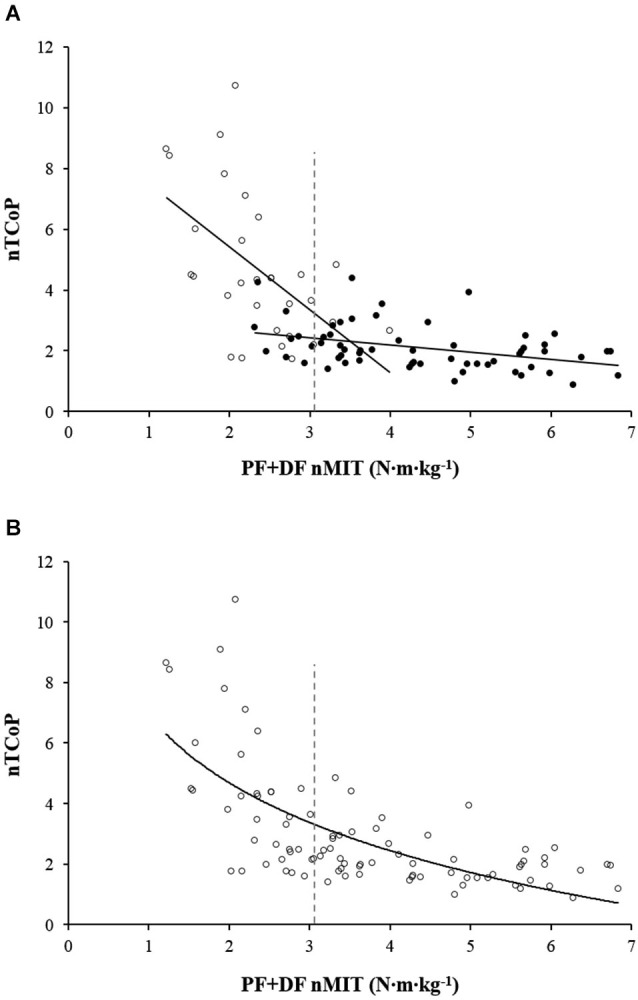
Figure 1
Figure 1
Relationship between TCoP displacement normalized for height (nTCoP) and the sum of plantar (PF) and dorsal (DF) flexors maximal isometric torque normalized for body weight (FP + FD nMIT). (A) represents the linear relationship between nTCoP and PF + DF nMIT for non-fallers (filled circle) and elderly fallers (EF) (empty circle). The linear regressions equations are nTCoP = −0.24·(FP + FD nMIT)+3.14 (r = 0.40, P < 0.001) for non-fallers and nTCoP = −2.07·(FP + FD nMIT) + 9.56 (r = 0.55, P < 0.001) for EF. The vertical gray dashed line represents the cut-off value of PF + DF nMIT that distinguishes between EF and non-fallers. It corresponds to the highest Youden index obtained from receiver operating characteristic analysis. (B) represents the logarithmic relationship between nTCoP and PF + DF nMIT for the whole sample; the equation is: nTCoP = −7.44·log10(FP + FD nMIT) + 6.93, (r = 0.68, P < 0.001). The vertical gray dashed line represents the cut-off value of PF + DF nMIT that distinguishes between EF and non-fallers. It corresponds to the highest Youden index obtained from receiver operating characteristic analysis.
Figure 2
Figure 2
Receiver Operating Characteristic (ROC) curve of the sum of maximal isometric torque of plantar flexion and dorsal flexion normalized for body weight (PF + DF nMIT). ROC curve of the sensitivity against the false-positive rate (1—specificity) plotted across a range of thresholds is represented. The major diagonal represents an area of curves equal to 0.5 and a prediction no better than chance. The black line represents the results taken from the PF + DF nMIT measurements.

References

    1. Amiridis I., Arabatzi F., Violaris P., Stavropoulos E., Hatzitaki V. (2005). Static balance improvement in elderly after dorsiflexors electrostimulation training. Eur. J. Appl. Physiol. 94, 424–433. 10.1007/s00421-005-1326-3 - DOI - PubMed
    1. Amiridis I. G., Hatzitaki V., Arabatzi F. (2003). Age-induced modifications of static postural control in humans. Neurosci. Lett. 350, 137–140. 10.1016/s0304-3940(03)00878-4 - DOI - PubMed
    1. Bento P. C., Pereira G., Ugrinowitsch C., Rodacki A. L. (2010). Peak torque and rate of torque development in elderly with and without fall history. Clin. Biomech. (Bristol, Avon) 25, 450–454. 10.1016/j.clinbiomech.2010.02.002 - DOI - PubMed
    1. Bergland A., Jarnlo G. B., Laake K. (2003). Predictors of falls in the elderly by location. Aging Clin. Exp. Res. 15, 43–50. 10.1007/bf03324479 - DOI - PubMed
    1. Bergland A., Wyller T. B. (2004). Risk factors for serious fall related injury in elderly women living at home. Inj. Prev. 10, 308–313. 10.1136/ip.2003.004721 - DOI - PMC - PubMed