


Epithelial to mesenchymal transition in tumor cells as consequence of phenotypic instability
- PMID: 25566541
- PMCID: PMC4264508
- DOI: 10.3389/fcell.2014.00071
Epithelial to mesenchymal transition in tumor cells as consequence of phenotypic instability
Abstract
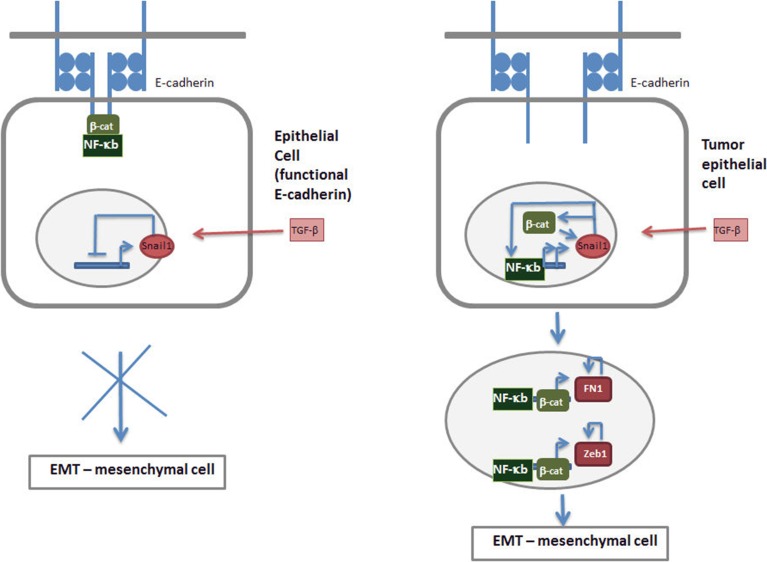
During the last years many articles have reported epithelial-to-mesenchymal transitions (EMT) induced by a myriad of gene products either when added to the cell medium or when transfected. Molecularly the EMT is characterized by the up-regulation of transcriptional factors (EMT-TFs) repressing the epithelial gene E-cadherin, a protein essential for the maintenance of the epithelial phenotype. These EMT-TFs are subjected to a complex regulation involving binary self-stimulatory loops, allowing the possibility of the amplification of input signals. The capability of EMT-TFs to promote an EMT is controlled by E-cadherin that limits the transcription of mesenchymal genes. We discuss here the differences between normal and tumor epithelial cells; in the latter a partial inactivation of E-cadherin function enables extracellular signals to be amplified and induce an EMT. This tumor cell phenotypic instability is exacerbated in cell culture conditions. Therefore, it is likely that many of the gene products reported to control this transition act only in very specific cell tumor cell lines; thus, in cells with an unstable phenotype due to pre-existing alterations in E-cadherin safeguard mechanism.
Keywords: E-cadherin; EMT; Snail1; self-amplification; tumor instability.
Figures

References
LinkOut - more resources
Full Text Sources
Other Literature Sources
Research Materials
