


Big dams and salmon evolution: changes in thermal regimes and their potential evolutionary consequences
- PMID: 25567632
- PMCID: PMC3352442
- DOI: 10.1111/j.1752-4571.2008.00032.x
Big dams and salmon evolution: changes in thermal regimes and their potential evolutionary consequences
Abstract
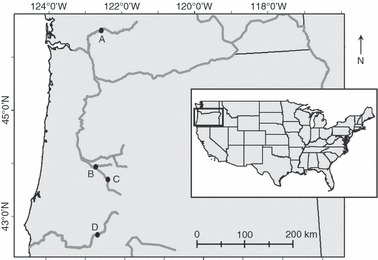
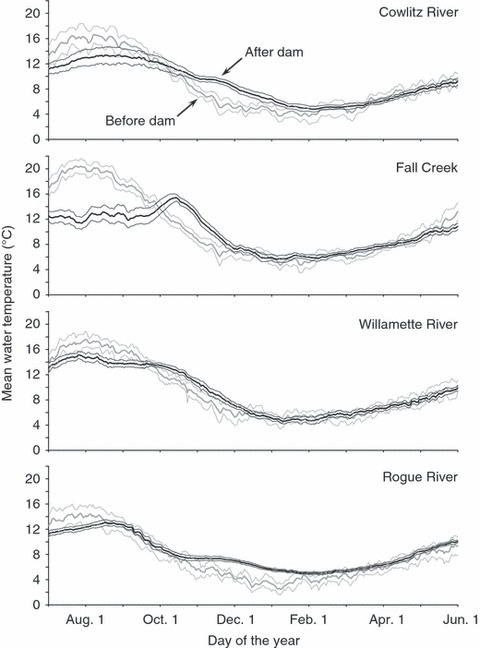
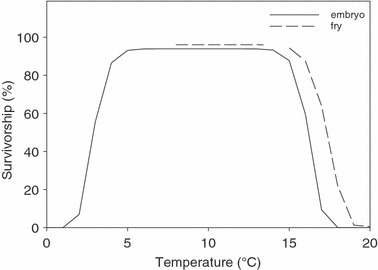
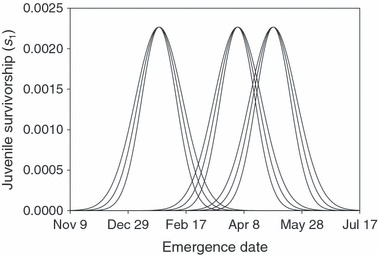
Dams designed for hydropower and other purposes alter the environments of many economically important fishes, including Chinook salmon (Oncorhynchus tshawytscha). We estimated that dams on the Rogue River, the Willamette River, the Cowlitz River, and Fall Creek decreased water temperatures during summer and increased water temperatures during fall and winter. These thermal changes undoubtedly impact the behavior, physiology, and life histories of Chinook salmon. For example, relatively high temperatures during the fall and winter should speed growth and development, leading to early emergence of fry. Evolutionary theory provides tools to predict selective pressures and genetic responses caused by this environmental warming. Here, we illustrate this point by conducting a sensitivity analysis of the fitness consequences of thermal changes caused by dams, mediated by the thermal sensitivity of embryonic development. Based on our model, we predict Chinook salmon likely suffered a decrease in mean fitness after the construction of a dam in the Rogue River. Nevertheless, these demographic impacts might have resulted in strong selection for compensatory strategies, such as delayed spawning by adults or slowed development by embryos. Because the thermal effects of dams vary throughout the year, we predict dams impacted late spawners more than early spawners. Similar analyses could shed light on the evolutionary consequences of other environmental perturbations and their interactions.
Keywords: Chinook salmon; anthropogenic change; dams; development; embryos; emergence; fry; selection gradients; temperature.
Figures
References
-
- Achord S, Zabel RW, Sandford BP. Migration timing, growth, and estimated parr-to-smolt survival rates of wild Snake River spring-summer Chinook salmon from the Salmon River basin, Idaho, to the Lower Snake River. Transactions of the American Fisheries Society. 2007;136:142–154.
-
- Angilletta MJ. Estimating and comparing thermal performance curves. Journal of Thermal Biology. 2006;31:541–545.
-
- Angilletta MJ, Niewiarowski PH, Navas CA. The evolution of thermal physiology in ectotherms. Journal of Thermal Biology. 2002;27:249–268.
-
- Arnold SJ, Wade MJ. On the measurement of natural and sexual selection: theory. Evolution. 1984;38:709–719. - PubMed
-
- Banks JL, Fowler LG, Elliott JW. Effects of rearing temperature on growth, body form, and hematology of fall chinook fingerlings. Progressive Fish Culturist. 1971;33:20–26.
LinkOut - more resources
Full Text Sources
