


Broad, Hybrid Capture-Based Next-Generation Sequencing Identifies Actionable Genomic Alterations in Lung Adenocarcinomas Otherwise Negative for Such Alterations by Other Genomic Testing Approaches
- PMID: 25567908
- PMCID: PMC4917003
- DOI: 10.1158/1078-0432.CCR-14-2683
Broad, Hybrid Capture-Based Next-Generation Sequencing Identifies Actionable Genomic Alterations in Lung Adenocarcinomas Otherwise Negative for Such Alterations by Other Genomic Testing Approaches
Abstract
Purpose: Broad, hybrid capture-based next-generation sequencing (NGS), as a clinical test, uses less tissue to identify more clinically relevant genomic alterations compared with profiling with multiple non-NGS tests. We set out to determine the frequency of such genomic alterations via this approach in tumors in which previous extensive non-NGS testing had not yielded a targetable driver alteration.
Experimental design: We enrolled patients with lung adenocarcinoma with a ≤ 15 pack-year smoking history whose tumors previously tested "negative" for alterations in 11 genes (mutations in EGFR, ERBB2, KRAS, NRAS, BRAF, MAP2K1, PIK3CA, and AKT1 and fusions involving ALK, ROS1, and RET) via multiple non-NGS methods. We performed hybridization capture of the coding exons of 287 cancer-related genes and 47 introns of 19 frequently rearranged genes and sequenced these to deep, uniform coverage.
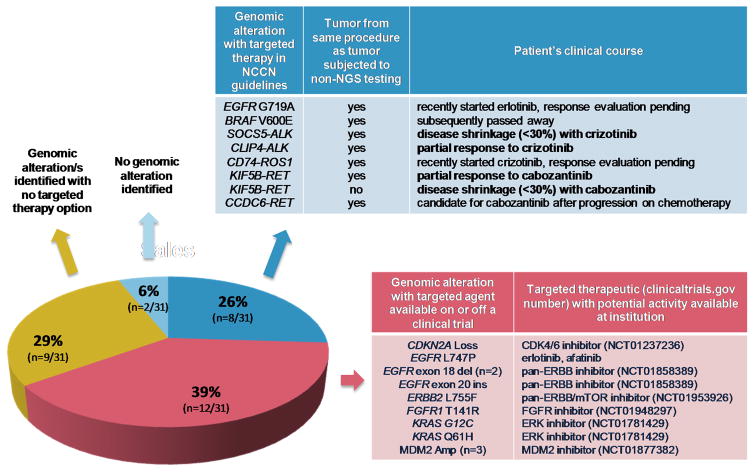
Results: Actionable genomic alterations with a targeted agent based on NCCN guidelines were identified in 26% [8 of 31: EGFR G719A, BRAF V600E, SOCS5-ALK, HIP1-ALK, CD74-ROS1, KIF5B-RET (n = 2), CCDC6-RET]. Seven of these patients either received or are candidates for targeted therapy. Comprehensive genomic profiling using this method also identified a genomic alteration with a targeted agent available on a clinical trial in an additional 39% (12 of 31).
Conclusions: Broad, hybrid capture-based NGS identified actionable genomic alterations in 65% [95% confidence interval (CI), 48%-82%] of tumors from never or light smokers with lung cancers deemed without targetable genomic alterations by earlier extensive non-NGS testing. These findings support first-line profiling of lung adenocarcinomas using this approach as a more comprehensive and efficient strategy compared with non-NGS testing. See related commentary by McCutcheon and Giaccone, p. 3584.
©2015 American Association for Cancer Research.
Figures
Comment in
-
Next-Generation Sequencing: Targeting Targeted Therapies.Clin Cancer Res. 2015 Aug 15;21(16):3584-5. doi: 10.1158/1078-0432.CCR-15-0407. Epub 2015 Apr 6. Clin Cancer Res. 2015. PMID: 25847989
References
-
- Lynch TJ, Bell DW, Sordella R, Gurubhagavatula S, Okimoto RA, Brannigan BW, et al. Activating mutations in the epidermal growth factor receptor underlying responsiveness of non-small-cell lung cancer to gefitinib. N Engl J Med. 2004;350:2129–39. - PubMed
-
- Paez JG, Janne PA, Lee JC, Tracy S, Greulich H, Gabriel S, et al. EGFR mutations in lung cancer: correlation with clinical response to gefitinib therapy. Science. 2004;304:1497–500. - PubMed
-
- Soda M, Choi YL, Enomoto M, Takada S, Yamashita Y, Ishikawa S, et al. Identification of the transforming EML4-ALK fusion gene in non-small-cell lung cancer. Nature. 2007;448:561–6. - PubMed
-
- Mok TS, Wu YL, Thongprasert S, Yang CH, Chu DT, Saijo N, et al. Gefitinib or carboplatin-paclitaxel in pulmonary adenocarcinoma. N Engl J Med. 2009;361:947–57. - PubMed
Publication types
MeSH terms
Substances
Grants and funding
LinkOut - more resources
Full Text Sources
Other Literature Sources
Medical
Research Materials
Miscellaneous
