


Worldwide invasion by the little fire ant: routes of introduction and eco-evolutionary pathways
- PMID: 25567931
- PMCID: PMC3352468
- DOI: 10.1111/j.1752-4571.2010.00119.x
Worldwide invasion by the little fire ant: routes of introduction and eco-evolutionary pathways
Abstract
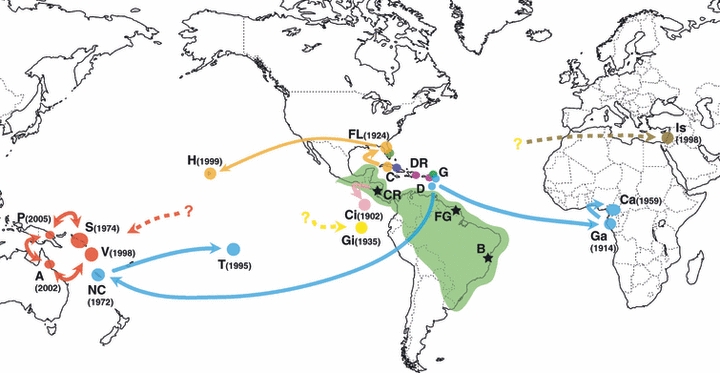
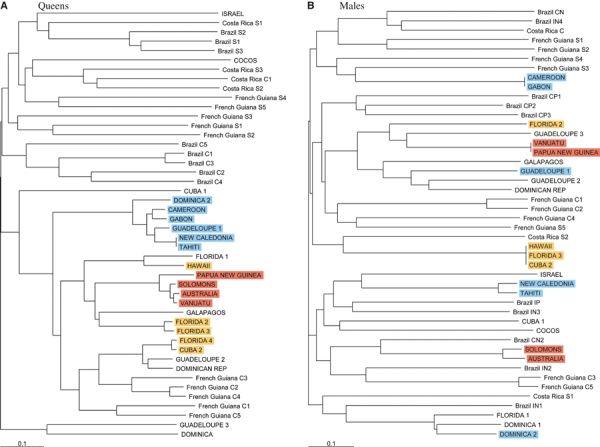
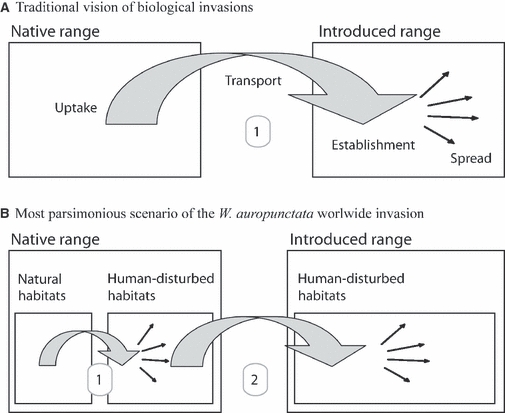
Biological invasions are generally thought to occur after human aided migration to a new range. However, human activities prior to migration may also play a role. We studied here the evolutionary genetics of introduced populations of the invasive ant Wasmannia auropunctata at a worldwide scale. Using microsatellite markers, we reconstructed the main routes of introduction of the species. We found three main routes of introduction, each of them strongly associated to human history and trading routes. We also demonstrate the overwhelming occurrence of male and female clonality in introduced populations of W. auropunctata, and suggest that this particular reproduction system is under selection in human-modified habitats. Together with previous researches focused on native populations, our results suggest that invasive clonal populations may have evolved within human modified habitats in the native range, and spread further from there. The evolutionarily most parsimonious scenario for the emergence of invasive populations of the little fire ant might thus be a two-step process. The W. auropunctata case illustrates the central role of humans in biological change, not only due to changes in migration patterns, but also in selective pressures over species.
Keywords: Wasmannia auropunctata; biological invasion; introduction routes; parthenogenesis; reproduction system.
Figures
References
-
- Calcaterra L, Livore J, Delgado A, Briano J. Ecological dominance of the red imported fire ant, Solenopsis invicta, in its native range. Oecologia. 2008;156:411–421. - PubMed
-
- Caldera E, Ross K, DeHeer C, Shoemaker D. Putative native source of the invasive fire ant Solenopsis invicta in the USA. Biological Invasions. 2008;10:1457–1479.
-
- Chakraborty R, Jin L. Determination of relatedness between individuals using DNA fingerprinting. Human Biology. 1993;65:875–895. - PubMed
-
- Clavero M, Garcia-Berthou E. Invasive species are a leading cause of animal extinctions. Trends in Ecology & Evolution. 2005;20:110. - PubMed
-
- Colautti RI, MacIsaac HJ. A neutral terminology to define ‘invasive’ species. Diversity and Distributions. 2004;10:135–141.
LinkOut - more resources
Full Text Sources
