. 2011 Mar;4(2):354-66.
doi: 10.1111/j.1752-4571.2010.00169.x.

Eco-evolutionary effects on population recovery following catastrophic disturbance

Affiliations

Eco-evolutionary effects on population recovery following catastrophic disturbance

Dylan J Weese et al. Evol Appl. 2011 Mar.

Abstract

Fine-scale genetic diversity and contemporary evolution can theoretically influence ecological dynamics in the wild. Such eco-evolutionary effects might be particularly relevant to the persistence of populations facing acute or chronic environmental change. However, experimental data on wild populations is currently lacking to support this notion. One way that ongoing evolution might influence the dynamics of threatened populations is through the role that selection plays in mediating the 'rescue effect', the ability of migrants to contribute to the recovery of populations facing local disturbance and decline. Here, we combine experiments with natural catastrophic events to show that ongoing evolution is a major determinant of migrant contributions to population recovery in Trinidadian guppies (Poecilia reticulata). These eco-evolutionary limits on migrant contributions appear to be mediated by the reinforcing effects of natural and sexual selection against migrants, despite the close geographic proximity of migrant sources. These findings show that ongoing adaptive evolution can be a double-edged sword for population persistence, maintaining local fitness at a cost to demographic risk. Our study further serves as a potent reminder that significant evolutionary and eco-evolutionary dynamics might be at play even where the phenotypic status quo is largely maintained generation to generation.

Keywords: adaptation; contemporary evolution; evolution; experimental evolution; genetics – empirical; natural selection and contemporary; population; population dynamics; population ecology; sexual selection.


Figures
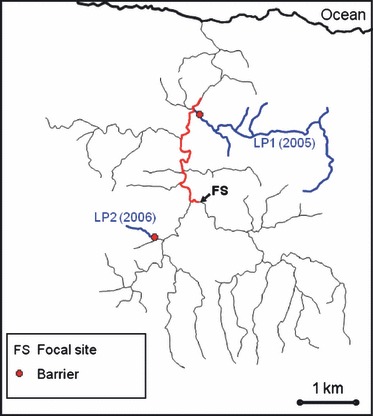
Figure 1
Figure 1
Map of the Marianne River drainage. Our focal site (FS) is where experimental populations were established. LP1 and LP2, shown in blue, indicate the locations of the two low-predation (LP) source populations used in 2005 and 2006, respectively. We have also indicated the location of barriers that are thought to have prevented the colonization of these LP tributaries by predatory fish. Shown in red is the section of the river where we observed that the guppy population had been decimated by floods in 2005 and 2006. We have confirmed the presence of predatory fish throughout the red section. The high-predation guppies introduced into our focal site originated from a series of localized side channels, within the red section (but well below our focal site), where some guppies had resisted the floods. Thus, as none of our guppies originated from the focal site, there is no potential for a home-site advantage.
Figure 2
Figure 2
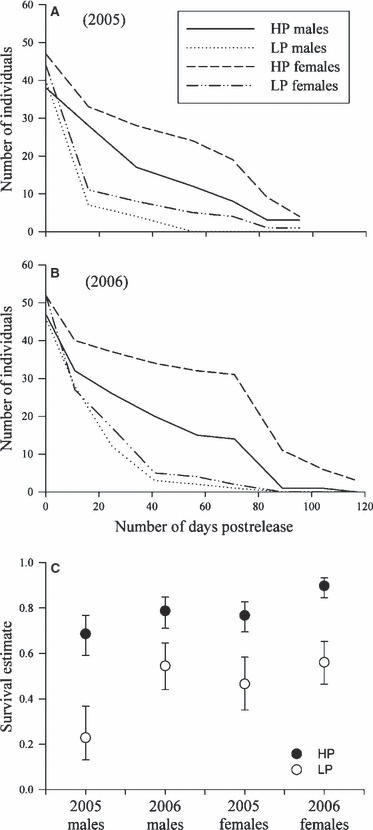
Survival of guppies introduced to our focal site. Numbers of the high- and low-predation guppies originally introduced into our experimental site for 2005 (Fig. 1A) and 2006 (Fig. 1B) plotted against number of days postrelease. Probability of survival over a recapture interval (Ψ) was formally estimated for the experimentally introduced fish using the program MARK (Fig. 1C), errors are 95% confidence intervals.
Figure 3
Figure 3
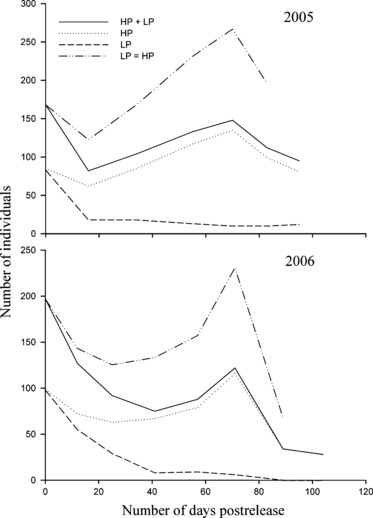
Population size at our focal site. The numbers of guppies (parents and offspring) whose genotypes assign to either the high- (HP) or low-predation (LP) population clusters, and the total number of guppies in the experimental population (HP + LP) plotted against the number of days postrelease. Also included is predicted population size assuming selective equivalence between the high- and low-predation ecotypes (LP = HP). This last line was generated by applying the high-predation (HP) birth rate and death rate to the total population size at the previous recapture episode {Nt = Nt−1−[Nt−1(HP deathrate)] + [Nt−1(HP birthrate)]}.
Figure 4
Figure 4
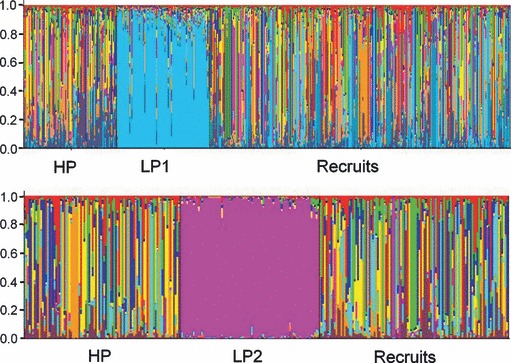
Genetic structure of experimental population. Output of STRUCTURE analyses. In 2005, the most likely number of clusters (K) was 12 (top); in 2006, the most likely number of clusters was 8 (bottom). In both years, these analyses identified a primary low-predation genetic cluster, and multiple high-predation genetic clusters. Each experimental individual (parents and recruits) is represented by a single vertical line. These lines are partitioned into colored segments which represent that individual's estimated membership fraction in a particular genetic cluster (Q-value).

References

    1. Araki H, Berejikian BA, Ford MJ, Blouin MS. Fitness of hatchery- reared salmonids in the wild. Evolutionary Applications. 2008;1:342–355. - PMC - PubMed
    1. Becher SA, Magurran AE. Gene flow in Trinidadian guppies. Journal of Fish Biology. 2000;56:241–249.
    1. Boulding EG, Hay T. Genetic and demographic parameters determining population persistence after a discrete change in the environment. Heredity. 2001;86:313–324. - PubMed
    1. Brown JH, Kodric-Brown A. Turnover rates in insular biogeography: effect of immigration on extinction. Ecology. 1977;58:445–449.
    1. Chevin L-M, Lande R, Mace GM. Adaptation, plasticity, and extinction in a changing environment: towards a predictive theory. PLoS Biology. 2010;8 e1000357. doi: . - DOI - PMC - PubMed

LinkOut - more resources