Review
. 2014 Dec;3(6):344-63.
doi: 10.3978/j.issn.2304-3881.2014.11.03.

Cellular and molecular functions of hepatic stellate cells in inflammatory responses and liver immunology

Affiliations
Review

Cellular and molecular functions of hepatic stellate cells in inflammatory responses and liver immunology

Ralf Weiskirchen et al. Hepatobiliary Surg Nutr. 2014 Dec.

Abstract

The liver is a central immunological organ. Liver resident macrophages, Kupffer cells (KC), but also sinusoidal endothelial cells, dendritic cells (DC) and other immune cells are involved in balancing immunity and tolerance against pathogens, commensals or food antigens. Hepatic stellate cells (HSCs) have been primarily characterized as the main effector cells in liver fibrosis, due to their capacity to transdifferentiate into collagen-producing myofibroblasts (MFB). More recent studies elucidated the fundamental role of HSC in liver immunology. HSC are not only the major storage site for dietary vitamin A (Vit A) (retinol, retinoic acid), which is essential for proper function of the immune system. This pericyte further represents a versatile source of many soluble immunological active factors including cytokines [e.g., interleukin 17 (IL-17)] and chemokines [C-C motif chemokine (ligand) 2 (CCL2)], may act as an antigen presenting cell (APC), and has autophagy activity. Additionally, it responds to many immunological triggers via toll-like receptors (TLR) (e.g., TLR4, TLR9) and transduces signals through pathways and mediators traditionally found in immune cells, including the Hedgehog (Hh) pathway or inflammasome activation. Overall, HSC promote rather immune-suppressive responses in homeostasis, like induction of regulatory T cells (Treg), T cell apoptosis (via B7-H1, PDL-1) or inhibition of cytotoxic CD8 T cells. In conditions of liver injury, HSC are important sensors of altered tissue integrity and initiators of innate immune cell activation. Vice versa, several immune cell subtypes interact directly or via soluble mediators with HSC. Such interactions include the mutual activation of HSC (towards MFB) and macrophages or pro-apoptotic signals from natural killer (NK), natural killer T (NKT) and gamma-delta T cells (γδ T-cells) on activated HSC. Current directions of research investigate the immune-modulating functions of HSC in the environment of liver tumors, cellular heterogeneity or interactions promoting HSC deactivation during resolution of liver fibrosis. Understanding the role of HSC as central regulators of liver immunology may lead to novel therapeutic strategies for chronic liver diseases.

Keywords: Hepatic stellate cells (HSCs); liver fibrosis; macrophages; myofibroblasts; retinol.


Figures
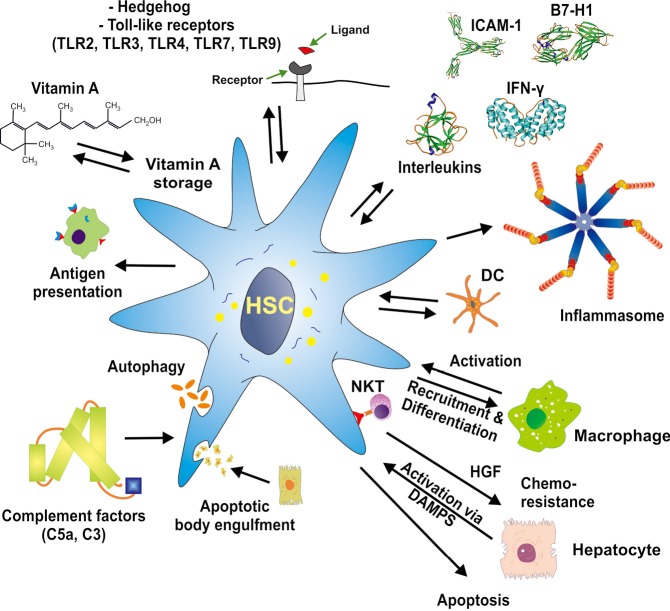
Figure 1
Figure 1
Immunoregulatory functions of hepatic stellate cells. HSC are the major storage site for vitamin A that represents a key factor in regulation of immune responses. Once activated, HSC acquire features with important impact on the immune system. It can serve as an APC, is able to mediate autophagy, controls apoptotic body engulfment of necrotic/apoptotic hepatocytes and modulates activity of dendritic cells, macrophages, and natural killer cells. The capacity of HSC to synthesize HGF is essential for hepatocyte chemoresistance. In addition, HSC produce or respond to various interleukins, ICAM-1, IFN-γ and B7-H1 that all are linked to adaptive or innate immune responses. HSC biology is further modulated by complement factors. In addition, HSC express different Toll-like receptors, mediate Hedgehog signalling and are equipped with several intracellular inflammasome platforms that initiate the inflammatory response in various disease settings. Some important consequences of cellular interactions between HSC and macrophages or hepatocytes are indicated. HSC, hepatic stellate cell; APC, antigen presenting cell; ICAM-1, intercellular adhesion molecule 1; IFN-γ, interferon-γ.
Figure 2
Figure 2
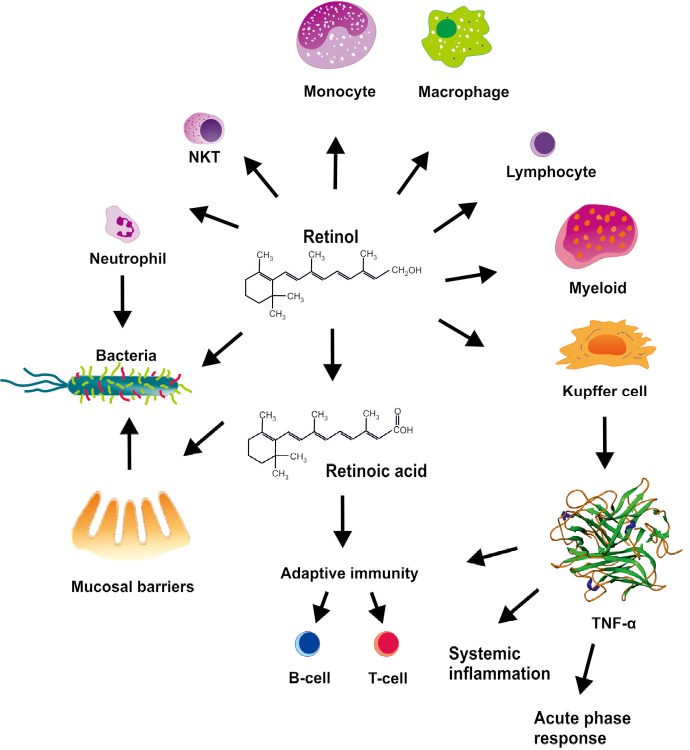
Vitamin A in systemic and hepatic immunity. Vitamin A (retinol) is metabolized into retinal and then to biologically active RA. RA regulates myeloid cell development and differentiation, diminishes or enhances activity of B- and T-cells, monocytes, macrophages, lymphocytes, KC, NKT and neutrophils. In addition, this vitamin is essential in stabilising mucosal barriers that prevent unhindered penetration of bacteria into the body. It further controls release of TNF-α from KC that acts as an endogenous pyrogen and is a central regulator of immune cells, systemic inflammation and the acute phase response. RA, retinoic acid; KC, Kupffer cells; NKT, natural killer T cells; TNF-α, tumor necrosis factor-α.
Figure 3
Figure 3
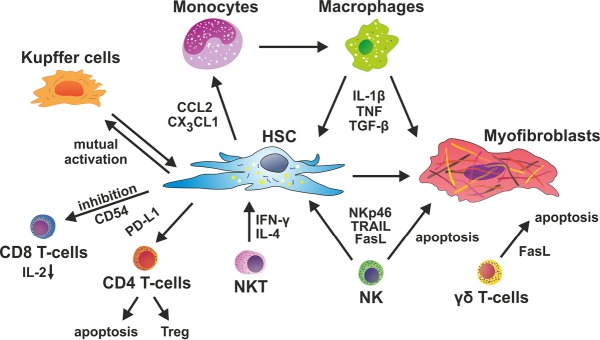
Cell-cell-interactions of hepatic stellate cells with immune cells. The properties of HSC are modulated by many immune cells. Vice versa, HSC produce many soluble factors that modulate immune cell properties. Details about the interactions with individual immune cell subpopulations and their role for liver immunology are given in the text. HSC, hepatic stellate cell.

References

    1. Gressner AM, Weiskirchen R. Modern pathogenetic concepts of liver fibrosis suggest stellate cells and TGF-β as major players and therapeutic targets. J Cell Mol Med 2006;10:76-99. - PMC - PubMed
    1. Friedman SL. Hepatic stellate cells: protean, multifunctional, and enigmatic cells of the liver. Physiol Rev 2008;88:125-72. - PMC - PubMed
    1. Mederacke I, Hsu CC, Troeger JS, et al. Fate tracing reveals hepatic stellate cells as dominant contributors to liver fibrosis independent of its aetiology. Nat Commun 2013;4:2823. - PMC - PubMed
    1. Geerts A.History, heterogeneity, developmental biology, and functions of quiescent hepatic stellate cells. Semin Liver Dis 2001;21:311-35. - PubMed
    1. Wake K, Sato T.Intralobular heterogeneity of perisinusoidal stellate cells in porcine liver. Cell Tissue Res 1993;273:227-37. - PubMed