. 2014 Dec;20(12):1980-9.
doi: 10.3201/eid2012.140281.

Geographic divergence of bovine and human Shiga toxin–producing Escherichia coli O157:H7 genotypes, New Zealand

Affiliations

Geographic divergence of bovine and human Shiga toxin–producing Escherichia coli O157:H7 genotypes, New Zealand

Patricia Jaros et al. Emerg Infect Dis. 2014 Dec.

Abstract

Shiga toxin-producing Escherichia coli (STEC)O157:H7 is a zoonotic pathogen of public health concern worldwide. To compare the local and large-scale geographic distributions of genotypes of STEC O157:H7 isolates obtained from various bovine and human sources during 2008–2011, we used pulsed-field gel electrophoresis and Shiga toxin–encoding bacteriophage insertion (SBI) typing. Using multivariate methods, we compared isolates from the North and South Islands of New Zealand with isolates from Australia and the United States. The STEC O157:H7 population structure differed substantially between the 2 islands and showed evidence of finer scale spatial structuring, which is consistent with highly localized transmission rather than disseminated foodborne outbreaks. The distribution of SBI types differed markedly among isolates from New Zealand, Australia, and the United States. Our findings also provide evidence for the historic introduction into New Zealand of a subset of globally circulating STEC O157:H7 strains that have continued to evolve and be transmitted locally between cattle and humans.


Figures
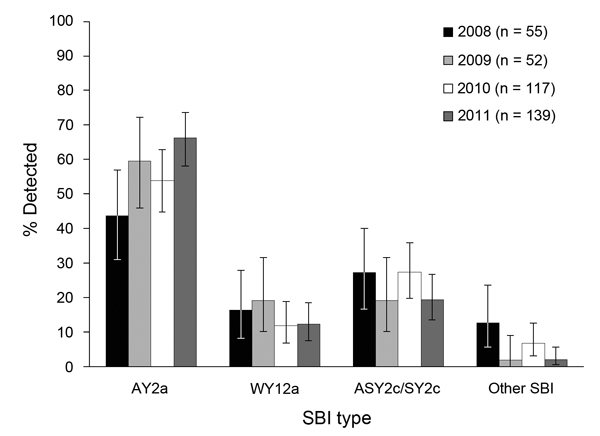
Figure 1
Figure 1
Proportional distributions, stratified by year, of Shiga toxin–encoding bacteriophage insertion (SBI) types AY2a, WY12a, and ASY2c/SY2c of 363 human Shiga toxin–producing Escherichia coli O157:H7 isolates from clinical case-patients in New Zealand, 2008–2011. Error bars indicate 95% CIs.
Figure 2
Figure 2
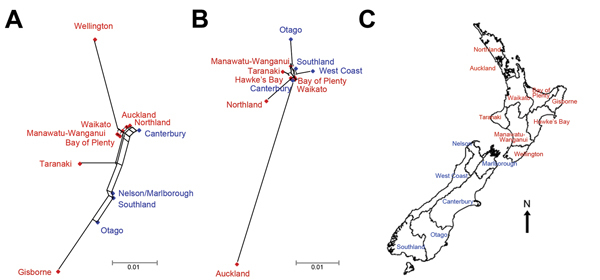
NeighborNet (16) trees showing population differentiation of Shiga toxin–producing Escherichia coli O157:H7 isolates from humans and cattle from different regions in the North Island (red) and the South Island (blue), New Zealand. A) Isolates from human case-patients (n = 355, 8 isolates excluded). B) Isolates from bovine meat samples (n = 233, 2 isolates excluded). C) Map of New Zealand showing different regions from which samples were collected. The distances indicate population differentiation measured as pairwise FST values.
Figure 3
Figure 3
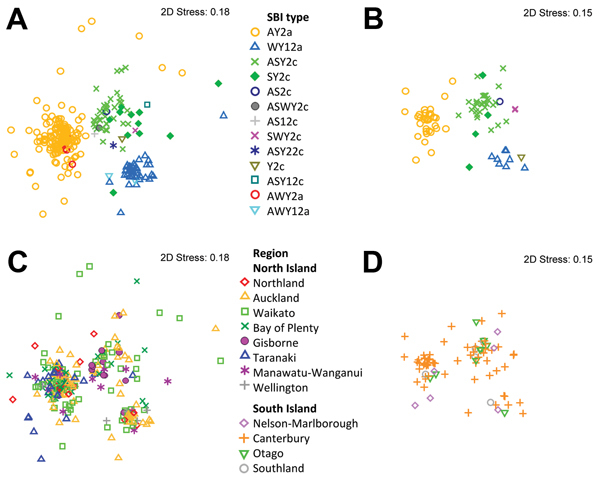
Multidimensional scaling plots showing the genotypic clustering of human Shiga toxin–producing Escherichia coli O157:H7 isolates originating from the North Island (n = 274, 4 isolates excluded) and the South Island (n = 81, 4 isolates excluded), New Zealand. The plots were determined on the basis of the isolates’ pulsed-field gel electrophoresis profiles. Clusters associated with Shiga toxin–encoding bacteriophage insertion (SBI) types (A) and regions (C) for isolates from the North Island. Clusters associated with SBI types (B) and regions (D) for isolates from the South Island. 2D, 2 dimensional.
Figure 4
Figure 4
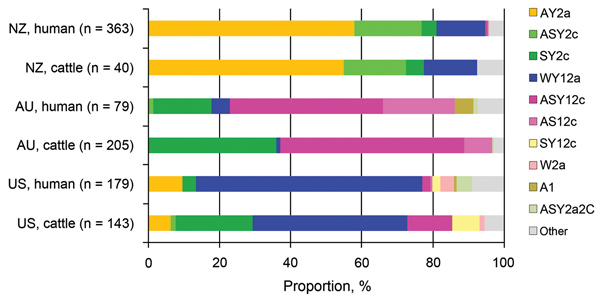
Proportional distributions of Shiga toxin–encoding bacteriophage insertion types of Shiga toxin–producing Escherichia coli O157:H7 isolates sourced from cattle and humans in New Zealand (NZ), Australia (AU), and the United States (US).
Figure 5
Figure 5
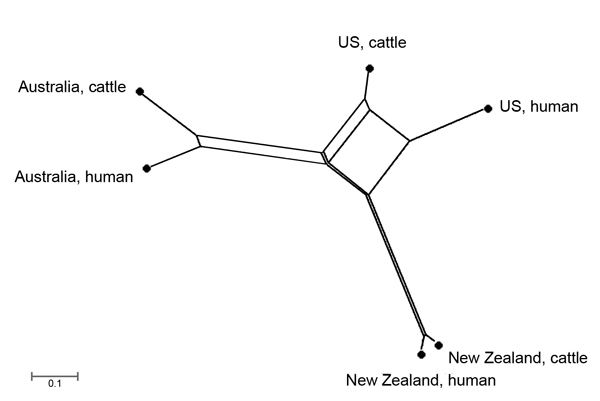
NeighborNet (16) tree showing geographic divergence of bovine and human Shiga toxin–producing Escherichia coli O157:H7 isolates sourced from New Zealand (40 cattle, 363 human), Australia (205 cattle, 79 human), and the United States (US) (143 cattle, 179 human). The distance indicates the difference in proportional similarity of Shiga toxin–encoding bacteriophage insertion types among the isolates.

References

    1. Karmali M, Petric M, Steele BT, Lim C. Sporadic cases of haemolytic-uraemic syndrome associated with faecal cytotoxin and cytotoxin-producing Escherichia coli in stools. Lancet. 1983;321:619–20. 10.1016/S0140-6736(83)91795-6 - DOI - PubMed
    1. Riley LW, Remis RS, Helgerson SD, McGee HB, Wells JG, Davis BR, et al. Hemorrhagic colitis associated with a rare Escherichia coli serotype. N Engl J Med. 1983;308:681–5. 10.1056/NEJM198303243081203 - DOI - PubMed
    1. Griffin PM, Tauxe RV. The epidemiology of infections caused by Escherichia coli O157:H7, other enterohemorrhagic E. coli and the associated hemolytic uremic syndrome. Epidemiol Rev. 1991;13:60–98 . - PubMed
    1. Institute of Environmental Science and Research Ltd. Surveillance report. Notifiable and other diseases in New Zealand: annual report 2012. [cited 2013 Sep 10]. https://surv.esr.cri.nz/surveillance/annual_surveillance.php?we_objectID....
    1. Binney B, Biggs PJ, Carter PE, Holland BR, French NP. Quantification of historical livestock importation into New Zealand [cited 2014 Jun 15]. N Z Vet J. 2014. Epub 2014 May 28 - PubMed

Publication types

MeSH terms

Substances

LinkOut - more resources