. 2015 Jan 6;16(1):1179-91.
doi: 10.3390/ijms16011179.

Trans-splicing improvement by the combined application of antisense strategies

Affiliations

Trans-splicing improvement by the combined application of antisense strategies

Ulrich Koller et al. Int J Mol Sci. .

Abstract

Spliceosome-mediated RNA trans-splicing has become an emergent tool for the repair of mutated pre-mRNAs in the treatment of genetic diseases. RNA trans-splicing molecules (RTMs) are designed to induce a specific trans-splicing reaction via a binding domain for a respective target pre-mRNA region. A previously established reporter-based screening system allows us to analyze the impact of various factors on the RTM trans-splicing efficiency in vitro. Using this system, we are further able to investigate the potential of antisense RNAs (AS RNAs), presuming to improve the trans-splicing efficiency of a selected RTM, specific for intron 102 of COL7A1. Mutations in the COL7A1 gene underlie the dystrophic subtype of the skin blistering disease epidermolysis bullosa (DEB). We have shown that co-transfections of the RTM and a selected AS RNA, interfering with competitive splicing elements on a COL7A1-minigene (COL7A1-MG), lead to a significant increase of the RNA trans-splicing efficiency. Thereby, accurate trans-splicing between the RTM and the COL7A1-MG is represented by the restoration of full-length green fluorescent protein GFP on mRNA and protein level. This mechanism can be crucial for the improvement of an RTM-mediated correction, especially in cases where a high trans-splicing efficiency is required.


Figures
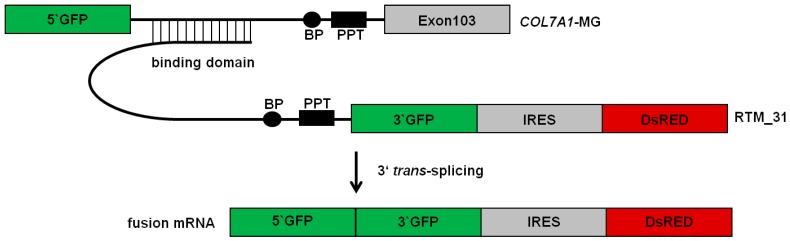
Figure 1
Figure 1
RNA trans-splicing molecules (RTMs) screening system and binding position of RTM_31 within COL7A1 intron 102/exon 103. The fluorescence-based model system consists of a COL7A1-minigene (COL7A1-MG), carrying the 5' portion of GFP upstream of the RTM binding region intron 102/exon 103 of COL7A1 and RNA trans-splicing molecules carrying a BD (binding domain) specific for intron 102 of COL7A1, a splicing domain (including branch point, BP; polypyrimidine tract, PPT; 3' acceptor splice site, ss), the missing portion of 3' GFP, an internal ribosomal entry site (IRES) and the reporter molecule, DsRED. Accurate trans-splicing between the COL7A1-MG and a functional RTM leads to fusion of both GFP parts provided by both interacting molecules, thereby restoring the function of the protein.
Figure 2
Figure 2
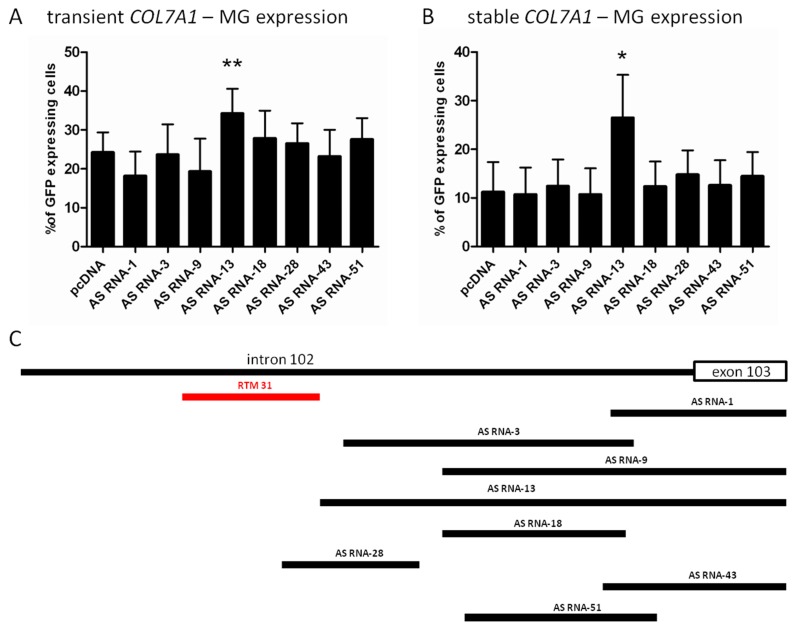
Comparison of AS RNA-mediated influence on trans-splicing efficiency. (A) Triple transfections of COL7A1-MG, RTM_31 and the most promising AS RNA (AS RNA-13) increased the amount of GFP expressing cells upon accurate trans-splicing from 24% to 34%. Mean + SD of five different experiments is shown. An unpaired T-test (two-tailed) was performed with GraphPad Prism software (GraphPad Software, San Diego, CA, USA) to prove the statistical significance between AS RNA-13 and the control pcDNA (** p value = 0.0073); (B) Co-transfection of RTM_31 and individual AS RNAs of the library into a COL7A1-MG expressing target cell line leads to a variable trans-splicing rate. AS RNA-13 showed the most promising effect, capable of increasing the trans-splicing efficiency of the RTM 2–3-fold on the protein level (measured by flow cytometry). AS RNA-13 was compared to the control (pcDNA). The mean + SD of 4 different experiments is shown. Unpaired, two-tailed t-test (* p value = 0.0298) confirmed statistical the significant increase in AS RNA-13 compared to the control pcDNA; and (C) Binding position of RTM_31 (red) and individual AS RNAs within the COL7A1 target region.
Figure 3
Figure 3
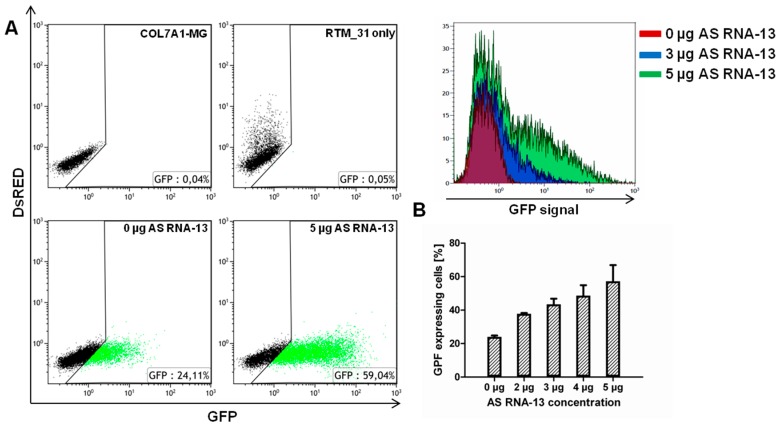
Increasing amounts of AS RNA-13 enhance GFP expression in a triple-transfection assay. After transfection of increasing amounts (0, 2, 3, 4 and 5 µg) of AS RNA-13 into HEK293 cells, co-transfected with 1 µg RTM_31 and 1 µg COL7A1-MG, the GFP-expressing cell population increased with the amount of AS RNA-13 introduced. (A) Dot blots showed increased GFP expression (green dots) in cells treated with 5 µg AS RNA-13 in comparison to the cell population exclusively transfected with RTM and COL7A1-MG-expressing plasmids; and (B) The increase of GFP expression correlates with the amount of AS RNA-13 (0 µg, 2–5 µg) transfected into HEK293 cells (the mean value + SD of two independent experiments is shown).
Figure 4
Figure 4
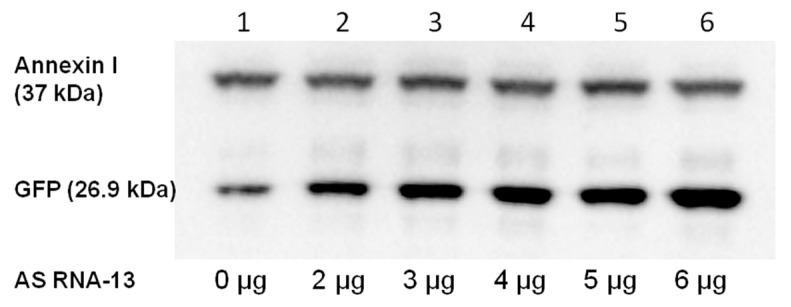
Detection of full-length GFP restoration by western blot analysis. The corresponding band for GFP is visible at a size of ~27 kDa on the nitrocellulose membrane after immunostaining. The amount of detected GFP increases with the amount of added AS RNA-13 (lanes 1–6: 0, 2–6 µg AS RNA-13). Analysis of the intensity of GFP signal revealed an up to eight-fold (relative quantification of GFP expression was measured using the Image Lab 3.0.1 software (Bio-Rad, Hercules, CA, USA) up-regulation after the addition of 6 µg AS RNA-13 expressing plasmids. Annexin I was included as loading control in the experiment visible at a size of 37 kDa on the nitrocellulose membrane.
Figure 5
Figure 5
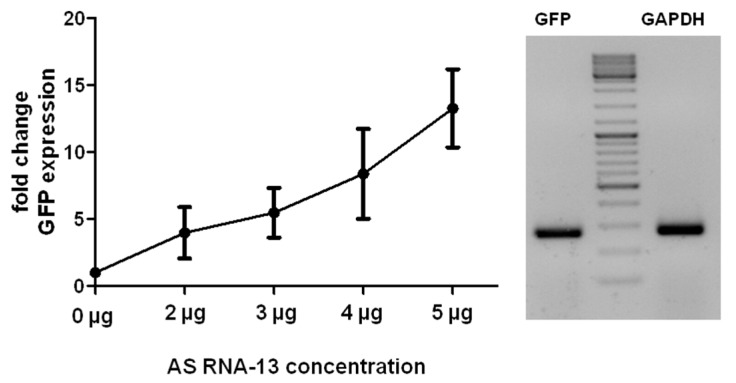
Quantification of full-length GFP transcripts by sqRT-PCR. Co-transfection of AS RNA-13, RTM_31 and COL7A1-MG-expressing plasmids into HEK293 cells increased the level of trans-splicing. The amount of GFP transcripts, representing accurate trans-splicing events between RTM_31 and COL7A1-MG, was quantified by sqRT-PCR using GFP specific primers. Similarly to the data obtained by flow cytometric measurements (Figure 3A) the GFP expression correlates with the amount of given AS RNA-13. The more AS RNA-13 expression plasmids were introduced into the cells, the higher was the trans-splicing efficiency manifested in the expression of full-length GFP transcripts. The mean value ± SD of three independent experiments is shown. All values were normalized to GAPDH.

References

    1. Chao H., Mansfield S.G., Bartel R.C., Hiriyanna S., Mitchell L.G., Garcia-Blanco M.A., Walsh C.E. Phenotype correction of hemophilia A mice by spliceosome-mediated RNA trans-splicing. Nat. Med. 2003;9:1015–1019. doi: 10.1038/nm900. - DOI - PubMed
    1. Mansfield S.G., Clark R.H., Puttaraju M., Kole J., Cohn J.A., Mitchell L.G., Garcia-Blanco M.A. 5' Exon replacement and repair by spliceosome-mediated RNA trans-splicing. RNA. 2003;9:1290–1297. doi: 10.1261/rna.5101903. - DOI - PMC - PubMed
    1. Wally V., Klausegger A., Koller U., Lochmuller H., Krause S., Wiche G., Mitchell L.G., Hintner H., Bauer J.W. 5' Trans-splicing repair of the PLEC1 gene. J. Investig. Dermatol. 2008;128:568–574. doi: 10.1038/sj.jid.5701152. - DOI - PubMed
    1. Wally V., Brunner M., Lettner T., Wagner M., Koller U., Trost A., Murauer E.M., Hainzl S., Hintner H., Bauer J.W. K14 mRNA reprogramming for dominant epidermolysis bullosa simplex. Hum. Mol. Genet. 2010;19:4715–4725. doi: 10.1093/hmg/ddq405. - DOI - PubMed
    1. Murauer E.M., Gache Y., Gratz I.K., Klausegger A., Muss W., Gruber C., Meneguzzi G., Hintner H., Bauer J.W. Functional correction of type VII collagen expression in dystrophic epidermolysis bullosa. J. Investig. Dermatol. 2011;131:74–83. doi: 10.1038/jid.2010.249. - DOI - PubMed

Publication types

Substances