


Intravenous versus intra-arterial thrombolysis in ischemic stroke: a systematic review and meta-analysis
- PMID: 25569136
- PMCID: PMC4287629
- DOI: 10.1371/journal.pone.0116120
Intravenous versus intra-arterial thrombolysis in ischemic stroke: a systematic review and meta-analysis
Abstract
Background: Reperfusion following ischemic stroke can be attained by either intravenous thrombolysis (IVT) or intra-arterial thrombolysis (IAT). Only a limited number of randomized prospective studies have compared the efficacy and safety of IVT and IAT. This meta-analysis investigated possible clinical benefits of IAT relative to IVT in patients with acute ischemic stroke.
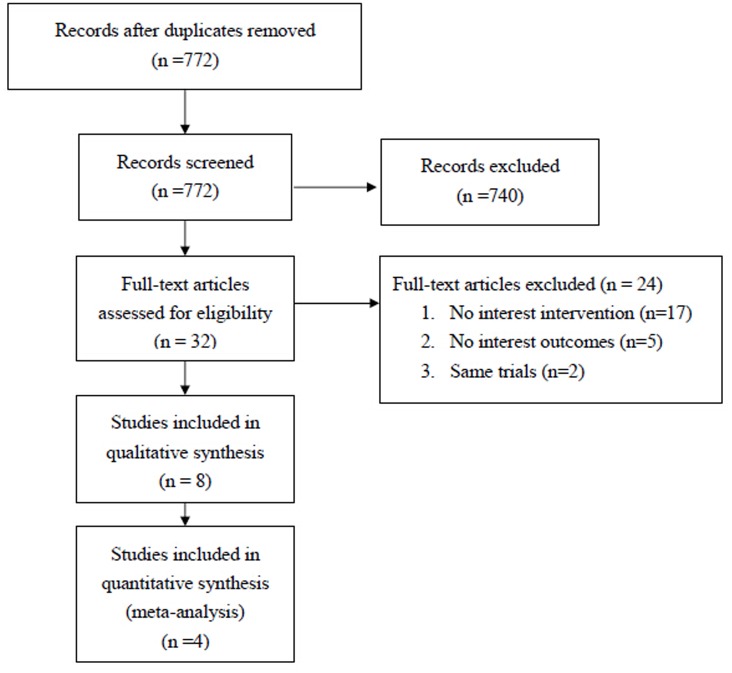
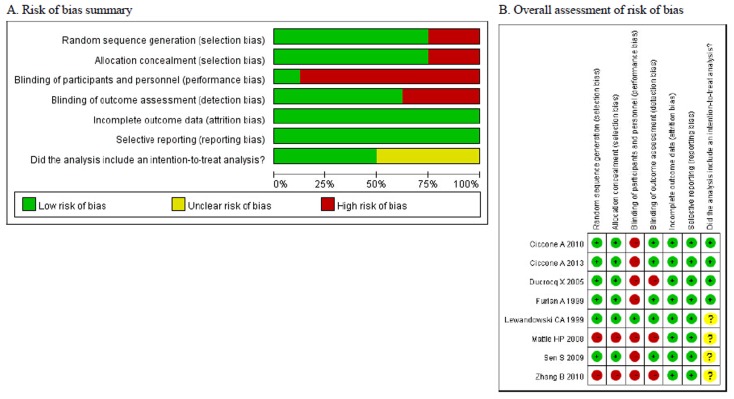
Methods: We searched the PubMed, Cochrane, and Google Scholar databases through October 2013 for manuscripts that describe the findings of randomized controlled or prospective studies that evaluated the outcomes of patients with ischemic stroke who were treated with IVT or IAT. The clinical outcome measures were score on the modified Rankin scale (mRS) and mortality at 90 days. A favorable outcome was defined as an mRS score of 0 to 2.
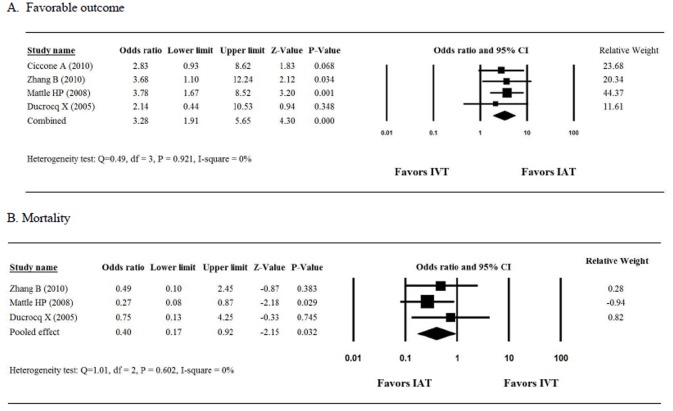
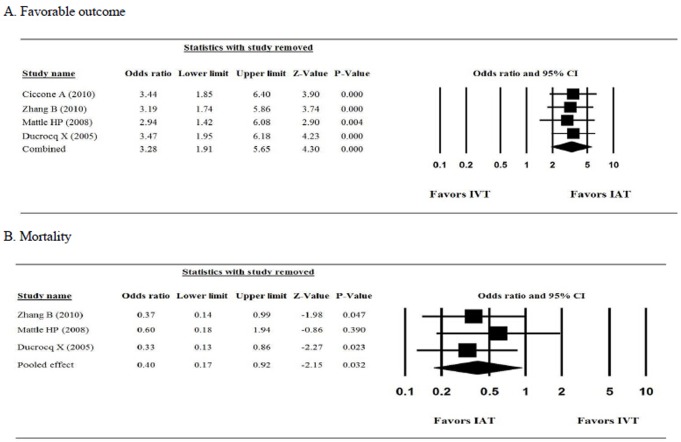
Results: For the mRS, the combined odds ratio (OR) of 3.28 (95% confidence interval (CI), 1.91 to 5.65, P < 0.001) indicated that patients who received IAT had a significantly higher chance for a favorable outcome than did those who received IVT. For mortality, the OR indicated that IAT therapy significantly reduced the proportion of patients who died within 90 days of the procedure (combined OR, 0.40; 95%CI, 0.17 to 0.92; P = 0.032).
Conclusion: This meta-analysis determined that IAT conferred a significantly greater probability of achieving a favorable outcome compared with IVT. There was also a significant difference in mortality rates between IAT and IVT. The studies included in this analysis were small and heterogeneous; therefore, larger randomized prospective clinical studies are necessary to further investigate this issue.
Conflict of interest statement
Figures
References
-
- del Zoppo GJ, Saver JL, Jauch EC, Adams HP Jr (2009) Expansion of the time window for treatment of acute ischemic stroke with intravenous tissue plasminogen activator: a science advisory from the American Heart Association/American Stroke Association. Stroke 40: 2945–2948. 10.1161/STROKEAHA.109.192535 - DOI - PMC - PubMed
-
- Saqqur M, Uchino K, Demchuk AM, Molina CA, Garami Z, et al. (2007) Site of arterial occlusion identified by transcranial Doppler predicts the response to intravenous thrombolysis for stroke. Stroke 38: 948–954. 10.1161/01.STR.0000257304.21967.ba - DOI - PubMed
Publication types
MeSH terms
Substances
LinkOut - more resources
Full Text Sources
Other Literature Sources
Medical
