Review
. 2015 Jan 6;5(1):102-26.
doi: 10.3390/life5010102.

Sucrose in cyanobacteria: from a salt-response molecule to play a key role in nitrogen fixation

Affiliations
Review

Sucrose in cyanobacteria: from a salt-response molecule to play a key role in nitrogen fixation

María A Kolman et al. Life (Basel). .

Abstract

In the biosphere, sucrose is mainly synthesized in oxygenic photosynthetic organisms, such as cyanobacteria, green algae and land plants, as part of the carbon dioxide assimilation pathway. Even though its central position in the functional biology of plants is well documented, much less is known about the role of sucrose in cyanobacteria. In those prokaryotes, sucrose accumulation has been associated with salt acclimation, and considered as a compatible solute in low-salt tolerant strains. In the last years, functional characterizations of sucrose metabolizing enzymes, metabolic control analysis, cellular localization of gene expressions, and reverse genetic experiments have revealed that sucrose metabolism is crucial in the diazotrophic growth of heterocystic strains, and besides, that it can be connected to glycogen synthesis. This article briefly summarizes the current state of knowledge of sucrose physiological functions in modern cyanobacteria and how they might have evolved taking into account the phylogenetic analyses of sucrose enzymes.


Figures
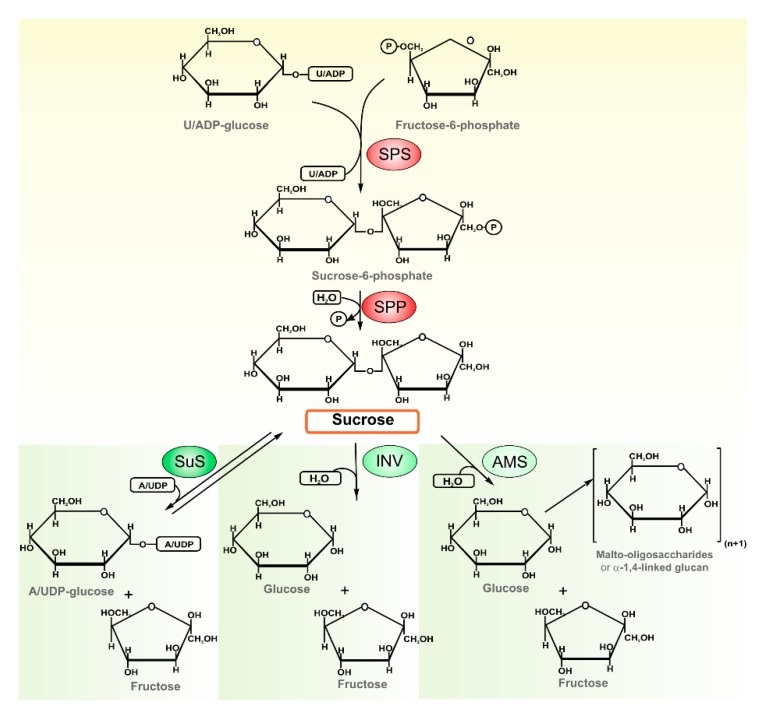
Figure 1
Figure 1
Schematic representation of sucrose metabolism in cyanobacteria. Sucrose biosynthesis involves the sequential action of SPS and SPP, yielding free sucrose and inorganic phosphate. Cyanobacterial SPSs preferentially use ADP-glucose or UDP-glucose, as substrates. The disaccharide degradation can be carried out by the activities of the three different enzymes: (i) SuS that catalyzes a readily reversible reaction but that in vivo acts in the cleavage of sucrose, supplying ADP-glucose, a precursor for glycogen synthesis; however in vitro, SuS can also accept other sugar nucleotides (i.e., UDP) as substrate; (ii) A/N-Inv that irreversible hydrolyzes sucrose into glucose and fructose; and (iii) AMS that is able to catalyze not only sucrose hydrolysis to hexoses, but also to transfer the glucose moiety to a soluble maltooligosaccharide or to an insoluble α 1,4-glucan.
Figure 2
Figure 2
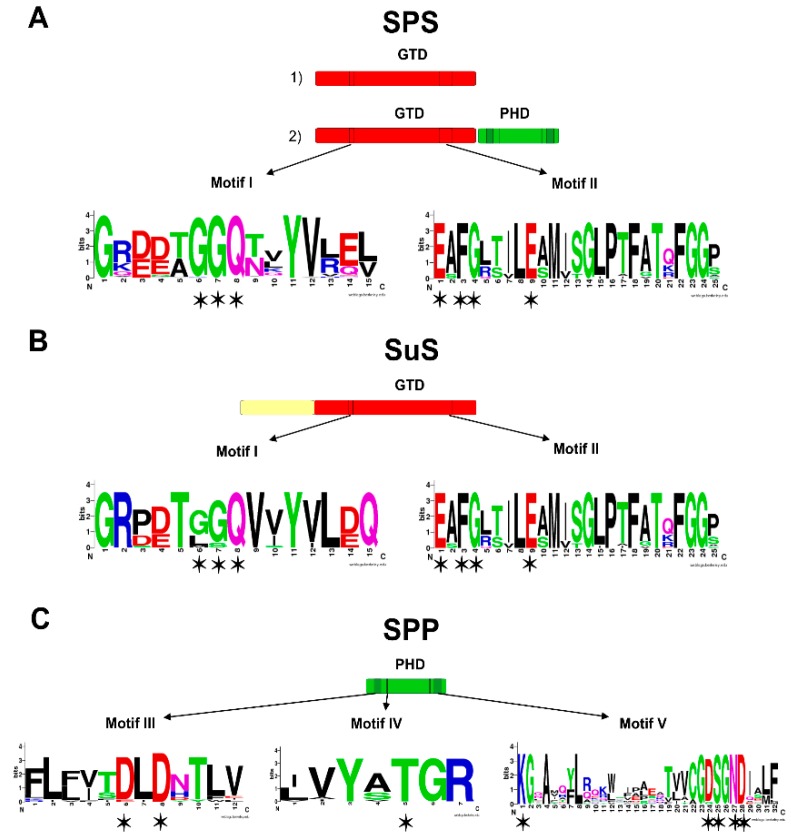
Domainal arrangements of sucrose-synthesis related proteins. SPS, SPP and SuS (sucrose-synthesis related proteins) are modular proteins based on a glycosyltransferase domain (GTD, red box) and a phosphohydrolase domain (PHD, green box) [9,19]. (A) Two domain arrangements have been described for cyanobacterial SPSs: (1) the minimal SPS unit (GTD), or unidomainal SPS; and (2) the two-domain SPS prototype (GTD-PHD) or bidomainal SPS; (B) SuS presents a GTD, with a characteristic N-terminal extension (yellow box). The resolution of the crystallographic structure of Halothermothrix orenii SPS (2r66A and 2r68A) [24], and of Arabidopsis thaliana SuS1 (3s28A) [25] allowed the identification of the residues involved in the sugar and in the NDP-glucose binding sites, within motif I and II, respectively (denoted with asterisks); (C) SPPs exhibit only a PHD. Motives III to V are characteristic of proteins grouped in the phosphohrydrolase superfamily and related to SPP activity. The crystallization Synechocystis sp. PCC 6803 SPP (1s2oA) led to the identification of the residues involved in the catalytic activity [26]. The critical residues were found within PHD motives (denoted with asterisks). Logos were constructed using the above mentioned conserved motives (WebLogo server [27]).
Figure 3
Figure 3
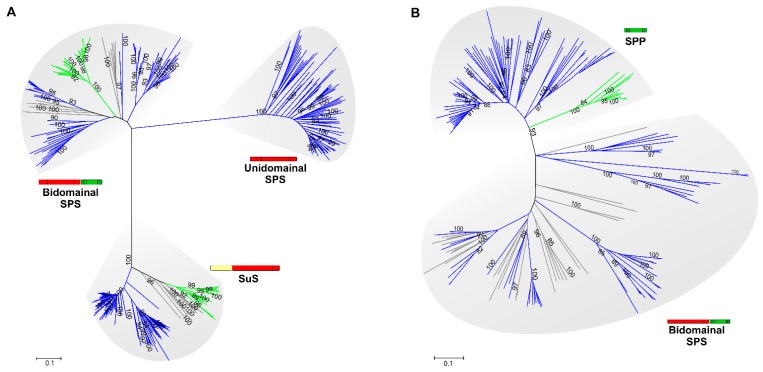
Phylogenetic analysis of SPS, SPP and SuS proteins based on GTD and PHD sequences. Homologs were retrieved from public databases (JGI-DOE, http://www.jgi.doe.gov) by BLASTp searches using as query SPS and SuS of Anabaena sp PCC 7120, and SPS and SPP of Synechocystis sp. PCC 6803. Unrooted dendrograms were obtained using the maximum parsimony (1000 replicates). After sequence alignments, GTD (A) or PHD (B) regions described by Cumino et al. [19] were identified with ClustalW [30]. Trees were generated with the MEGA5 software [31]. Major groups are identified to give clues about their function, species, or taxonomic information: (A) GTDs corresponding to bidomainal and unidomainal SPSs and SuS; (B) PHDs, corresponding to SPP and to bidomainal SPSs. Cyanobacteria, blue lines; plants, green lines; bacteria, grey lines. Bootstrap results are not shown when values were lower than 90%.
Figure 4
Figure 4
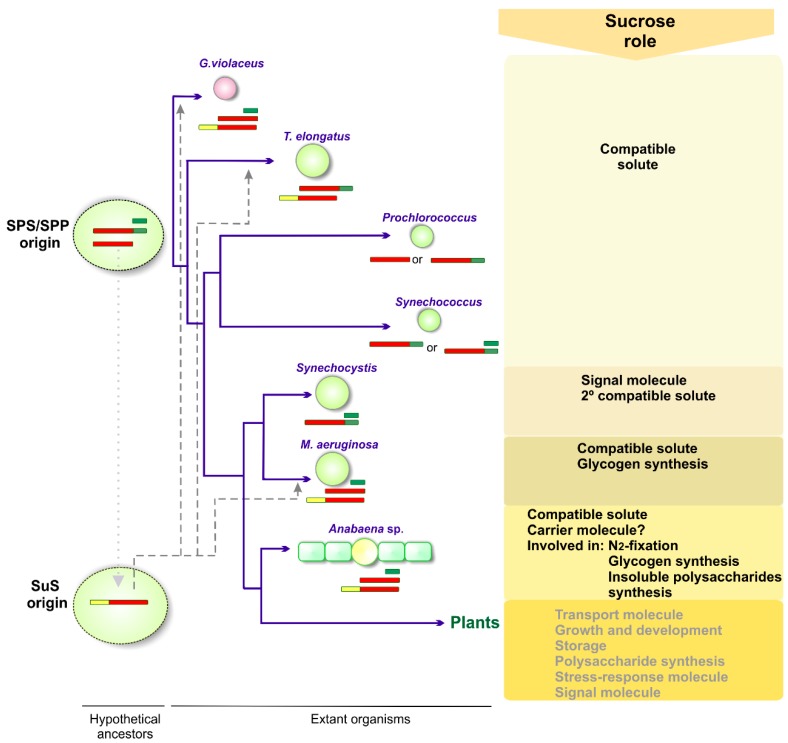
Schematic representation of sucrose roles along the hypothetical evolutionary pathway of cyanobacteria. The phylogenetic relationships among species are depicted according to rDNA 16S sequence analysis. Sucrose metabolism is likely to be originated in freshwater habitat and multiple sucrose synthesis genes might have been present in a cyanobacterial ancestor [27]. Sucrose synthesis is found in G. violaceus that has ancestral characteristics and diverged early within the radiation of cyanobacteria. A fusion of primordial GTD and PHD might have given rise to a hypothetical common-ancestral SPS (GTD-PHD) gene, which is found mostly in the marine Prochlorococcus/Synechococcus clade. Sucrose has been identified as a primary compatible solute in Prochlorococcus, and as secondary osmolyte in Synechococcus strains and in Synechocystis sp. PCC 6803 [36]. The involvement of sucrose in glycogen and polysaccharides production seems to be due to the emergence of SuS (dotted line), crucial in filamentous heterocyst-forming strains [20,21], as well as in strains (such as G. violaceus, Thermosynechococcus elongatus and Microcystis aeruginosa PCC 7806), where SuS are likely to be acquired by lateral gene transfer (dashed lines). In heterocystic strains, sucrose is a key molecule during nitrogen fixation and it was proposed as a carrier molecule to transport carbon along the filament. It is also involved in glycogen synthesis and in other polysaccharide accumulation. Plant sucrose metabolism has been acquired during the endosymbiotic origin of the chloroplast at the time of the cyanobacterial phylogenetic radiation.

References

    1. Rippka R., Deruelles J., Waterbury J.B., Herdman M., Stanier R.Y. Generic assignments, strain histories and properties of pure cultures of cyanobacteria. J. Gen. Microbiol. 1979;111:1–61. doi: 10.1099/00221287-111-1-1. - DOI
    1. Whitton B.A., Potts M. Introduction to the cyanobacteria. In: Whitton B.A., editor. Ecology of Cyanobacteria II. Springer; Dordrecht, The Netherlands: 2012. pp. 1–13.
    1. Reed R.H., Stewart W.D.P. The responses of cyanobacteria to salt stress. In: Rogers L.J., Gallon J.R., editors. Biochemistry of the Algae and Cyanobacteria. Clarendon Press; Oxford, UK: 1988. pp. 217–231. Chapter 12.
    1. Hagemann M. Molecular biology of cyanobacterial salt acclimation. FEMS Microbiol. Rev. 2011;35:87–123. doi: 10.1111/j.1574-6976.2010.00234.x. - DOI - PubMed
    1. Blumwald E., Tel-Or E. Osmoregulation and cell composition in salt-adaptation of Nostoc. Muscorum. Arch. Microbiol. 1982;132:168–172. doi: 10.1007/BF00508725. - DOI

LinkOut - more resources