


The colorectal cancer mortality-to-incidence ratio as an indicator of global cancer screening and care
- PMID: 25572676
- PMCID: PMC4424055
- DOI: 10.1002/cncr.29228
The colorectal cancer mortality-to-incidence ratio as an indicator of global cancer screening and care
Abstract
Background: Disparities in cancer screening, incidence, treatment, and survival are worsening globally. The mortality-to-incidence ratio (MIR) has been used previously to evaluate such disparities.
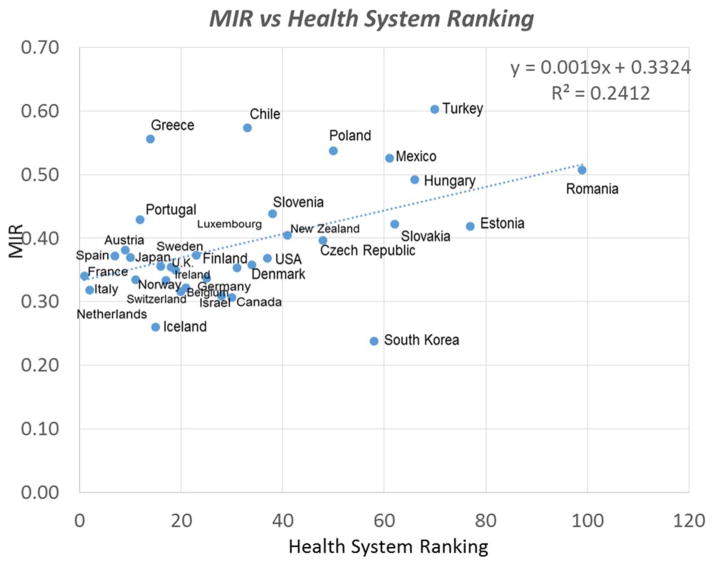
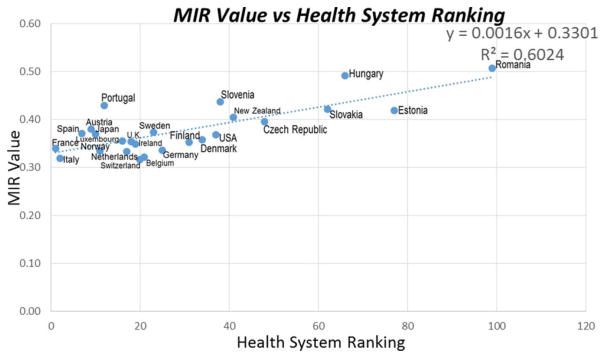
Methods: The MIR for colorectal cancer is calculated for all Organisation for Economic Cooperation and Development (OECD) countries using the 2012 GLOBOCAN incidence and mortality statistics. Health system rankings were obtained from the World Health Organization. Two linear regression models were fit with the MIR as the dependent variable and health system ranking as the independent variable; one included all countries and one model had the "divergents" removed.
Results: The regression model for all countries explained 24% of the total variance in the MIR. Nine countries were found to have regression-calculated MIRs that differed from the actual MIR by >20%. Countries with lower-than-expected MIRs were found to have strong national health systems characterized by formal colorectal cancer screening programs. Conversely, countries with higher-than-expected MIRs lack screening programs. When these divergent points were removed from the data set, the recalculated regression model explained 60% of the total variance in the MIR.
Conclusions: The MIR proved useful for identifying disparities in cancer screening and treatment internationally. It has potential as an indicator of the long-term success of cancer surveillance programs and may be extended to other cancer types for these purposes.
Keywords: clinical medicine; colorectal cancer; mass screening; public health.
© 2015 American Cancer Society.
Conflict of interest statement
CONFLICT OF INTEREST DISCLOSURES
Dr. Hebert is the owner of Connecting Health Innovations LLC, which exists to commercialize his inventions (developed as an employee of the University of South Carolina). Currently, Connecting Health Innovations LLC has a grant from the National Institute of Diabetes and Digestive and Kidney Diseases for work related to commercializing the dietary inflammatory index for use in clinical practice. That work has absolutely nothing to do with the current study.
Figures
Comment in
-
The application of the mortality-to-incidence ratio for the evaluation of cancer care disparities globally.Cancer. 2016 Feb 1;122(3):487-8. doi: 10.1002/cncr.29746. Epub 2015 Oct 20. Cancer. 2016. PMID: 26484652 No abstract available.
-
Conceptual considerations and methodological recommendations for the use of the mortality-to-incidence ratio in time-lagged, ecological-level analysis for public health systems-oriented cancer research.Cancer. 2016 Feb 1;122(3):486-7. doi: 10.1002/cncr.29747. Epub 2015 Oct 20. Cancer. 2016. PMID: 26484751 No abstract available.
References
-
- International Agency for Research on Cancer. Latest World Cancer Statistics. Geneva, Switzerland: World Health Organization; 2013.
-
- World Bank. World Development Indicators 2012. Washington, DC: World Bank; 2012.
-
- Tapay N, Colombo F. OECD Health Working Papers No 15. Paris, France: OECD Publishing; 2004. Private Health Insurance in OECD Countries: The Benefits and Costs for Individuals and Health Systems; pp. 265–319.
-
- Devaux M. Income-related inequalities and inequities in health care services utilisation in 18 selected OECD countries. Eur J Health Econ published online ahead of print December 14, 2013. - PubMed
-
- Machii R, Saito H. Time trends in cervical cancer screening rates in the OECD countries. Jpn J Clin Oncol. 2011;41:731–732. - PubMed
Publication types
MeSH terms
Grants and funding
LinkOut - more resources
Full Text Sources
Other Literature Sources
Medical
