. 2015 May;172(10):2507-18.
doi: 10.1111/bph.13074. Epub 2015 Mar 17.

GPCR dimerization in brainstem nuclei contributes to the development of hypertension

Affiliations

GPCR dimerization in brainstem nuclei contributes to the development of hypertension

Gwo-Ching Sun et al. Br J Pharmacol. 2015 May.

Abstract

Background and purpose: μ-Opioid receptors, pro-opiomelanocortin and pro-enkephalin are highly expressed in the nucleus tractus solitarii (NTS) and μ receptor agonists given to the NTS dose-dependently increased BP. However, the molecular mechanisms of this process remain unclear. In vitro, μ receptors heterodimerize with α2A -adrenoceptors. We hypothesized that α2A -adrenoceptor agonists would lose their depressor effects when their receptors heterodimerize in the NTS with μ receptors.

Experimental approach: We microinjected μ-opioid agonists and antagonists into the NTS of rats and measured changes in BP. Formation of μ receptor/α2A -adrenoceptor heterodimers was assessed with immunofluorescence and co-immunoprecipitation methods, along with proximity ligation assays.

Key results: Immunofluorescence staining revealed colocalization of α2A -adrenoceptors and μ receptors in NTS neurons. Co-immunoprecipitation revealed interactions between α2A -adrenoceptors and μ receptors. In situ proximity ligation assays confirmed the presence of μ receptor/α2A -adrenoceptor heterodimers in the NTS. Higher levels of endogenous endomorphin-1 and μ receptor/α2A -adrenoceptor heterodimers were found in the NTS of hypertensive rats, than in normotensive rats. Microinjection of the μ receptor agonist [D-Ala(2) , MePhe(4) , Gly(5) -ol]-enkephalin (DAMGO), but not that of the α2A -adrenoceptor agonist guanfacine, into the NTS of normotensive rats increased μ receptor/α2A -adrenoceptor heterodimer formation and BP elevation. The NO-dependent BP-lowering effect of α2A -adrenoceptor agonists was blunted following increased formation of μ receptor/α2A -adrenoceptor heterodimers in the NTS of hypertensive rats and DAMGO-treated normotensive rats.

Conclusions and implications: Increases in endogenous μ receptor agonists in the NTS induced μ receptor/α2A -adrenoceptor heterodimer formation and reduced the NO-dependent depressor effect of α2A -adrenoceptor agonists. This process could contribute to the pathogenesis of hypertension.


Figures

Figure 1
Figure 1
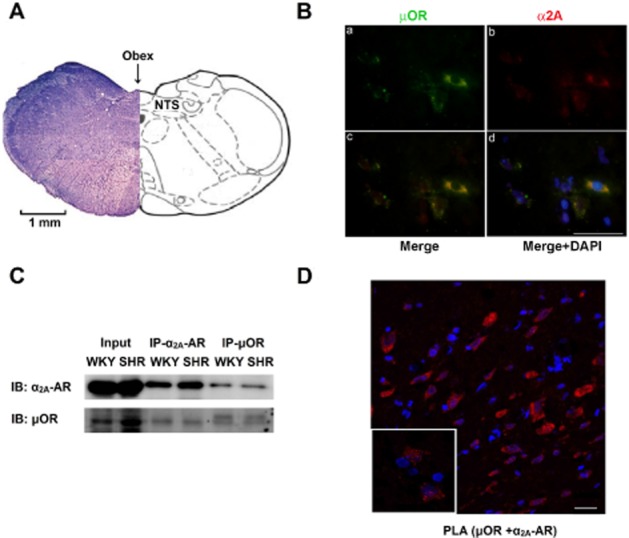
Formation of μ receptor and α2A-adrenoceptor heterodimers in the NTS. (A) Cross-section of the medulla oblongata rostral to the obex, indicating the location of the NTS. (B) Representative immunofluorescence images of the NTS showing that μ receptors (μOR; a, green) and α2A-adrenoceptors (α2A; b, red) were colocalized (c, d) in the neuronal cells of the NTS of WKY rats. (C) Confirmation of the μ receptor (μOR) and α2A-adrenoceptor (α2A-AR) interaction using co-immunoprecipitation from an NTS protein lysate. (D) Confirmation of μ receptor/α2A-adrenoceptor heterodimer formation in the NTS of SHRs using in situ PLA. Red, μ receptor/α2A-adrenoceptor heterodimers; blue, DAPI. Scale bar: 20 μm.
Figure 2
Figure 2
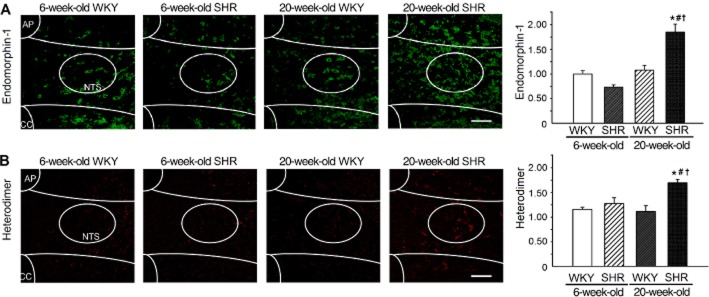
The NTS of hypertensive SHRs contains more endomorphin-1 and μ receptor/α2A-adrenoceptor heterodimers than found in normotensive rats. (A) Immunofluorescence images (green) and the summary results of endomorphin-1 in the NTS of normotensive rats and hypertensive, 20-week-old SHRs. (B) The PLA images (red) and the summary results of μ receptor/α2A-adrenoceptor heterodimers in the NTS of normotensive rats and hypertensive, 20-week-old SHRs. Scale bar: 20 μm. All values are means ± SEM (n = 6). *P < 0.05, significantly different from 6-week-old WKY rats. #P < 0.05, significantly different from 6-week-old SHRs. †P < 0.05, significantly different from 20-week-old WKY rats.
Figure 3
Figure 3
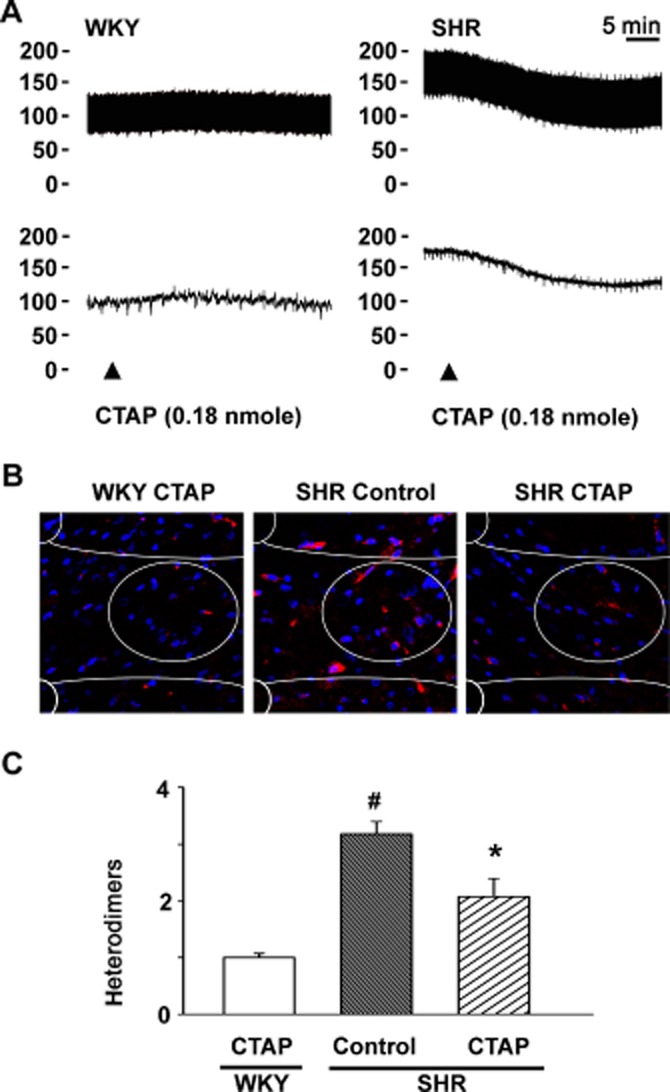
Effects of blocking μ receptors in the NTS of SHRs on μ-opioid receptor/α2A-adrenoceptor heterodimer formation and hypertension. (A) Representative BP recordings of an intra-NTS microinjection of the μ receptor antagonist CTAP in WKY rats and hypertensive SHRs. (B) The PLA images (red) and (C) summary results of μ receptor/α2A-adrenoceptor heterodimers in the NTS of WKY rats and hypertensive SHRs, 30 min after intra-NTS CTAP microinjection. Scale bar: 20 μm. Values shown are means ± SEM (n = 6). #P < 0.05, significantly different from WKY rats. *P < 0.05, significantly different from control SHRs.
Figure 4
Figure 4
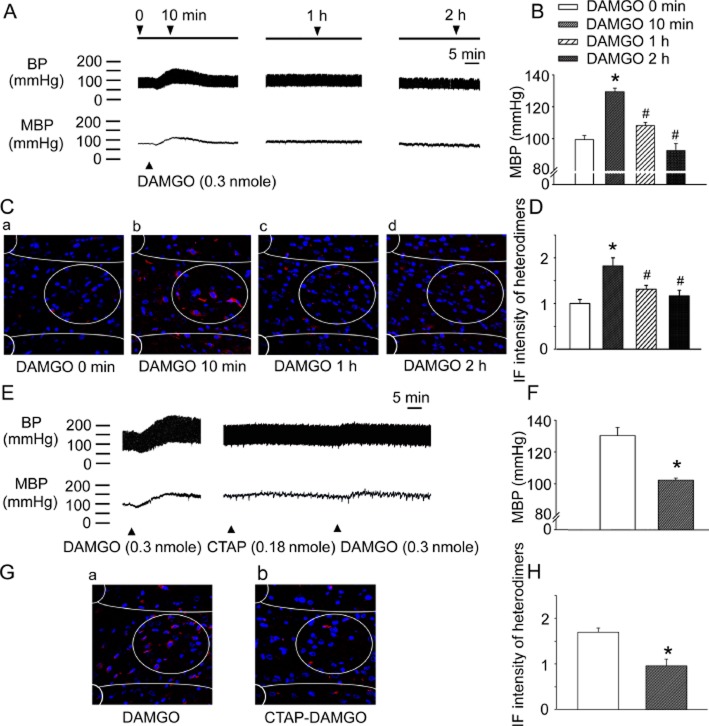
A microinjection of exogenous μ receptor agonist into the NTS of WKY rats induces μ receptor/α2A-adrenoceptor heterodimer formation and BP elevation. (A) Representative BP recordings and (B) the summary results of BP recordings at different time points after intra-NTS DAMGO injection. (C) Representative PLA images (red) and (D) the summary results of μ receptor/α2A-adrenoceptor heterodimers at different time points after intra-NTS. DAMGO microinjection. (E) The representative BP recordings and (F) summary results demonstrate that CTAP blocked the BP-elevating effect of intra-NTS DAMGO administration. (G) The representative PLA images (red) and (H) summary results demonstrate that CTAP pretreatment reduced the DAMGO-induced formation of μ receptor/α2A-adrenoceptor heterodimers. Values shown are means ± SEM (n = 6). *P < 0.01, significantly different from the control group. #P < 0.05, significantly different from the 10 min group. Scale bar: 20 μm.
Figure 5
Figure 5
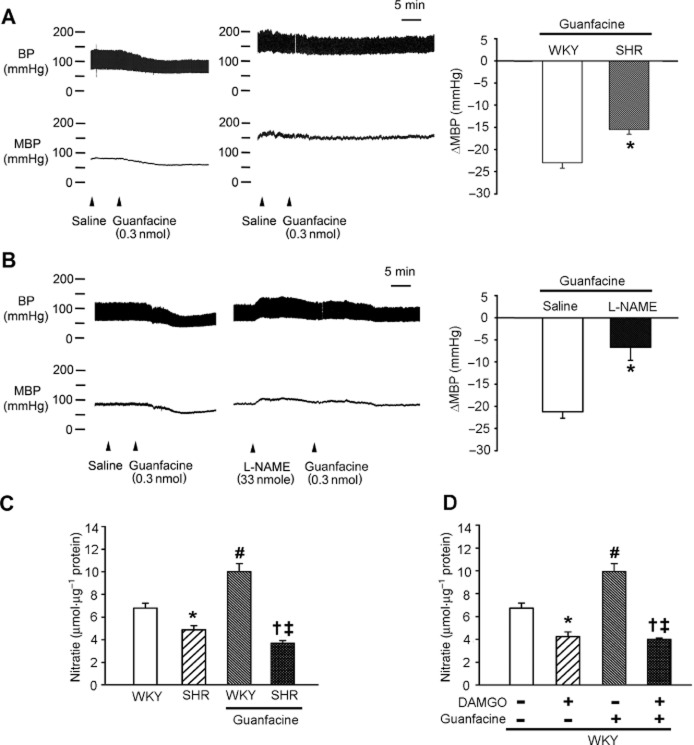
Formation of μ receptor/α2A-adrenoceptor heterodimers impairs the NO-dependent BP-lowering effect of a α2A-adrenoceptor agonist in the NTS. (A) Representative BP recordings and the summary results (means ± SEM; n = 6) of the different BP-lowering effects of guanfacine (the α2A-adrenoceptor agonist) in the NTS of WKY rats and SHRs. *P < 0.05, significantly different from WKY. (B) Representative BP recordings and the summary results (means ± SEM; n = 6) of the effect of the NOS inhibitor L-NAME on the BP-lowering effect of α2A-adrenoceptor activation in the NTS. *P < 0.05, significantly different from saline. (C) A bar graph (means ± SEM; n = 6) illustrating the different NO production in the NTS of WKY rats and SHRs, with or without guanfacine treatment. *P < 0.05, significantly different from WKY; #P < 0.05, significant effect of guanfacine in WKY; †P < 0.05, significant effect of guanfacine in SHR; ‡P < 0.05, significantly different from WKY + guanfacine group. (D) A bar graph (means ± SEM; n = 6) illustrating the differences of NO production in the NTS of WKY rats with or without DAMGO, guanfacine or both types of treatment. *P < 0.05, significant effect of DAMGO; #P < 0.05, significant effect of guanfacine; †P < 0.05, significantly different from DAMGO alone; ‡P < 0.05, significantly different from guanfacine alone
Figure 6
Figure 6
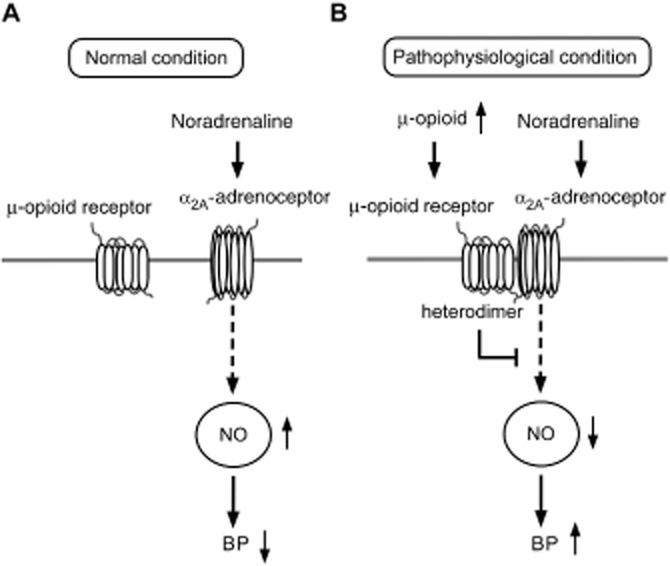
The proposed pathogenetic mechanisms of α2A-adrenoceptor and μ receptor heterodimer induced hypertension in the NTS. (A) Under normal conditions, endogenous noradrenaline binds to α2A-adrenoceptor and increases NO production in the NTS. The physiological concentration of NO in the NTS maintains BP within the normal range. (B) Under pathophysiological conditions that result from environmental factors or genetic abnormalities, the level of endogenous μ-opioid agonists increases in the CNS. These additional peptides can then induce additional μ receptor/α2A-adrenoceptor heterodimer formation. In turn, fewer functional and free α2A-adrenoceptor molecules remain in the NTS; subsequently, less NO is produced, ultimately leading to BP increases.

References

    1. AbdAlla S, Lother H, el Massiery A, Quitterer U. Increased AT(1) receptor heterodimers in preeclampsia mediate enhanced angiotensin II responsiveness. Nat Med. 2001;7:1003–1009. - PubMed
    1. Alexander SP, Benson HE, Faccenda E, Pawson AJ, Sharman JL, McGrath JC, et al. The Concise Guide to PHARMACOLOGY 2013/14: overview. Br J Pharmacol. 2013;170:1449–1458. - PubMed
    1. Altman JD, Trendelenburg AU, MacMillan L, Bernstein D, Limbird L, Starke K, et al. Abnormal regulation of the sympathetic nervous system in alpha2A-adrenergic receptor knockout mice. Mol Pharmacol. 1999;56:154–161. - PubMed
    1. Bhuiyan ME, Waki H, Gouraud SS, Takagishi M, Cui H, Yamazaki T, et al. Complex cardiovascular actions of alpha-adrenergic receptors expressed in the nucleus tractus solitarii of rats. Exp Physiol. 2009;94:773–784. - PubMed
    1. Brede M, Wiesmann F, Jahns R, Hadamek K, Arnolt C, Neubauer S, et al. Feedback inhibition of catecholamine release by two different alpha2-adrenoceptor subtypes prevents progression of heart failure. Circulation. 2002;106:2491–2496. - PubMed

Publication types

MeSH terms