


Stress and the kidney
- PMID: 25573512
- PMCID: PMC4871619
- DOI: 10.1053/j.ackd.2014.06.008
Stress and the kidney
Abstract
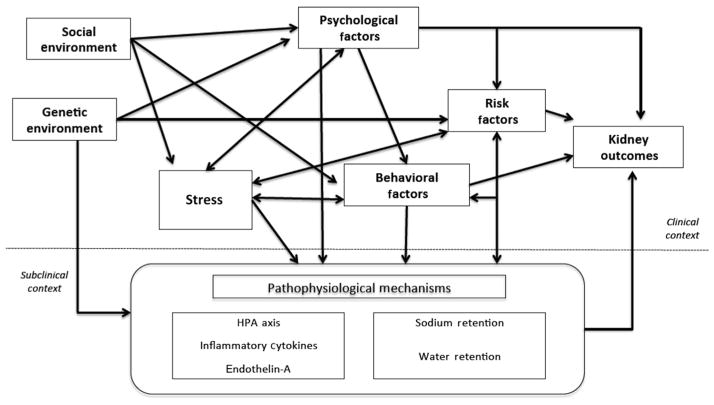
The prevalence of CKD has increased considerably over the past 2 decades. The rising rates of CKD have been attributed to known comorbidities such as diabetes, hypertension, and obesity; however, recent research has begun to explore the degree to which social, economic, and psychological factors have implications for the prevalence and progression of CKD, especially among high-risk populations such as African Americans. It has been suggested that stress can have implications for CKD, but this area of research has been largely unexplored. One contributing factor associated with the paucity of research on CKD is that many of the social, psychological, and environmental stressors cannot be recreated or simulated in a laboratory setting. Social science has established that stress can have implications for health, and we believe that stress is an important determinant of the development and progression of CKD. We draw heavily from the social scientific and social epidemiologic literature to present an intersectional conceptual frame specifying how stress can have implications for kidney disease, its progression, and its complications through multiple stressors and pathways.
Keywords: Kidney disease; Minority health; Psychological stress; Social determinants of health; Socioeconomic factors.
Copyright © 2015 National Kidney Foundation, Inc. Published by Elsevier Inc. All rights reserved.
Figures
References
-
- Harwood L, Wilson B, Sontrop J. Sociodemographic differences in stressful experience and coping amongst adults with chronic kidney disease. J Adv Nurs. 2011;67(8):1779–1789. - PubMed
-
- U.S. Renal Data System. USRDS 2011 Annual Data Report: Atlas of Chronic Kidney Disease and End-Stage Renal Disease in the United States. Bethesda, MD: National Institutes of Health, National Institute of Diabetes and Digestive and Kidney Diseases; 2011.
-
- Crook ED, Patel SR. Diabetic nephropathy in African-American patients. Curr Diab Rep. 2004;4(6):455–461. - PubMed
Publication types
MeSH terms
Grants and funding
LinkOut - more resources
Full Text Sources
Other Literature Sources
Medical
Miscellaneous
