


Treatment of proximal humerus fractures in the elderly: a systemic review of 409 patients
- PMID: 25574643
- PMCID: PMC4443467
- DOI: 10.3109/17453674.2014.999299
Treatment of proximal humerus fractures in the elderly: a systemic review of 409 patients
Abstract
Background and purpose: There is no consensus on the treatment of proximal humerus fractures in the elderly.
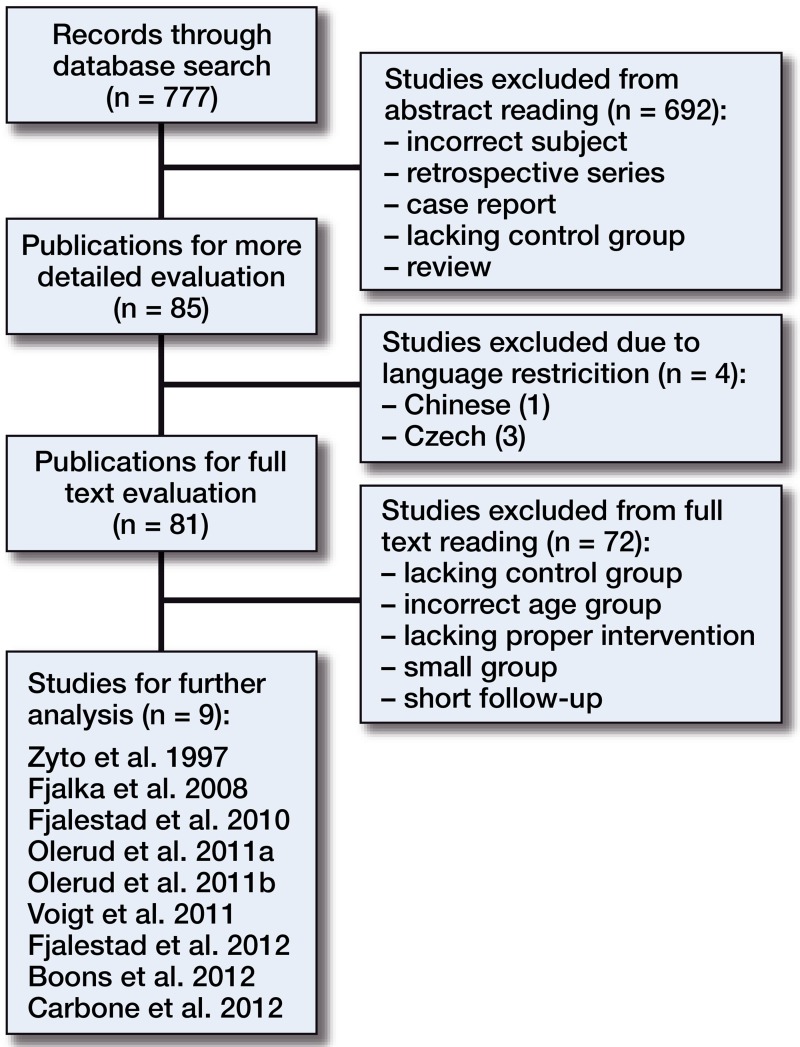
Patients and methods: We conducted a systematic search of the medical literature for randomized controlled trials and controlled clinical trials from 1946 to Apr 30, 2014. Predefined PICOS criteria were used to search relevant publications. We included randomized controlled trials involving 2- to 4-part proximal humerus fractures in patients over 60 years of age that compared operative treatment to any operative or nonoperative treatment, with a minimum of 20 patients in each group and a minimum follow-up of 1 year. Outcomes had to be assessed with functional or disability measures, or a quality-of-life score.
Results: After 2 independent researchers had read 777 abstracts, 9 publications with 409 patients were accepted for the final analysis. No statistically significant differences were found between nonoperative treatment and operative treatment with a locking plate for any disability, for quality-of-life score, or for pain, in patients with 3- or 4-part fractures. In 4-part fractures, 2 trials found similar shoulder function between hemiarthroplasty and nonoperative treatment. 1 trial found slightly better health-related quality of life (higher EQ-5D scores) at 2-year follow-up after hemiarthroplasty. Complications were common in the operative treatment groups (10-29%).
Interpretation: Nonoperative treatment over locking plate systems and tension banding is weakly supported. 2 trials provided weak to moderate evidence that for 4-part fractures, shoulder function is not better with hemiarthroplasty than with nonoperative treatment. 1 of the trials provided limited evidence that health-related quality of life may be better at 2-year follow-up after hemiarthroplasty. There is a high risk of complications after operative treatment.
Figures
Comment in
-
Why do we operate proximal humeral fractures?Acta Orthop. 2015 Jun;86(3):279. doi: 10.3109/17453674.2015.1042321. Epub 2015 Apr 17. Acta Orthop. 2015. PMID: 25885421 Free PMC article. No abstract available.
References
-
- Boons HW, Goosen JH, van Grinsven S, van Susante JL, van Loon CJ. Hemiarthroplasty for humeral four-part fractures for patients 65 years a... . Clin Orthop Relat Res. 2012;470:12, 3483–91. - PMC - PubMed
-
- Brorson S, Rasmussen JV, Frich LH, Olsen BS, Hrobjartsson A. Benefits and harms of locking plate osteosynthesis in intraarticular (OT... . Injury. 2012;43(7):999–1005. - PubMed
-
- Carbone S, Tangari M, Gumina S, Postacchini R, Campi A, Postacchini F. Percutaneous pinning of three- or four-part fractures of the proximal hu... . Int Orthop. 2012;36(6):1267–73. - PMC - PubMed
-
- Cazeneuve JF, Cristofari DJ. Grammont reversed prosthesis for acute complex fracture of the proximal ... . Orthop Traumatol Surg Res. 2014;100(1):93–7. - PubMed
-
- Court-Brown CM, Caesar B. Epidemiology of adult fractures: A review . Injury. 2006;37(8):691–7. - PubMed
Publication types
MeSH terms
LinkOut - more resources
Full Text Sources
Other Literature Sources
Medical
Miscellaneous