


Indacaterol, a once-daily beta2-agonist, versus twice-daily beta₂-agonists or placebo for chronic obstructive pulmonary disease
- PMID: 25575340
- PMCID: PMC6464646
- DOI: 10.1002/14651858.CD010139.pub2
Indacaterol, a once-daily beta2-agonist, versus twice-daily beta₂-agonists or placebo for chronic obstructive pulmonary disease
Abstract
Background: Indacaterol is an inhaled long-acting beta2-agonist that is administered once daily and has been investigated as a treatment for chronic obstructive pulmonary disease (COPD). Four different doses have been investigated (75 mcg, 150 mcg, 300 mcg and 600 mcg). The relative effects of different doses of once-daily indacaterol in the management of patients with COPD are uncertain.
Objectives: To compare the efficacy and safety of indacaterol versus placebo and alternative twice-daily long-acting beta2-agonists for the treatment of patients with stable COPD.
Search methods: We identified trials from the Cochrane Airways Group Specialised Register of trials (CAGR), handsearched respiratory journals and meeting abstracts and searched the Novartis trials registry and ClinicalTrials.gov. The date of the most recent search was 8 November 2014.
Selection criteria: We included all randomised controlled trials comparing indacaterol at any dose versus placebo or alternative long-acting beta2-agonists. Trials were required to be of at least 12 weeks' duration and had to include adults older than 18 years with a confirmed spirometric diagnosis of COPD.
Data collection and analysis: Two review authors (JBG, EJD) independently assessed for possible inclusion all citations identified as a result of the search. Disagreements were resolved through discussion or, if required, through resolution by a third review author (RWB). One review author (JBG) extracted data from trials identified by the search and entered these data into Review Manager 5.1 for statistical analysis. Data entry was cross-checked by a second review author (EJD, CJC).
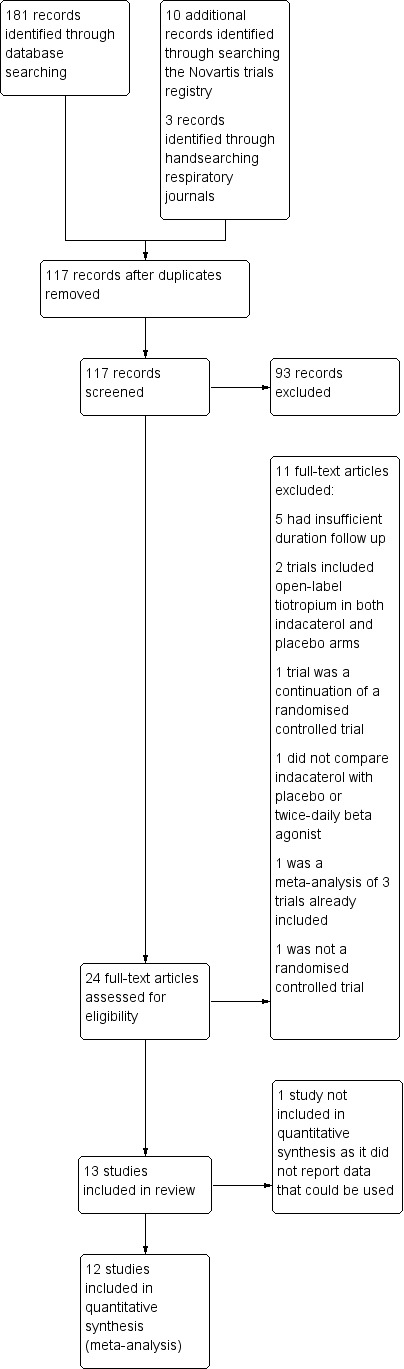
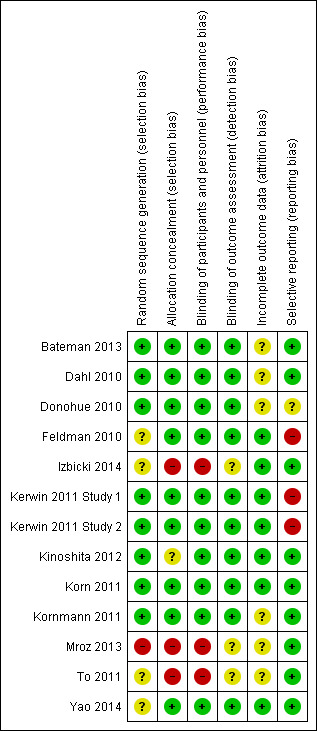
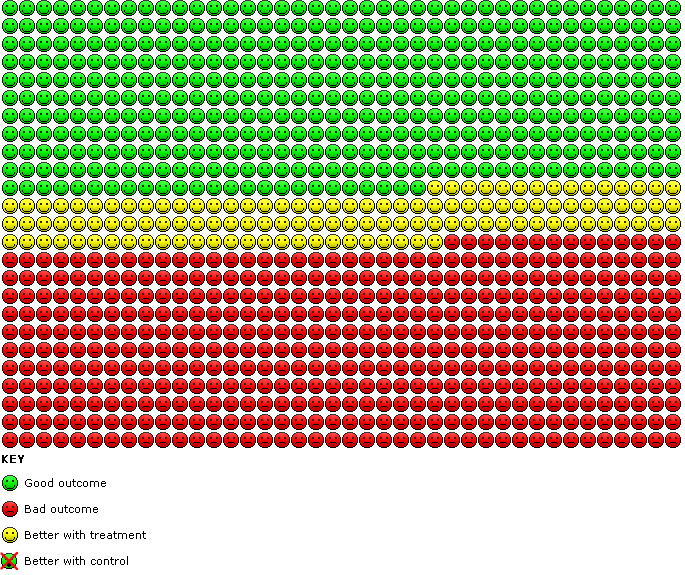
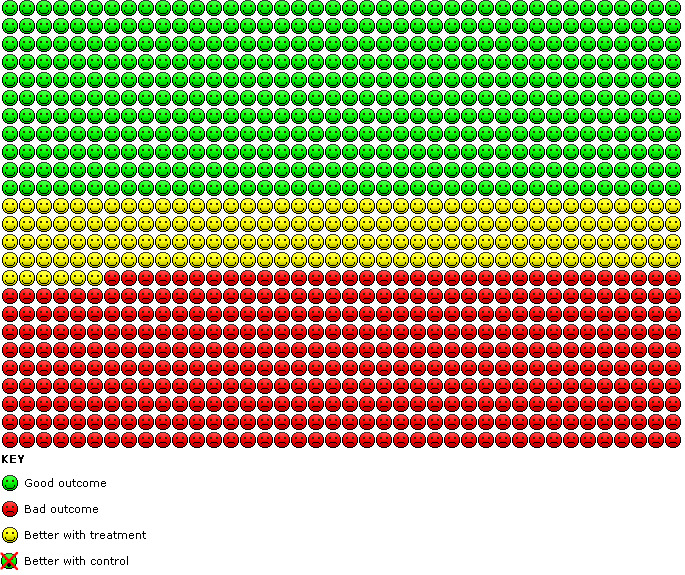
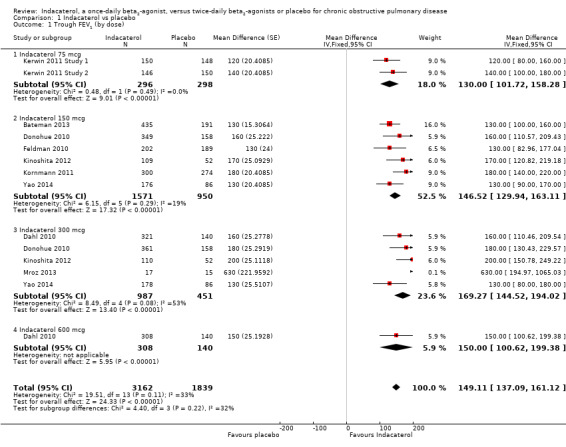
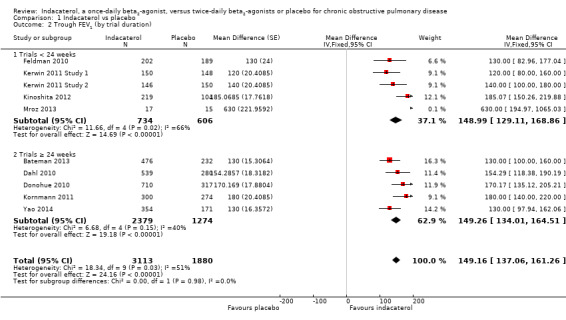
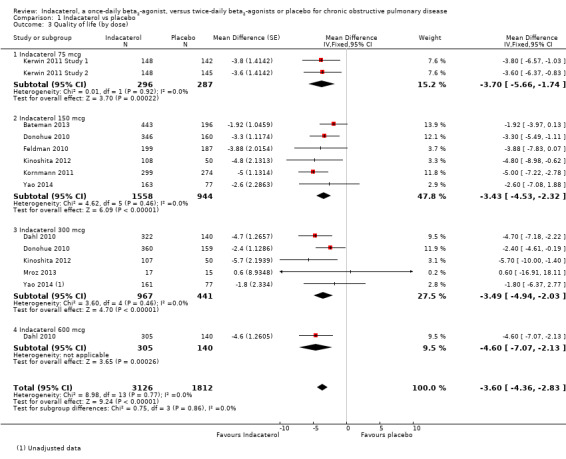
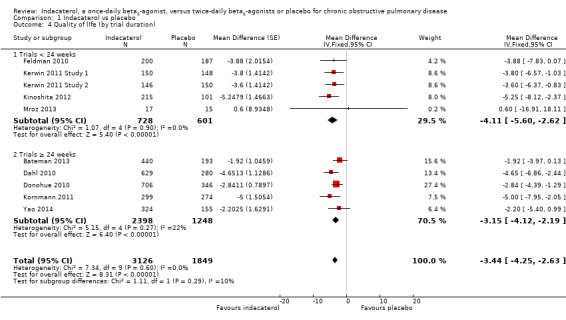
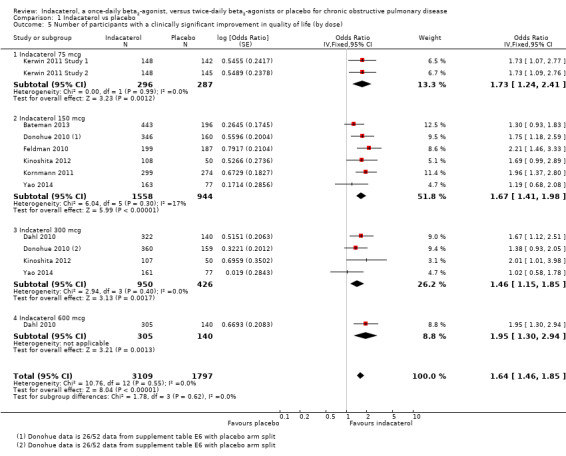
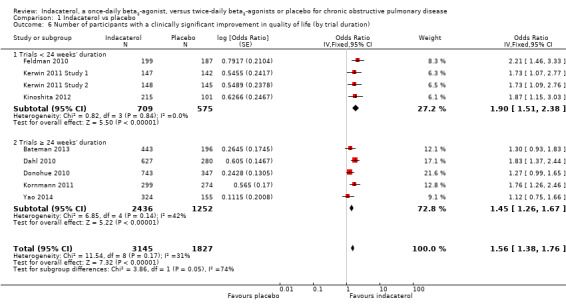
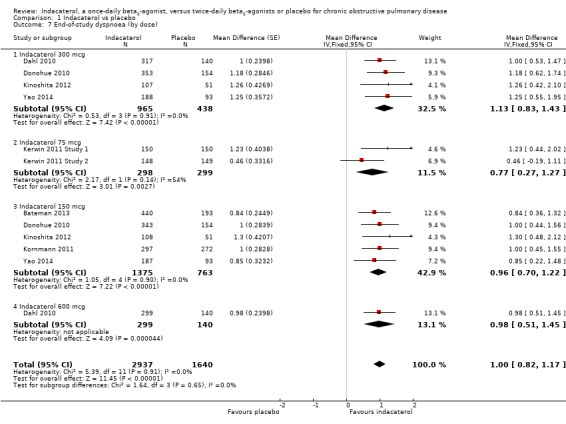
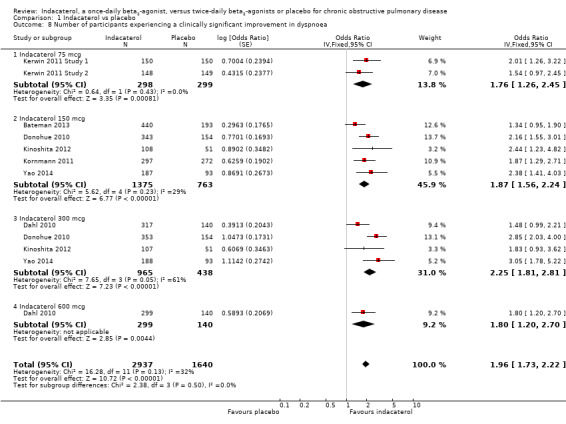
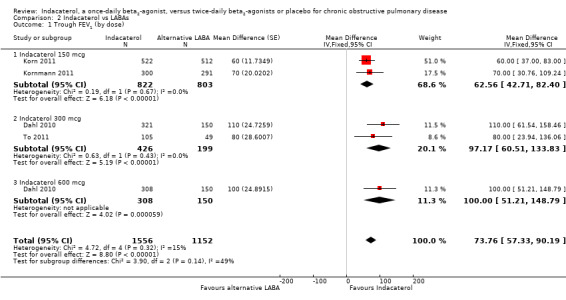
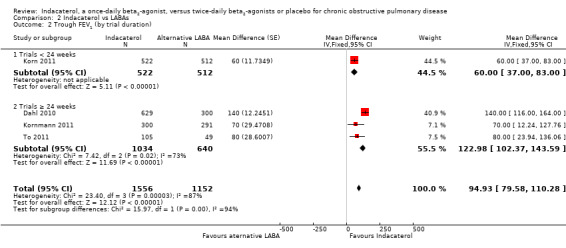
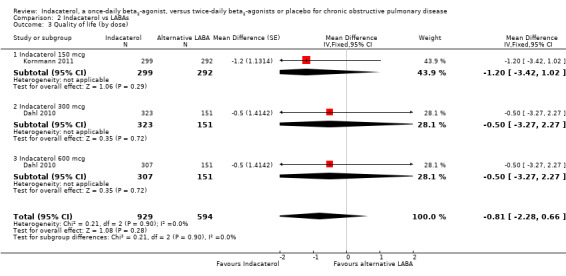
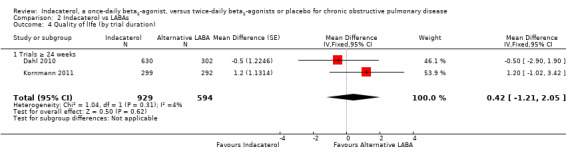
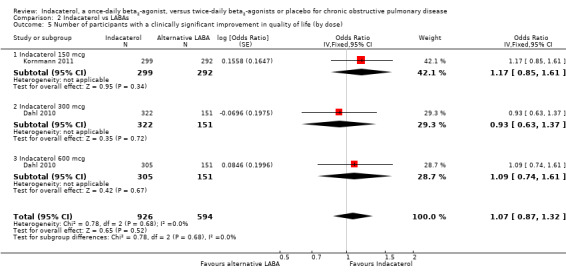
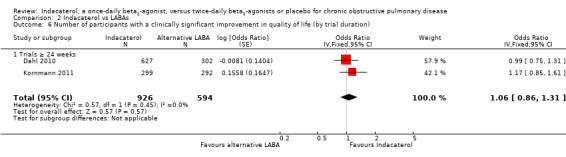
Main results: A total of 13 trials with 9961 participants were included in the review. Ten trials with a total of 8562 participants involved an indacaterol versus placebo comparison. Five trials with a total of 4133 participants involved an indacaterol versus twice-daily beta2-agonist comparison. The comparator beta2-agonists were salmeterol, formoterol and eformoterol. One of these trials, with a total of 90 participants, provided no data that could be used in this review. Two trials included both indacaterol versus placebo and indacaterol versus twice-daily beta2-agonist comparisons. Trials were between 12 weeks and 52 weeks in duration. Overall the quality of the evidence was strong, and risk of significant bias was minimal in most of the included studies. Enrolled participants had stable COPD across a range of spirometric severities. Forced expiratory volume in 1 second (FEV1) was generally between 30% and 80% predicted, and a mean FEV1 of approximately 50% was predicted in most studies. Patients with concurrent respiratory disease, including asthma, were excluded. Concomitant use of inhaled corticosteroids was permitted.The primary objectives were to compare trough FEV1 at the end of dosing, exacerbation rates and quality of life. Significant adverse events, mortality and dyspnoea were included as secondary outcomes. Compared with placebo, a significant and clinically relevant improvement in trough FEV1 was noted with indacaterol (mean difference (MD) 149.11, 95% confidence interval (CI) 137.09 to 161.12). In addition, compared with placebo, a significant improvement in mean St George Respiratory Questionaire (SGRQ) score (MD -3.60, 95% CI -4.36 to -2.83) was reported, and the proportion of participants experiencing clinically relevant improvement in SGRQ score was significantly greater (odds ratio (OR) 1.63, 95% CI 1.46 to 1.84). Compared with twice-daily beta2-agonists, a small but statistically significant increase in trough FEV1 was seen with indacaterol (MD 61.71 mL, 95% CI 41.24 to 82.17). Differences between indacaterol and twice-daily beta2-agonists in mean SGRQ scores (MD -0.81, 95% CI -2.28 to 0.66) and in the proportions of participants achieving clinically relevant improvements in SGRQ scores (OR 1.07, 95% CI 0.87 to 1.32) were not statistically significant, but the confidence intervals are too wide to permit the conclusion that the treatments were equivalent. Data were insufficient for analysis of differences in exacerbation rates for both placebo and twice-daily beta2-agonist comparisons.
Authors' conclusions: For patients with stable COPD, use of indacaterol versus placebo results in statistically significant and clinically meaningful improvements in lung function and quality of life. The clinical benefit for lung function is at least as good as that seen with twice-daily long-acting beta2-agonists. The comparative effect on quality of life remains uncertain, as important differences cannot be excluded.
Conflict of interest statement
JBG: none known.
EJD: none known.
RWB: none known.
CJC: As CC is the Co‐ordinating Editor of the Cochrane Airways Group, editing and the peer review process for this review were handled by another editor, Milo Puhan.
Figures
Update of
References
References to studies included in this review
Bateman 2013 {published and unpublished data}
Dahl 2010 {published and unpublished data}
-
- Dahl R, Chung KF, Buhl R, Magnussen H, Nonikov V, Jack D, et al. Efficacy of a new once‐daily long‐acting inhaled beta2‐agonist indacaterol versus twice‐daily formoterol in COPD. Thorax 2010;65:473‐9. - PubMed
-
- Magnussen H, Paggiaro P, Jack D, Owen R, Higgins M, Kramer B. Bronchodilator treatment with indacaterol once‐daily vs formoterol twice‐daily in COPD: a 52‐week study. American Thoracic Society International Conference; 2009 May 15‐20 San Diego. 2009.
-
- Magnussen H, Paggiaro P, Jack D, Owen R, Higgins M, Kramer B. Indacaterol once‐daily improves health‐related quality of life (HRQOL) in COPD: a 52‐week study. European Respiratory Society 19th Annual Congress; 2009 Sep 12‐15; Vienna. 2009.
Donohue 2010 {published and unpublished data}
-
- Donahue JF, Fogarty C, Lotvall J, Mahler D, Worth H, Yorgancioglu A, et al. Once‐daily bronchodilators for chronic obstructive pulmonary disease. American Journal of Respiratory and Critical Care Medicine 2010;182(2):155‐62. - PubMed
Feldman 2010 {published and unpublished data}
Izbicki 2014 {published and unpublished data}
-
- Izbicki G, Shitrit D, Raz M, Vilayi‐Weiler Z, Fink G, Schwarz Y, et al. Real‐life efficacy of indacaterol and other LABAs in COPD patients in Israel. Chest 2014;145(3):431B. [DOI: 10.1378/chest.1829807] - DOI
Kerwin 2011 Study 1 {published and unpublished data}
-
- Gotfried M, Kerwin E, Lawrence D, Lassen C, Kramer B. Efficacy of Indacaterol 75mcg once‐daily on dyspnea and health status: results of two double‐blind, placebo‐controlled 12‐week studies. COPD 2012;9(6):629‐36. - PubMed
-
- Kerwin E, Gotfried M, Lawrence D, Lassen C, Kramer B. Efficacy and tolerability of indacaterol 75mcg once daily in patients aged > 40 years with chronic obstructive pulmonary disease: results from 2 double‐blind, placebo‐controlled 12 week studies. Clinical Therapeutics 2011;33(12):1974‐84. - PubMed
Kerwin 2011 Study 2 {published and unpublished data}
-
- Gotfried M, Kerwin E, Lawrence D, Lassen C, Kramer B. Efficacy of Indacaterol 75mcg once‐daily on dyspnea and health status: results of two double‐blind, placebo‐controlled 12‐week studies. COPD 2012;9(6):629‐36. - PubMed
-
- Kerwin E, Gotfried M, Lawrence D, Lassen C, Kramer B. Efficacy and tolerability of indacaterol 75mcg once daily in patients aged > 40 years with chronic obstructive pulmonary disease: results from 2 double‐blind, placebo‐controlled 12 week studies. Clinical Therapeutics 2011;33(12):1974‐84. - PubMed
Kinoshita 2012 {published and unpublished data}
-
- Kinoshita M, Lee SH, Hang LW, Ichinose M, Hosoe M, Okino N, et al. Efficacy and safety of indacaterol 150 and 300 mcg in chronic obstructive pulmonary disease patients from six Asian areas including Japan: a 12‐week placebo controlled study. Respirology 2012;17:379‐89. - PubMed
-
- To Y, Kinoshita M, Lee SH, Hang LW, Ichinose M, Fukuchi Y, et al. Assessing efficacy of indacaterol in moderate and severe COPD patients: a 12‐week study in an Asian population. Respiratory Medicine 2012;106:1715‐21. - PubMed
Korn 2011 {published data only}
-
- Korn S, Kerwin E, Atis S, Amos C, Owen R, Lassen C. Indacaterol once‐daily provides superior efficacy to salmeterol twice‐daily in COPD: a 12‐week study. Respiratory Medicine 2011;105:719‐26. - PubMed
Kornmann 2011 {published data only}
-
- Kornmann O, Dahl R, Centanni S, Dogra A, Owen R, Lassen C, et al. Once‐daily indacaterol versus twice‐daily salmeterol for COPD: a placebo‐controlled comparison. European Respiratory Journal 2011;37:273‐9. - PubMed
Mroz 2013 {published and unpublished data}
To 2011 {unpublished data only}
-
- To Y, Nishimura M, Fukuchi Y, Kitawaki T, Okino N, Lassen C, et al. Long‐term safety and tolerability of indacaterol versus salmeterol in Japanese COPD patients: a 52‐week open‐labeled study. Respirology 2011;16(2):96.
Yao 2014 {published and unpublished data}
References to studies excluded from this review
Barnes 2010 {published and unpublished data}
-
- Barnes PJ, Pocock SJ, Magnussen H, Iqbal A, Kramer B, Higgins M, et al. Integrating indacaterol dose selection in a clinical study in COPD using an adaptive seamless design. Pulmonary Pharmacology and Therapeutics 2010;23(3):165‐71. - PubMed
Beeh 2011 {published and unpublished data}
-
- Beeh KM, Wagner F, Khindri S, Drollmann AF. Effect of indacaterol on dynamic lung hyperinflation and breathlessness in hyperinflated patients with COPD. COPD 2011;8(5):340‐5. - PubMed
Buhl 2011 {published and unpublished data}
-
- Buhl R, Dunn LJ, Disdier C, Lassen C, Amos C, Henley M, et al. Blinded 12‐week comparison of once‐daily indacaterol and tiotropium in COPD. European Respiratory Journal 2011;38(4):797‐803. - PubMed
Chapman 2011 {published and unpublished data}
-
- Chapman KR, Rennard SI, Dogra A, Owen R, Lassen C, Kramer B. Long‐term safety and efficacy of indacaterol, a long‐acting beta2‐agonist, in subjects with COPD: a randomized, placebo‐controlled study. Chest 2011;140(1):68‐75. - PubMed
Hataji 2013 {published and unpublished data}
Jones 2011 {published and unpublished data}
-
- Jones PW, Mahler DA, Gale R, Owen R, Kramer B. Profiling the effects of indacaterol on dyspnoea and health status in patients with COPD. Respiratory Medicine 2011;105(6):892‐9. - PubMed
Khindri 2011 {published and unpublished data}
-
- Beeh KM, Wagner F, Khindri S, Drollmann AF. Effect of indacaterol on dynamic lung hyperinflation and breathlessness in hyperinflated patients with COPD. COPD 2011;8(5):340‐5. - PubMed
Magnussen 2010 {published and unpublished data}
-
- Magnussen H, Verkindre C, Jack D, Jadayel D, Henley M, Woessner R, et al. Indacaterol once‐daily is equally effective dosed in the evening or morning in COPD. Respiratory Medicine 2010;104(12):1869‐76. - PubMed
Mahler 2012 Study 1 {published and unpublished data}
-
- Mahler DA, D'Urzo A, Bateman ED, Ozkan S, White T, Peckitt C, et al. Concurrent use of indacaterol plus tiotropium in patients with COPD provides superior bronchodilation compared with tiotropium alone: a randomised double‐blind comparison. Thorax 2012;67:781‐8. - PubMed
Mahler 2012 Study 2 {published and unpublished data}
-
- Mahler DA, D'Urzo A, Bateman ED, Ozkan S, White T, Peckitt C, et al. Concurrent use of indacaterol plus tiotropium in patients with COPD provides superior bronchodilation compared with tiotropium alone: a randomised double‐blind comparison. Thorax 2012;67:781‐8. - PubMed
Van de Maele 2010 {published and unpublished data}
-
- Maele B, Fabbri LM, Martin C, Horton R, Dolker M, Overend T. Cardiovascular safety of QVA149, a combination of Indacaterol and NVA237, in COPD patients. COPD 2010;7(6):418‐27. - PubMed
References to ongoing studies
CQVA149A2336 {published and unpublished data}
-
- Novartis Pharmaceuticals. A 12‐week treatment, multi‐centre, randomized, double‐blind, parallel‐group, placebo and active controlled study to assess the efficacy, safety, and tolerability of indacaterol maleate/glycopyrronium bromide in COPD patients with moderate to severe airflow limitation. http://www.novctrd.com/ctrdWebApp/clinicaltrialrepository/public/product... (accessed 8 February 2014).
Novartis CQAB149BIL01 {published and unpublished data}
-
- Novartis. A 12‐week multi‐centre randomised open label study evaluating the efficacy and safety of treatment regimens that include onbrez (indacaterol) in patients with moderate to severe COPD (MOVE‐ON). http://www.novctrd.com/ctrdWebApp/clinicaltrialrepository/displayFile.do... (accessed 9 May 2013).
Novartis CQVA149A2337 {published and unpublished data}
-
- Novartis Pharmaceuticals. A 12‐week treatment, multi‐centre, randomised, double‐blind, parallel‐group, placebo and active controlled study to assess the efficacy, safety and tolerability of indacaterol maleate/glycopyrronium bromide in COPD patients with moderate to severe airflow limitation. http://www.clinicaltrials.gov/ct2/show/NCT01712516?term=NCT01712516&... (accessed on 17 September 2014).
Additional references
Buist 2007
-
- Buist AS, McBurnie MA, Vollmer WM, Gillespie S, Burney P, Mannino DM, et al. International variation in the prevalence of COPD (the BOLD Study): a population‐based prevalence study. Lancet 2007;370(9589):741‐50. [PUBMED: 17765523] - PubMed
Chung 2013
Decramer 2012
-
- Decramer M, Rossi A, Lawrence D, McBryan D. Indacaterol therapy in patients with COPD not receiving other maintenance treatment. Respiratory Medicine 2012;106:1706‐14. - PubMed
Donahue 2005
-
- Donahue JF. Minimal clinically important differences in COPD lung function. COPD 2005;2(1):111‐24. - PubMed
Gershon 2010
-
- Gershon AS, Wang C, Wilton AS, Raut R, To T. Trends in chronic obstructive pulmonary disease prevalence, incidence, and mortality in Ontario, Canada, 1996 to 2007: a population‐based study. Archives of Internal Medicine 2010;170(6):560‐5. [PUBMED: 20308643] - PubMed
GOLD 2014
-
- Global Initiative for Chronic Obstructive Lung Disease. Global strategy for the diagnosis, management, and prevention of chronic obstructive pulmonary disease. http://www.goldcopd.org/uploads/users/files/GOLD_Report_2014_Jan23.pdf (accessed 12 March 2014).
Han 2013
Higgins 2011
-
- Higgins JPT, Green S (editors). Cochrane Handbook for Systematic Reviews of Interventions Version 5.1 [updated March 2011]. The Cochrane Collaboration, 2011. www.cochrane‐handbook.org.
Jiang 2013
-
- Jiang FM, Liang ZA, Zheng QL, Wang RC, Li CT. Safety and efficacy of 12‐week or longer indacaterol treatment in moderate‐to‐severe COPD patients: a systematic review. Lung 2013;191:135‐46. - PubMed
Jones 2002
-
- Jones PW. Interpreting thresholds for a clinically significant change in health status in asthma and COPD. European Respiratory Journal 2002;19(3):398‐404. - PubMed
Renard 2011
-
- Renard D, Looby M, Kramer B, Lawrence D, Morris D, Stanski D. Characterization of the bronchodilatory dose response to indacaterol in patients with chronic obstructive pulmonary disease using model‐based approaches. Respiratory Research 2011;12(1):54. [DOI: 10.1186/1465-9921-12-54] - DOI - PMC - PubMed
RevMan 2011 [Computer program]
-
- The Nordic Cochrane Centre, The Cochrane Collaboration. Review Manager (RevMan). Version 5.1. Copenhagen: The Nordic Cochrane Centre, The Cochrane Collaboration, 2011.
Ribeiro 2012
Rodrigo 2012
-
- Rodrigo G, Neffen H. Comparison of indacaterol with tiotropium or twice‐daily long‐acting beta agonists for stable COPD. Chest 2012;145(5):1104‐10. - PubMed
WHO 2008
-
- World Health Organization. World Health Statistics. www.who.int/whosis/whostat/2008/en/index.html (accessed 3 September 2012).
Witek 2003
-
- Witek TJ, Mahler DA. Minimal important difference of the transition dyspnoea index in a multinational clinical trial. European Respiratory Journal 2003;21(2):267‐72. - PubMed
Publication types
MeSH terms
Substances
LinkOut - more resources
Full Text Sources
