


Identification of oxidized phospholipids in bronchoalveolar lavage exposed to low ozone levels using multivariate analysis
- PMID: 25575758
- PMCID: PMC4375957
- DOI: 10.1016/j.ab.2014.12.018
Identification of oxidized phospholipids in bronchoalveolar lavage exposed to low ozone levels using multivariate analysis
Abstract
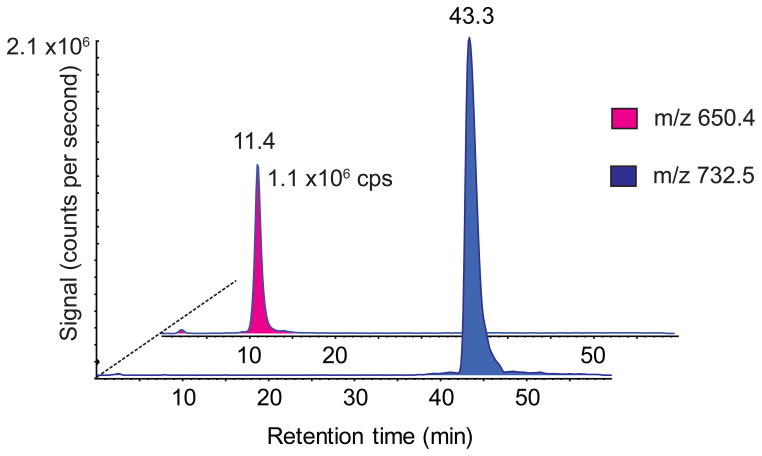
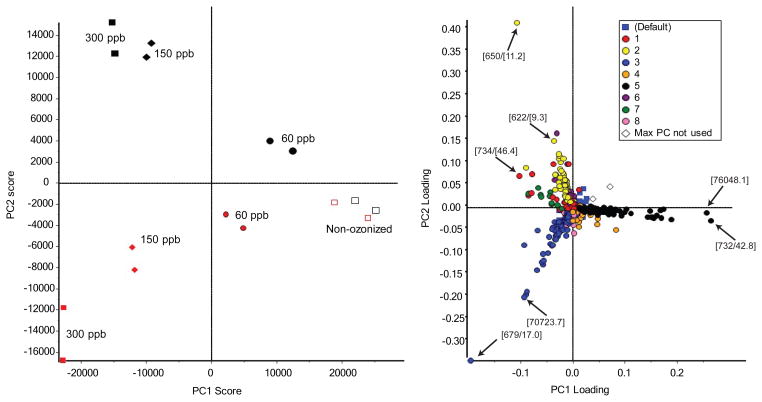
Chemical reactions with unsaturated phospholipids in the respiratory tract lining fluid have been identified as one of the first important steps in the mechanisms mediating environmental ozone toxicity. As a consequence of these reactions, complex mixtures of oxidized lipids are generated in the presence of mixtures of non-oxidized naturally occurring phospholipid molecular species, which challenge methods of analysis. Untargeted mass spectrometry and statistical methods were employed to approach these complex spectra. Human bronchoalveolar lavage (BAL) was exposed to low levels of ozone, and samples with and without derivatization of aldehydes were analyzed by liquid chromatography electrospray ionization tandem mass spectrometry. Data processing was carried out using principal component analysis (PCA). Resulting PCA scores plots indicated an ozone dose-dependent increase, with apparent separation between BAL samples exposed to 60 ppb ozone and non-exposed BAL samples as well as a clear separation between ozonized samples before and after derivatization. Corresponding loadings plots revealed that more than 30 phosphatidylcholine (PC) species decreased due to ozonation. A total of 13 PC and 6 phosphatidylglycerol oxidation products were identified, with the majority being structurally characterized as chain-shortened aldehyde products. This method exemplifies an approach for comprehensive detection of low-abundance, yet important, components in complex lipid samples.
Keywords: Lung; Mass spectrometry; Oxidized lipids; Ozone; Principal component analysis; Pulmonary surfactant.
Copyright © 2015 Elsevier Inc. All rights reserved.
Figures

References
-
- Mudway IS, Kelly FJ. Ozone and the lung: a sensitive issue. Mol Aspects Med. 2000;21:1–48. - PubMed
-
- Chiba H, Piboonpocanun S, Mitsuzawa H, Kuronuma K, Murphy RC, Voelker DR. Pulmonary surfactant proteins and lipids as modulators of inflammation and innate immunity. Respirology. 2006;11(Suppl):S2–6. - PubMed
-
- Wright JR. Immunomodulatory functions of surfactant. Physiol Rev. 1997;77:931–962. - PubMed
Publication types
MeSH terms
Substances
Grants and funding
LinkOut - more resources
Full Text Sources
Other Literature Sources
Medical
Research Materials
