. 2015 Feb 20;6(5):2615-22.
doi: 10.18632/oncotarget.2811.

Tumor-targeting Salmonella typhimurium A1-R arrests growth of breast-cancer brain metastasis

Affiliations

Tumor-targeting Salmonella typhimurium A1-R arrests growth of breast-cancer brain metastasis

Yong Zhang et al. Oncotarget. .

Abstract

Brain metastasis is a morbid, treatment-resistant, end-stage frequent occurrence in breast cancer patients. The aim of this study was to evaluate the efficacy of tumor-targeting Salmonella typhimurium A1-R on breast cancer brain metastases. High brain-metastatic variants of murine 4T1 breast cancer cells expressing red fluorescent protein (RFP) were injected orthotopically in the mammary fat pad in non-transgenic nude mice or in the left ventricle of non-transgenic nude mice and transgenic nude mice expressing nestin-driven green fluorescent protein (ND-GFP). ND-GFP mice express GFP in nascent blood vessels. In the orthotopically-injected mice, the primary tumor was surgically-resected in order to allow brain metastasis to develop. At various time points, the tumors and vasculature in the brain were imaged by confocal and stereo fluorescence microscopy. Some of the breast cancer cells that reached the brain extravasated and grew perivascularly and some of the cells proliferated within the vasculature. S. typhimurium A1-R significantly inhibited brain metastasis in both metastatic models and increased survival of the orthotopically-transplanted, primary-tumor-resected mice (p<0.05). The results of the present study suggest the clinical potential of bacterial therapy of breast cancer brain metastasis.


Figures
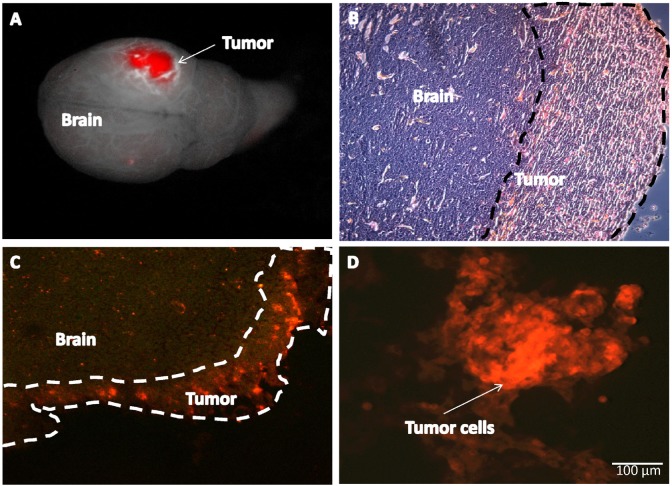
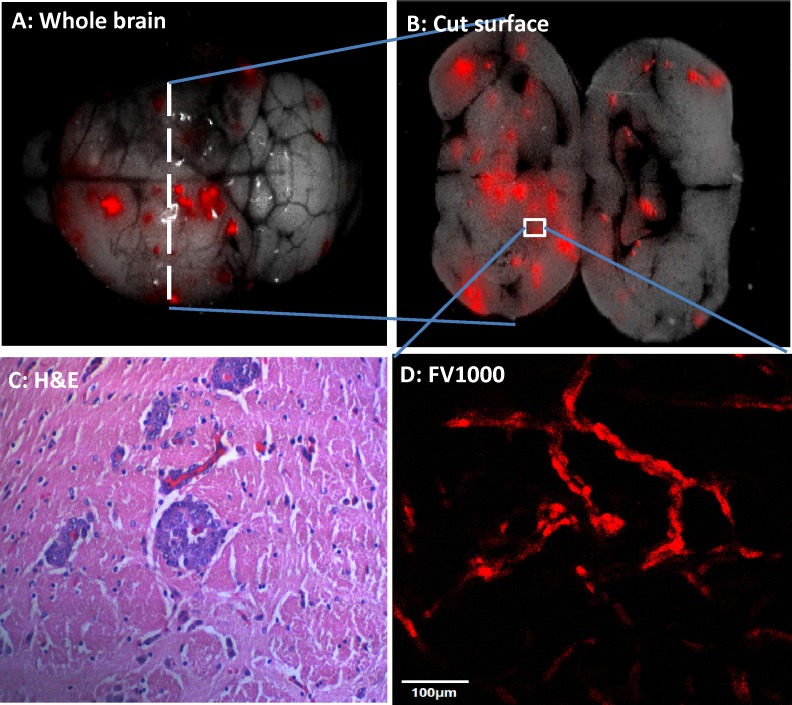
Figure 1
Figure 1. Brain metastasis of RFP 4T1 in nude mice
A: 4T1 RFP brain metastasis in mice two weeks after resection of the primary tumor. Images were obtained with the Maestro fluorescence imaging system. B: Metastatic breast tumor in the brain cortex (H&E stain) (magnification 200x). C: Frozen sections were observed with an IV-100 scanning laser microscope equipped with 488 nm argon laser (Olympus Corp, Tokyo, Japan). D: 4T1-RFP breast cancer cells were isolated from brain metastasis for further rounds of in vivo selection of brain metastasis. Cells observed in vitro with an IX71 inverted microscope (Olympus) (Bar = 100 μm).
Figure 2
Figure 2. Brain metastasis after cardiac ventrical injection of high brain-metastatic variants
4T1-RFP cells were injected into the left cardiac ventricle of female nude mice. (A) Intact brain with metastases. (B) Metastases were located in both cerebral hemispheres. (C) H&E stain demonstrates thrombosis-like infarction of the brain parenchyma (agnification 200x). (D) Intravascular metastases appears to follow blood vessels (confocal fluorescence microscopy). Bar = 100 μm.
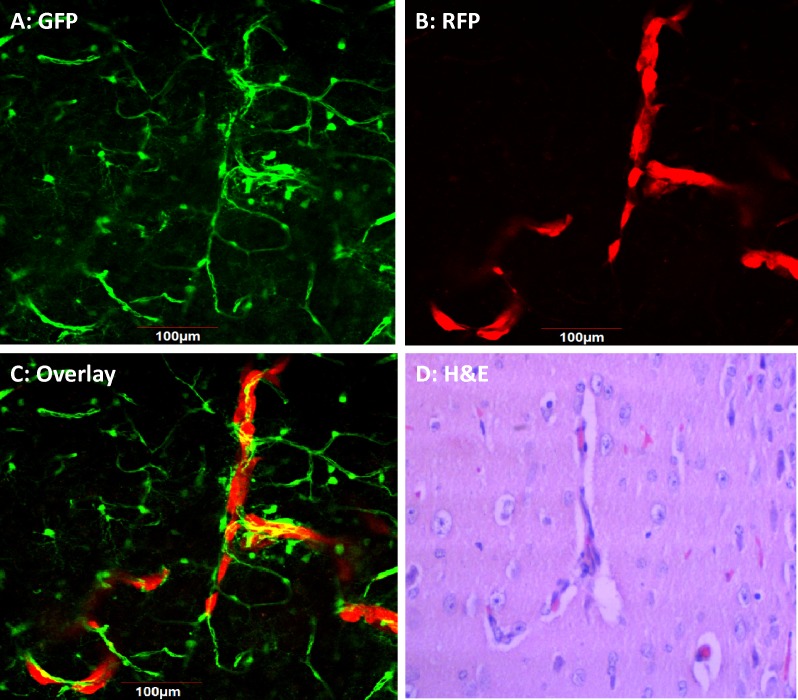
Figure 3
Figure 3. Intravascular growth of breast cancer brain metastasis in nestin-driven GFP (ND-GFP) nude mice
4T1-RFP cells were injected into the left cardiac ventricle of female ND-GFP nude mice. Intact brains were recovered from mice on days 7-20 after injection. (A) ND-GFP-expressing blood vessels. (B) RFP-expressing metastases. (C) Merged image of GFP blood vessels and RFP metastases. (A-C) Confocal fluorescence microscopy. (D) H&E staining of a thin-section (from the area of C).
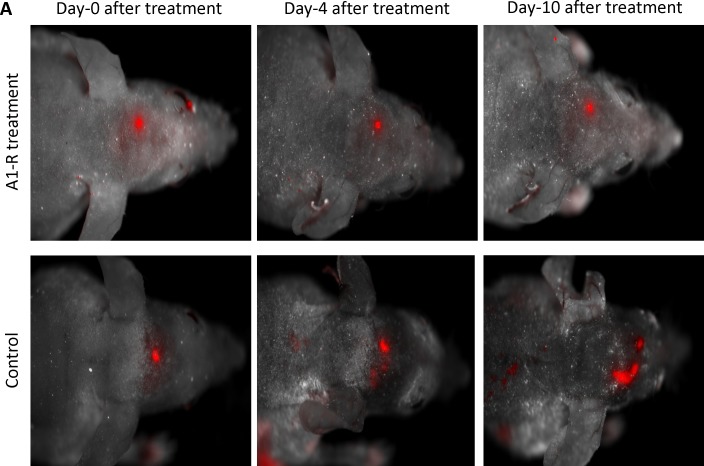
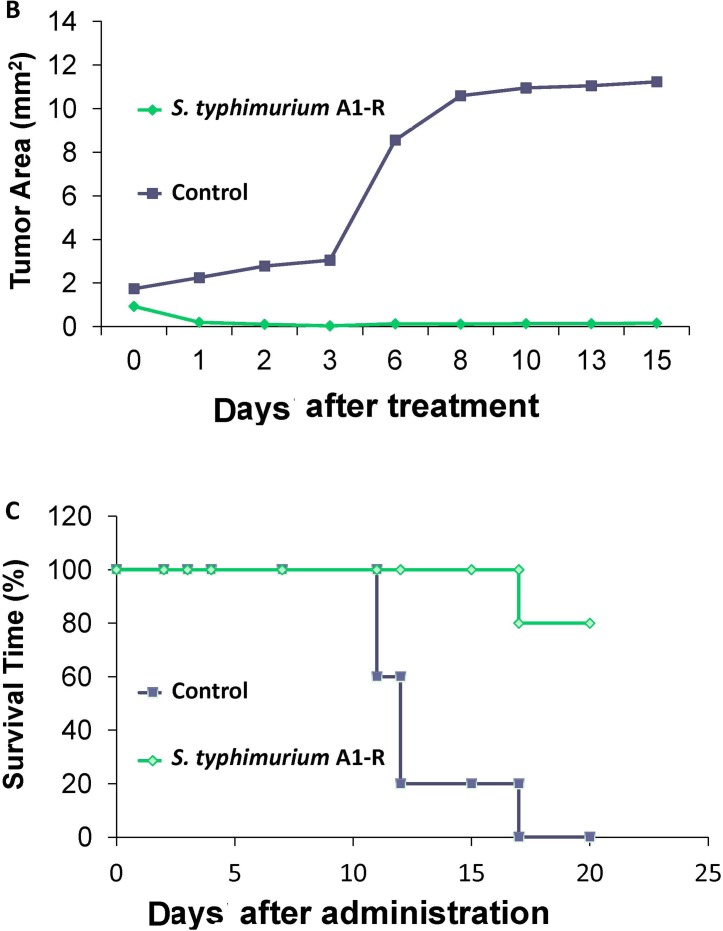
Figure 4
Figure 4. Efficacy of S. typhimurium A1-R on the growth of 4T1-RFP brain metastases and mouse survival
(A) Nude mice with brain metastatic 4T1-RFP two weeks after surgical removal of orthotopic primary tumor. Mice were injected i.v. with S. typhimurium A1-R (5 × 10⁷ CFU in 100 μl PBS). Tumors were visualized with the Maestro fluorescence imaging system at indicated time points after infection. (Upper row): S. typhimurium A1-R treated mice. (Lower row): Control mice. (B) Growth curve of brain metastasis in control and S. typhimurium A1-R-treated mice (p<0.01). (C) Efficacy of S. typhimurium A1-R on survival of nude mice with 4T1-RFP breast cancer brain metastasis formed from orthotopic implantation and primary tumor resection. Survival of the S. typhimurium A1-R-treated animals was prolonged as shown by Kaplan Meier curves (p=0.005)
Figure 4
Figure 4. Efficacy of S. typhimurium A1-R on the growth of 4T1-RFP brain metastases and mouse survival
(A) Nude mice with brain metastatic 4T1-RFP two weeks after surgical removal of orthotopic primary tumor. Mice were injected i.v. with S. typhimurium A1-R (5 × 10⁷ CFU in 100 μl PBS). Tumors were visualized with the Maestro fluorescence imaging system at indicated time points after infection. (Upper row): S. typhimurium A1-R treated mice. (Lower row): Control mice. (B) Growth curve of brain metastasis in control and S. typhimurium A1-R-treated mice (p<0.01). (C) Efficacy of S. typhimurium A1-R on survival of nude mice with 4T1-RFP breast cancer brain metastasis formed from orthotopic implantation and primary tumor resection. Survival of the S. typhimurium A1-R-treated animals was prolonged as shown by Kaplan Meier curves (p=0.005)

References

    1. Hoffman RM, Zhao M. Methods for the development of tumor-targeting bacteria. Expert Opin Drug Discov. 2014;9:741–50. - PubMed
    1. Yazawa K, Fujimori M, Nakamura T, Sasaki T, Amano J, Kano Y, Taniguchi S. Bifidobacterium longum as a delivery system for gene therapy of chemically induced rat mammary tumors. Breast Cancer Res Treat. 2001;66:165–70. - PubMed
    1. Dang LH, Bettegowda C, Huso DL, Kinzler KW, Vogelstein B. Combination bacteriolytic therapy for the treatment of experimental tumors. Proc Natl Acad Sci USA. 2001;98:15155–60. - PMC - PubMed
    1. Forbes NS. Engineering the perfect (bacterial) cancer therapy. Nat Rev Cancer. 2010;10:785–94. - PMC - PubMed
    1. Hoffman RM. Bugging tumors. Cancer Discov. 2012;2:588–90. - PMC - PubMed

Publication types

MeSH terms