. 2015 Apr;32(4):1072-9.
doi: 10.1093/molbev/msv002. Epub 2015 Jan 8.

Regulation of splicing factors by alternative splicing and NMD is conserved between kingdoms yet evolutionarily flexible

Affiliations

Regulation of splicing factors by alternative splicing and NMD is conserved between kingdoms yet evolutionarily flexible

Liana F Lareau et al. Mol Biol Evol. 2015 Apr.

Abstract

Ultraconserved elements, unusually long regions of perfect sequence identity, are found in genes encoding numerous RNA-binding proteins including arginine-serine rich (SR) splicing factors. Expression of these genes is regulated via alternative splicing of the ultraconserved regions to yield mRNAs that are degraded by nonsense-mediated mRNA decay (NMD), a process termed unproductive splicing (Lareau et al. 2007; Ni et al. 2007). As all human SR genes are affected by alternative splicing and NMD, one might expect this regulation to have originated in an early SR gene and persisted as duplications expanded the SR family. But in fact, unproductive splicing of most human SR genes arose independently (Lareau et al. 2007). This paradox led us to investigate the origin and proliferation of unproductive splicing in SR genes. We demonstrate that unproductive splicing of the splicing factor SRSF5 (SRp40) is conserved among all animals and even observed in fungi; this is a rare example of alternative splicing conserved between kingdoms, yet its effect is to trigger mRNA degradation. As the gene duplicated, the ancient unproductive splicing was lost in paralogs, and distinct unproductive splicing evolved rapidly and repeatedly to take its place. SR genes have consistently employed unproductive splicing, and while it is exceptionally conserved in some of these genes, turnover in specific events among paralogs shows flexible means to the same regulatory end.

Keywords: alternative splicing; nonsense mediated decay; ultraconserved elements.


Figures

F<sc>ig</sc>. 1.
Fig. 1.
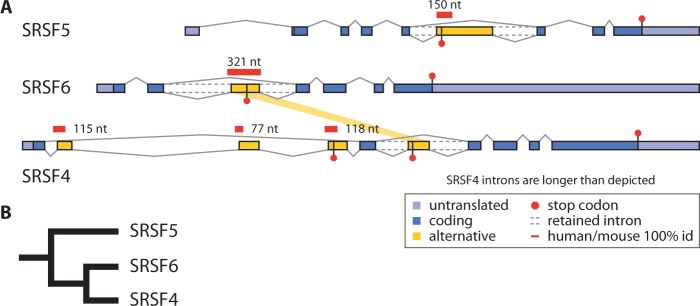
(A) Unproductive splicing of the closely related human SR genes SRSF4, SRSF5, and SRSF6. Alternative exons with in-frame stop codons target mRNAs for NMD. Alternative exons in intron 2 of SRSF6 and SRSF4 are homologous, shown by yellow band. Regions of 100% sequence identity between human and mouse are indicated. (B) Phylogenetic tree of SRSF4, SRSF5, and SRSF6. A single origin of unproductive splicing at the base of this tree would result in homologous events in each gene, but the events observed in SR genes are not homologous (Lareau et al. 2007).
F<sc>ig</sc>. 2.
Fig. 2.
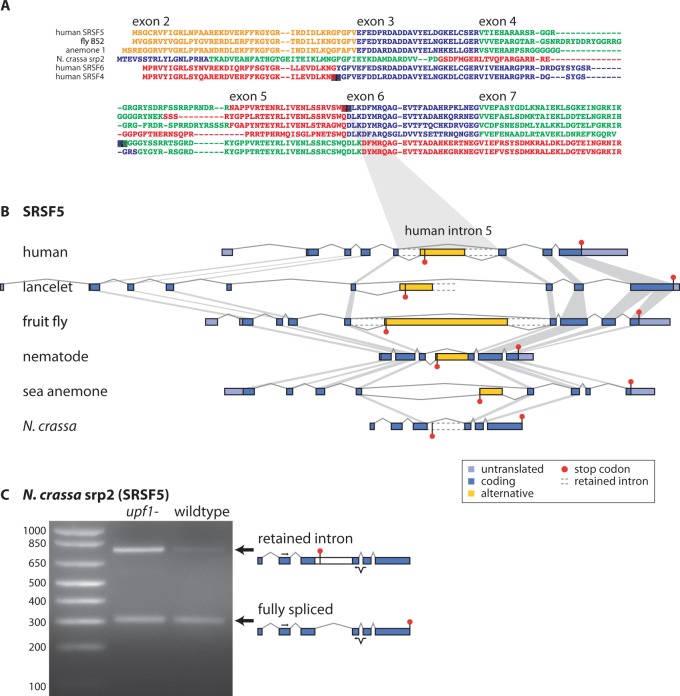
(A) Alignment of SRSF4, SRSF5, and SRSF6 protein sequences indicating exon positions. Colors denote exons (labeled relative to SRSF5). Positions of human cassette exon inclusion are indicated with gray boxes at splice junctions. Sequences were trimmed after the second RNA recognition motif (RRM) domain before alignment. See alignment of all genes in supplementary figure S1B, Supplementary Material online. (B) The exon/intron structure of SRSF5 is conserved in animals and some intron positions are conserved between animals and fungi. Gray bars show corresponding exons with conserved boundaries. An alternative exon in SRSF5 is conserved in animals. Intron retention is shared between animals and fungi. SRSF5 genes in vertebrates including mouse, rat, chicken, frog, and zebrafish were equivalent to human SRSF5 (supplementary figs. S1 and S2 and table S1, Supplementary Material online). (C) mRNAs of Neurospora crassa srp2 with retained intron 3 (the equivalent of human SRSF5 intron 5) are stabilized in an NMD-deficient strain.
F<sc>ig</sc>. 3.
Fig. 3.
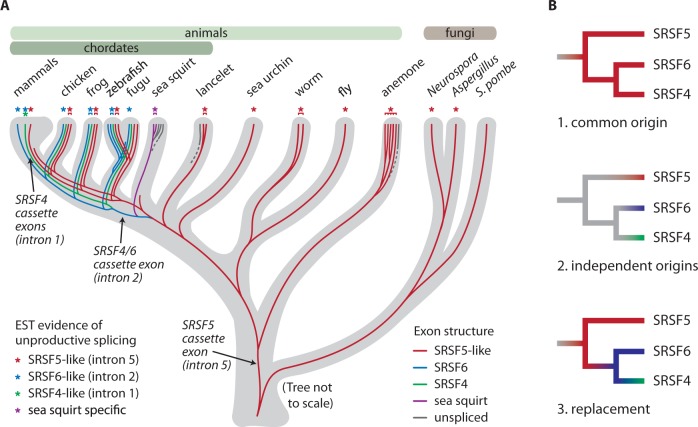
(A) Evolution of the SRSF4/SRSF5/SRSF6 family and origins of its unproductive splicing. A single SRSF5-like gene in the ancestor of animals and fungi duplicated in chordates and again in vertebrates. A phylogenetic tree of orthologs was constructed using maximum likelihood and refined by comparing exon boundaries of each gene (supplementary figs. S1A and S1B, Supplementary Material online). Gray tree shows species relationships and lines show gene relationships (not to scale). Dashed lines indicate uncertain relationships. Asterisks depict genes with EST evidence of unproductive splicing. (B) Our data rule out two simple evolutionary models: 1) a single origin of unproductive splicing in the common ancestor of the three genes (shown in red), or 2) independent evolution of unproductive splicing in each gene (shown in red, blue, and green). Instead, the data support a third model: Unproductive splicing was present in the common ancestor, and as the genes duplicated and diverged, unproductive splicing events were replaced with functionally similar unproductive splicing.
F<sc>ig</sc>. 4.
Fig. 4.
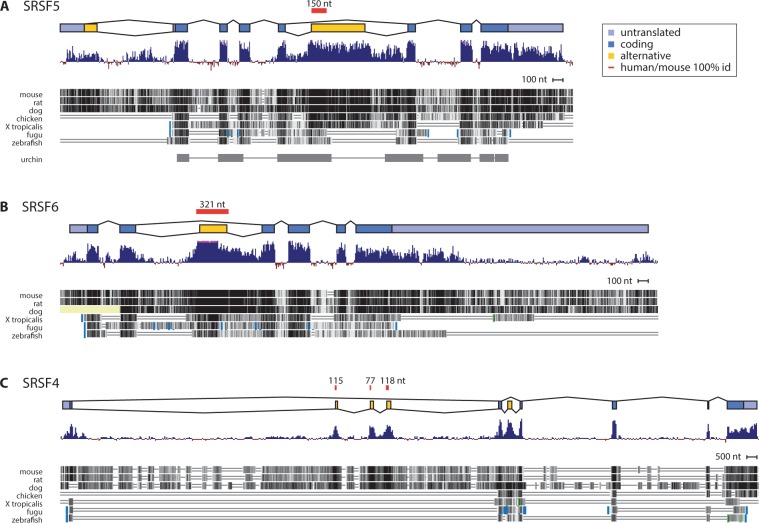
Conservation of SRSF4, SRSF5, and SRSF6 was assessed using data from vertebrate PhyloP conservation scores and whole-genome alignment tracks in the UCSC human genome browser (Pollard et al. 2010; Fujita et al. 2011). Regions of human/mouse 100% identity in alternative exons are marked with red bars. Vertebrate alignments are from MultiZ alignment of 46 vertebrates against human genome version hg19 and sea urchin alignment is from Strongylocentrotus purpuratus (September 2006 [Baylor 2.1/strPur2]) net alignment against human genome version hg18. The alternative exons of (A) SRSF5 and (B) SRSF6 have detectable similarity in all vertebrates and SRSF5 also has detectable homology in sea urchin. (C) Intron 1 of SRSF4, including three cassette exons, has no detectable similarity outside of mammals.

References

    1. Änkö ML, Morales L, Henry I, Beyer A, Neugebauer KM. Global analysis reveals SRp20- and SRp75-specific mRNPs in cycling and neural cells. Nat Struct Mol Biol. 2010;17:962–970. - PubMed
    1. Änkö ML, Muller-McNicoll M, Brandl H, Curk T, Gorup C, Henry I, Ule J, Neugebauer KM. The RNA-binding landscapes of two SR proteins reveal unique functions and binding to diverse RNA classes. Genome Biol. 2012;13:R17. - PMC - PubMed
    1. Awan AR, Manfredo A, Pleiss JA. Lariat sequencing in a unicellular yeast identifies regulated alternative splicing of exons that are evolutionarily conserved with humans. Proc Natl Acad Sci U S A. 2013;110:12762–12767. - PMC - PubMed
    1. Barberan-Soler S, Lambert NJ, Zahler AM. Global analysis of alternative splicing uncovers developmental regulation of nonsense-mediated decay in C. elegans. RNA. 2009;15:1652–1660. - PMC - PubMed
    1. Barberan-Soler S, Zahler AM. Alternative splicing regulation during C. elegans development: splicing factors as regulated targets. PLoS Genet. 2008;4:e1000001. - PMC - PubMed

Publication types