Review
. 2015 Mar;14(3):196-205.
doi: 10.1128/EC.00207-14. Epub 2015 Jan 9.

DNA double-strand breaks and telomeres play important roles in trypanosoma brucei antigenic variation

Affiliations
Review

DNA double-strand breaks and telomeres play important roles in trypanosoma brucei antigenic variation

Bibo Li. Eukaryot Cell. 2015 Mar.

Abstract

Human-infecting microbial pathogens all face a serious problem of elimination by the host immune response. Antigenic variation is an effective immune evasion mechanism where the pathogen regularly switches its major surface antigen. In many cases, the major surface antigen is encoded by genes from the same gene family, and its expression is strictly monoallelic. Among pathogens that undergo antigenic variation, Trypanosoma brucei (a kinetoplastid), which causes human African trypanosomiasis, Plasmodium falciparum (an apicomplexan), which causes malaria, Pneumocystis jirovecii (a fungus), which causes pneumonia, and Borrelia burgdorferi (a bacterium), which causes Lyme disease, also express their major surface antigens from loci next to the telomere. Except for Plasmodium, DNA recombination-mediated gene conversion is a major pathway for surface antigen switching in these pathogens. In the last decade, more sophisticated molecular and genetic tools have been developed in T. brucei, and our knowledge of functions of DNA recombination in antigenic variation has been greatly advanced. VSG is the major surface antigen in T. brucei. In subtelomeric VSG expression sites (ESs), VSG genes invariably are flanked by a long stretch of upstream 70-bp repeats. Recent studies have shown that DNA double-strand breaks (DSBs), particularly those in 70-bp repeats in the active ES, are a natural potent trigger for antigenic variation in T. brucei. In addition, telomere proteins can influence VSG switching by reducing the DSB amount at subtelomeric regions. These findings will be summarized and their implications will be discussed in this review.


Figures

FIG 1
FIG 1
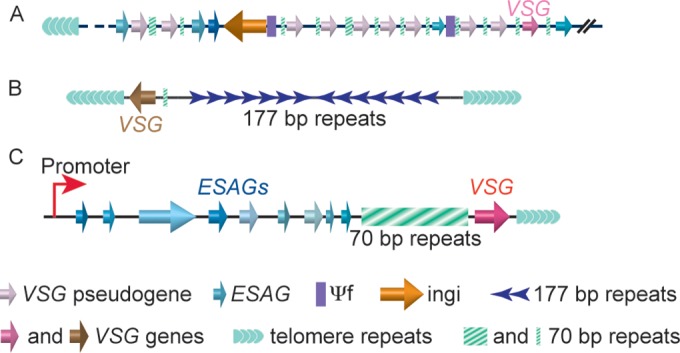
VSG genes are located mostly at subtelomeric regions in the T. brucei genome. (A) Large subtelomeric VSG arrays, including both VSG genes and pseudogenes. (B) Individual VSG genes often are found on minichromosomes at subtelomeric regions. (C) A typical VSG expression site (ES). VSG is the last gene in any ES and is located within 2 kb of the telomere repeats. A long stretch of 70-bp repeats is upstream of the VSG gene. ESs also contain a number of ESAG genes, which are upstream of the 70-bp repeats. The ES promoter is often 40 to 60 kb upstream of the VSG gene. ESs are located on megabase and intermediate chromosomes.
FIG 2
FIG 2
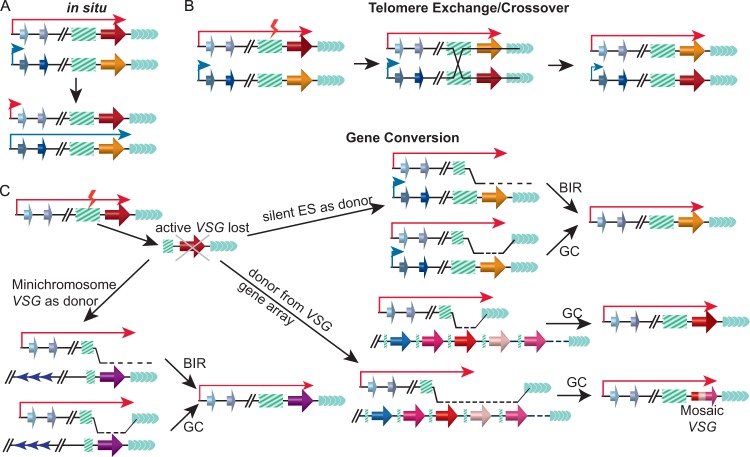
Major VSG switching pathways. (A) In situ switch. The originally active ES is silenced, while an originally silent ES is expressed. (B) In telomere exchange/crossover (TE/CO) switches, the active VSG and a silent VSG exchange places. A silent ES is depicted to participate in CO. However, a VSG gene at a minichromosome subtelomere theoretically can be involved in a TE/CO event as well. (C) In gene conversion (GC) switches, the originally active VSG gene is lost and an originally silent VSG gene is copied into the active ES. Top right, a silent ES-linked VSG serves as the GC donor; bottom left, a silent VSG gene at a minichromosome subtelomere serves as the GC donor; bottom right, one or several VSG gene(s) in a VSG gene array serve(s) as the GC donor. Both a break-induced replication (BIR) event that copies the whole telomeric region downstream of the VSG donor and a true GC event can occur when a silent ES-linked or a minichromosome subtelomeric VSG gene serves as the GC donor. When a VSG gene array serves as the donor, a mosaic VSG can be built from several silent VSG genes. TE/CO and GC switches are proposed to be initiated with breaks in the 70-bp repeats (shown as a red lightning bolt). Long red arrow, active ES promoter; short blue arrow, silent ES promoter; red, orange, purple, and pink three-dimensional (3D) arrows, VSG genes; blue 3D arrows, ESAG genes; green boxes with diagonal bars, 70-bp repeats; arrays of green arrowheads, telomere repeats; arrays of dark blue arrowheads, 177-bp repeats.
FIG 3
FIG 3
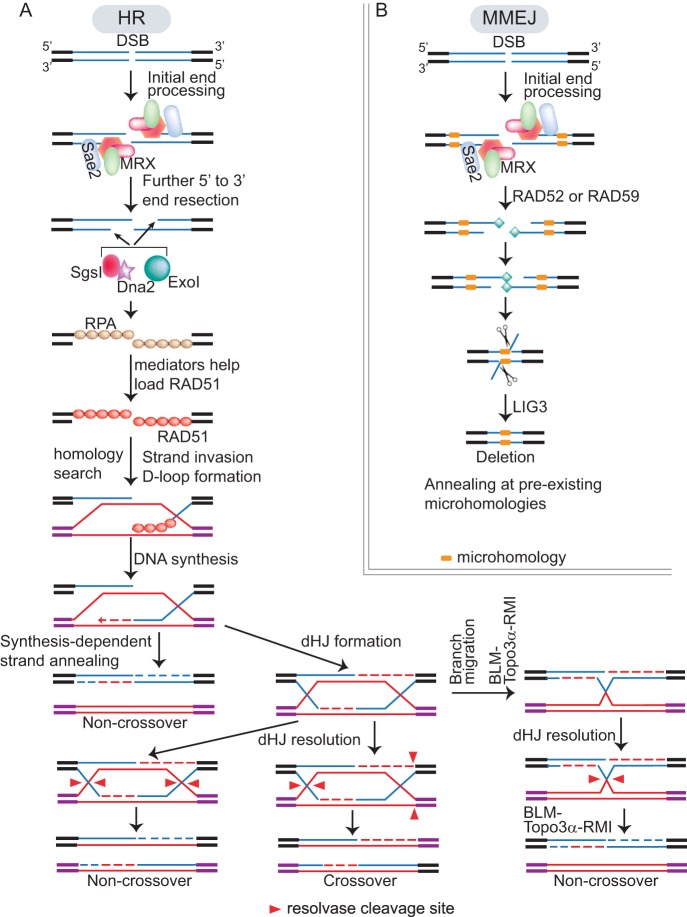
Schematic diagram of HR and MMEJ pathways. (A) Mechanisms of HR. DNA 5′ ends at a DSB site initially are processed by the MRX complex and Sae2 nucleases, followed by further resection by ExoI and Sgs1/Dna2. The resulting single-stranded 3′ ends then are bound by RPA. With the help of RAD51 mediators, RAD51 displaces RPA on the single-stranded DNA. Subsequently, RAD51 mediates homology search, strand invasion, and D-loop formation steps. (Bottom left) Synthesis-dependent strand annealing leads to noncrossover products. (Bottom middle) Double Holliday junction (dHJ) can lead to either noncrossover or crossover products depending on resolvase cleavage sites (shown as red arrowheads). (Bottom right) Branch migration mediated by the BLM-Topo3α-RMI complex also can resolve dHJ into noncrossover products. (B) A current model of MMEJ. DNA ends at the DSB site also are processed by MRX and Sae2 nucleases in MMEJ. Subsequently, Rad52 or Rad59 help DNA ends search and anneal at preexisting microhomologies. Ligase 3 finishes the ligation of the broken ends in MMEJ. Yeast and mammalian homologues of different nucleases and Rad51 mediators are listed in Table 1.

References

    1. Barry JD, McCulloch R. 2001. Antigenic variation in trypanosomes: enhanced phenotypic variation in a eukaryotic parasite. Adv Parasitol 49:1–70. doi: 10.1016/S0065-308X(01)49037-3. - DOI - PubMed
    1. Berriman M, Ghedin E, Hertz-Fowler C, Blandin G, Renauld H, Bartholomeu DC, Lennard NJ, Caler E, Hamlin NE, Haas B, Bohme U, Hannick L, Aslett MA, Shallom J, Marcello L, Hou L, Wickstead B, Alsmark UC, Arrowsmith C, Atkin RJ, Barron AJ, Bringaud F, Brooks K, Carrington M, Cherevach I, Chillingworth TJ, Churcher C, Clark LN, Corton CH, Cronin A, Davies RM, Doggett J, Djikeng A, Feldblyum T, Field MC, Fraser A, Goodhead I, Hance Z, Harper D, Harris BR, Hauser H, Hostetler J, Ivens A, Jagels K, Johnson D, Johnson J, Jones K, Kerhornou AX, Koo H, Larke N, Landfear S, Larkin C, Leech V, Line A, Lord A, Macleod A, Mooney PJ, Moule S, Martin DM, Morgan GW, Mungall K, Norbertczak H, Ormond D, Pai G, Peacock CS, Peterson J, Quail MA, Rabbinowitsch E, Rajandream MA, Reitter C, Salzberg SL, Sanders M, Schobel S, Sharp S, Simmonds M, Simpson AJ, Tallon L, Turner CM, Tait A, Tivey AR, Van Aken S, Walker D, Wanless D, Wang S, White B, White O, Whitehead S, Woodward J, Wortman J, Adams MD, Embley TM, Gull K, Ullu E, Barry JD, Fairlamb AH, Opperdoes F, Barrell BG, Donelson JE, Hall N, Fraser CM, Melville SE, El-Sayed NM. 2005. The genome of the African trypanosome Trypanosoma brucei. Science 309:416–422. doi: 10.1126/science.1112642. - DOI - PubMed
    1. Cross GAM, Kim HS, Wickstead B. 2014. Capturing the variant surface glycoprotein repertoire (the VSGnome) of Trypanosoma brucei Lister 427. Mol Biochem Parasitol 195:59–73. doi: 10.1016/j.molbiopara.2014.06.004. - DOI - PubMed
    1. Horn D, Barry JD. 2005. The central roles of telomeres and subtelomeres in antigenic variation in African trypanosomes. Chromosome Res 13:525–533. doi: 10.1007/s10577-005-0991-8. - DOI - PubMed
    1. Wickstead B, Ersfeld K, Gull K. 2004. The small chromosomes of Trypanosoma brucei involved in antigenic variation are constructed around repetitive palindromes. Genome Res 14:1014–1024. doi: 10.1101/gr.2227704. - DOI - PMC - PubMed

MeSH terms

Substances

LinkOut - more resources