


Injury risk factors, screening tests and preventative strategies: a systematic review of the evidence that underpins the perceptions and practices of 44 football (soccer) teams from various premier leagues
- PMID: 25576530
- PMCID: PMC4413799
- DOI: 10.1136/bjsports-2014-094104
Injury risk factors, screening tests and preventative strategies: a systematic review of the evidence that underpins the perceptions and practices of 44 football (soccer) teams from various premier leagues
Abstract
Purpose: To systematically review the scientific level of evidence for the 'Top 3' risk factors, screening tests and preventative exercises identified by a previously published survey of 44 premier league football (soccer) teams. Also, to provide an overall scientific level of evidence and graded recommendation based on the current research literature.
Methods: A systematic literature search (Pubmed [MEDLINE], SportDiscus, PEDRO and Cochrane databases). The quality of the articles was assessed and a level of evidence (1++ to 4) was assigned. Level 1++ corresponded to the highest level of evidence available and 4, the lowest. A graded recommendation (A: strong, B: moderate, C: weak, D: insufficient evidence to assign a specific recommendation) for use in the practical setting was given.
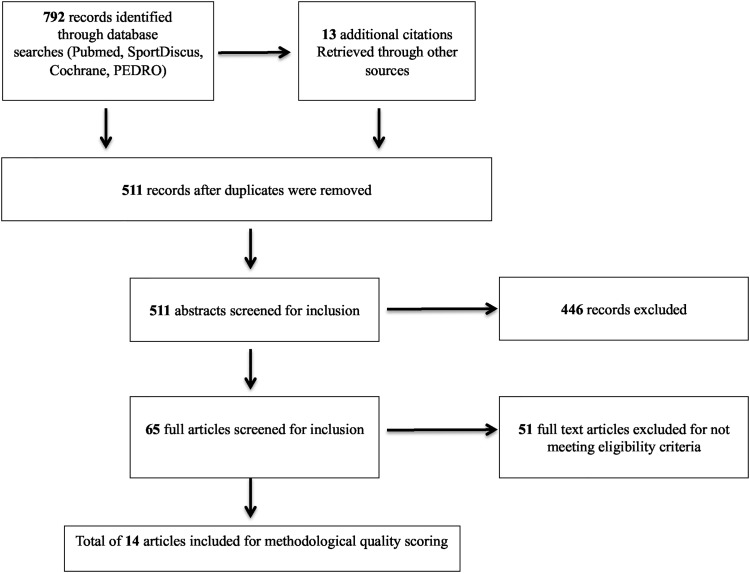
Results: Fourteen studies were analysed. The overall level of evidence for the risk factors previous injury, fatigue and muscle imbalance were 2++, 4 and 'inconclusive', respectively. The graded recommendation for functional movement screen, psychological questionnaire and isokinetic muscle testing were all 'D'. Hamstring eccentric had a weak graded 'C' recommendation, and eccentric exercise for other body parts was 'D'. Balance/proprioception exercise to reduce ankle and knee sprain injury was assigned a graded recommendation 'D'.
Conclusions: The majority of perceptions and practices of premier league teams have a low level of evidence and low graded recommendation. This does not imply that these perceptions and practices are not important or not valid, as it may simply be that they are yet to be sufficiently validated or refuted by research.
Keywords: exercise; prevention.
Published by the BMJ Publishing Group Limited. For permission to use (where not already granted under a licence) please go to http://group.bmj.com/group/rights-licensing/permissions.
Figures
References
-
- McCall A, Carling C, Nedelec M, et al. Risk factors, testing and preventative strategies for non-contact injuries in professional football: current perceptions and practices of 44 teams from various premier leagues. Br J Sports Med 2014;48:1352–7. doi:10.1136/bjsports-2014-093439 - DOI - PubMed
Publication types
MeSH terms
LinkOut - more resources
Full Text Sources
Other Literature Sources
