


Comparative Study
doi: 10.1017/S0016672314000172.
Reduction in the structural instability of cloned eukaryotic tandem-repeat DNA by low-temperature culturing of host bacteria
Affiliations
- PMID: 25578068
- PMCID: PMC7045003
- DOI: 10.1017/S0016672314000172
Item in Clipboard
Comparative Study
Reduction in the structural instability of cloned eukaryotic tandem-repeat DNA by low-temperature culturing of host bacteria
Genet Res (Camb).
.
Abstract
Summary For accurate analyses of eukaryotic tandem-repeat DNA, it is often required to clone a genomic DNA fragment into a bacterial plasmid. It is, however, a serious problem that tandem-repeat DNA is frequently subjected to structural changes during maintenance or amplification in the host bacteria. Here, we show an example of a clear difference in the instability of tandem-repeat DNA between different culturing temperatures. A fragment of monkey centromeric DNA carried by pUC19 was considerably degraded by culturing bacteria at 37 °C, but the damage was reduced at 25 °C. Thus, culturing temperature is a significant factor for avoiding degradation, in addition to the genotype of the host bacteria.
Figures
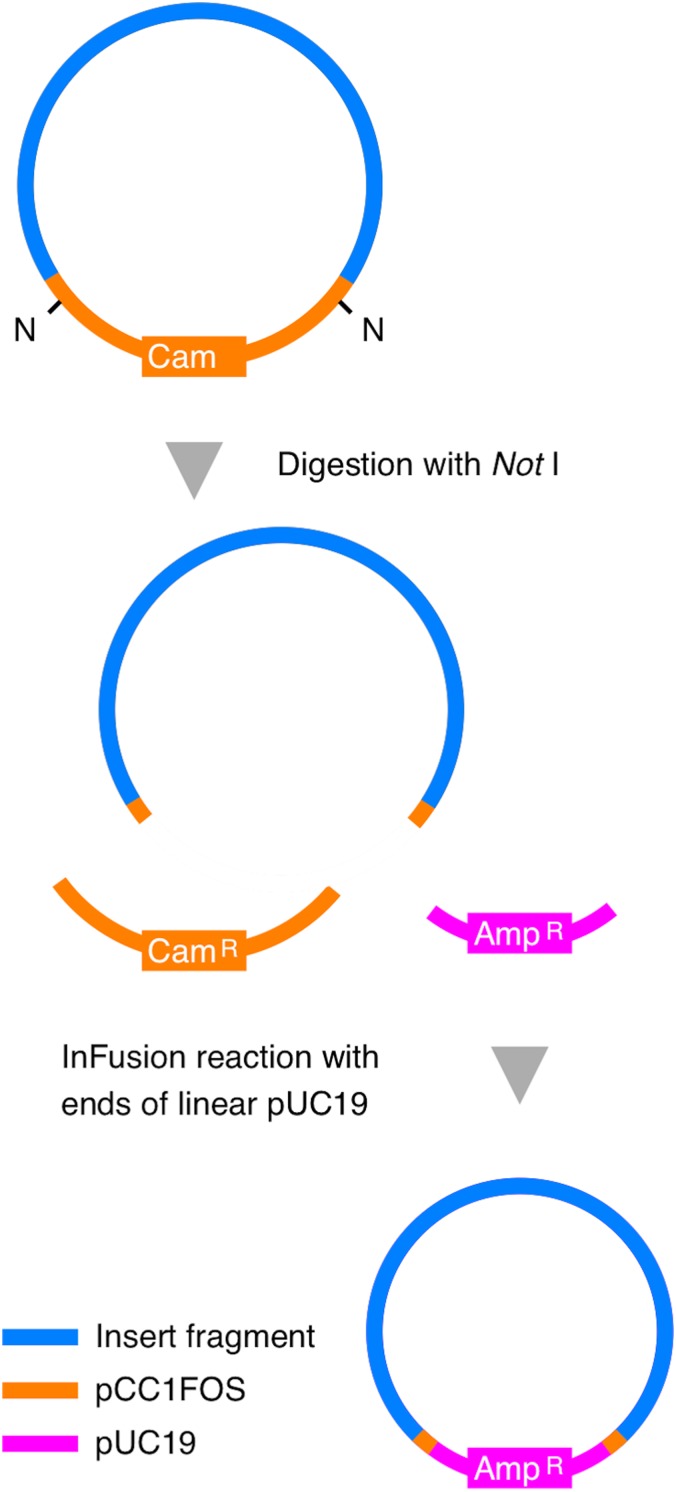
Scheme for the transfer of an insert fragment from the pCC1FOS fosmid vector to the pUC19 plasmid vector. pCC1FOS has two NotI recognition sites located outside its cloning site. Fosmid DNA was digested with NotI and mixed with a linear fragment carrying the pUC19 sequence. The end regions of the fragment had been modified to carry 15-bp blocks corresponding to the end regions of the insert fragment. The DNA mixture was subjected to the InFusion reaction that caused recombination in the corresponding regions between pUC19 and the insert fragment. The reaction mixture was introduced into bacterial cells and the colonies formed on ampicillin-containing agar plates were selected randomly and used in subsequent experiments.
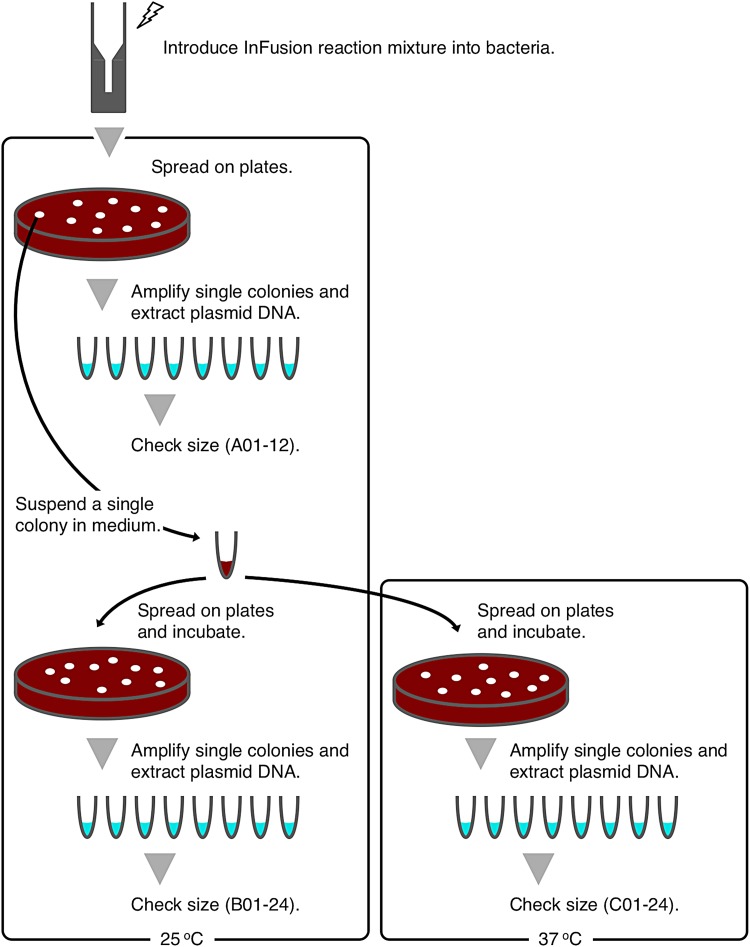
Assay for the fragility of plasmid clones. Incubation of bacterial cells was conducted at 25 °C during the initial steps. Incubation at 25 °C or 37 °C was performed after picking up a single colony.
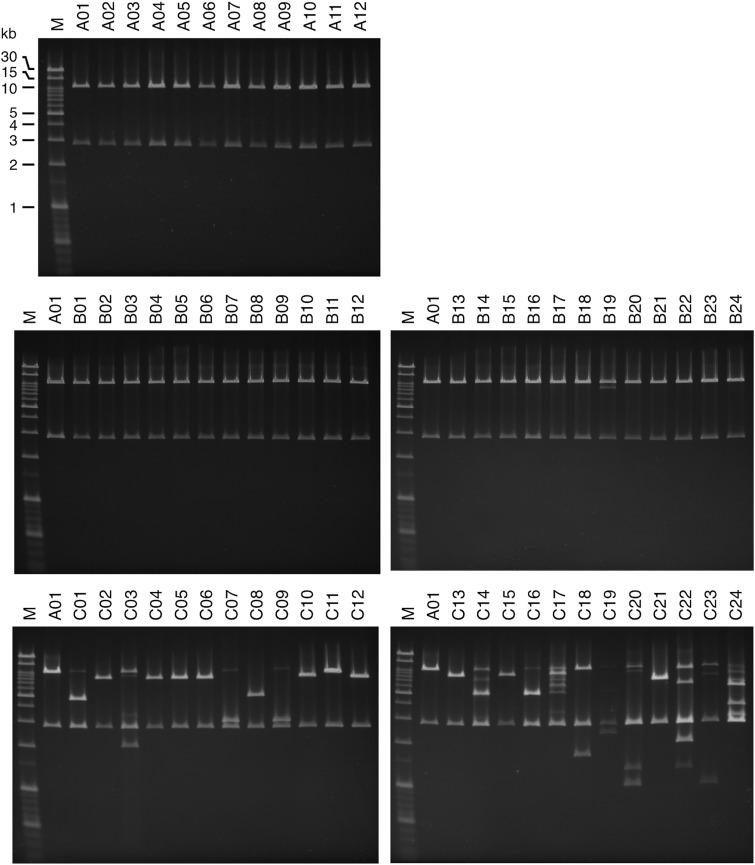
Results of agarose gel electrophoreses for size variation among plasmid clones. pCC1FOS carried two HindIII recognition sites just adjacent to its cloning site, and the OwlAlp2 fragment did not have sites for this enzyme. The two sites were transferred to pUC19 together with the entire OwlAlp2 fragment. Because the pUC19 portion did not contain a HindIII site, digestion of pUC19 clones with HindIII produced the insert fragment (originally 11 kb) and a vector fragment (2·9 kb) that consisted of the pUC19 backbone and short fragments originating from pCC1FOS. “M” stands for size marker. The sizes of the marker fragments are shown along the left margin of the top picture.
References
-
- Brutlag D., Fry K., Nelson T. & Hung P. (1977). Synthesis of hybrid bacterial plasmids containing highly repeated satellite DNA. Cell 10, 509–519. - PubMed
-
- Doherty J. P., Lindeman R., Trent R. J., Graham M. W. & Woodcock D. M. (1993). Escherichia coli host strains SURE and SRB fail to preserve a palindrome cloned in lambda phage: improved alternate host strains. Gene 124, 29–35. - PubMed
-
- Maio J. J. (1971). DNA strand reassociation and polyribonucleotide binding in the African green monkey, Cercopithecus aethiops. Journal of Molecular Biology 56, 579–595. - PubMed
Publication types
MeSH terms
LinkOut - more resources
Full Text Sources
Other Literature Sources