Visualizing endocytotic pathways at transmission electron microscopy via diaminobenzidine photo-oxidation by a fluorescent cell-membrane dye
- PMID: 25578976
- PMCID: PMC4289848
- DOI: 10.4081/ejh.2014.2449
Visualizing endocytotic pathways at transmission electron microscopy via diaminobenzidine photo-oxidation by a fluorescent cell-membrane dye
Abstract
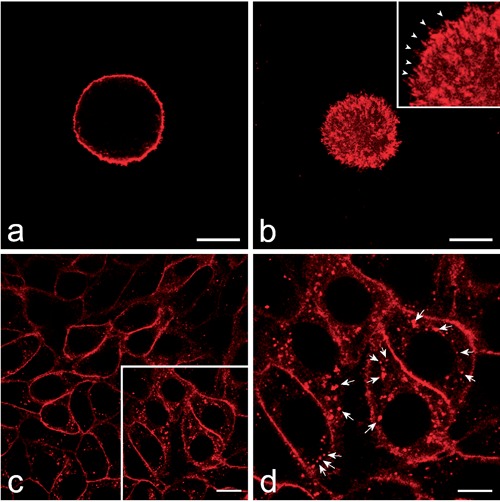
The endocytotic pathway involves a complex, dynamic and interacting system of intracellular compartments. PKH26 is a fluorescent dye specific for long-lasting cell membrane labelling which has been successfully used for investigating cell internalization processes, at either flow cytometry or fluorescence microscopy. In the present work, diaminobenzidine photo-oxidation was tested as a procedure to detect PKH26 dye at transmission electron microscopy. Our results demonstrated that DAB-photo-oxidation is a suitable technique to specifically visualise this fluorescent dye at the ultrastructural level: the distribution of the granular dark reaction product perfectly matches the pattern of the fluorescence staining, and the electron density of the fine precipitates makes the signal evident and precisely detectable on the different subcellular compartments involved in the plasma membrane internalization routes.
Figures

References
-
- Panzeri D, Lavazza T, Malgaroli A. Advanced tracer techniques to monitor synaptic activity. Arch Ital Biol 2005; 143:157-68. - PubMed
-
- de Souza W, Sant’Anna C, Cunha-e-Silva NL. Electron microscopy and cytochemistry analysis of the endocytic pathway of pathogenic protozoa. Prog Histochem Cytochem 2009;44:67-124. - PubMed
-
- Bissig C, Johnson S, Gruenberg J. Studying lipids involved in the endosomal pathway. Methods Cell Biol 2012;108:19-46. - PubMed
MeSH terms
Substances
LinkOut - more resources
Full Text Sources
Other Literature Sources