Review
. 2015:84:199-226.
doi: 10.1146/annurev-biochem-060614-034010. Epub 2015 Jan 2.

DNA triplet repeat expansion and mismatch repair

Affiliations
Review

DNA triplet repeat expansion and mismatch repair

Ravi R Iyer et al. Annu Rev Biochem. 2015.

Abstract

DNA mismatch repair is a conserved antimutagenic pathway that maintains genomic stability through rectification of DNA replication errors and attenuation of chromosomal rearrangements. Paradoxically, mutagenic action of mismatch repair has been implicated as a cause of triplet repeat expansions that cause neurological diseases such as Huntington disease and myotonic dystrophy. This mutagenic process requires the mismatch recognition factor MutSβ and the MutLα (and/or possibly MutLγ) endonuclease, and is thought to be triggered by the transient formation of unusual DNA structures within the expanded triplet repeat element. This review summarizes the current knowledge of DNA mismatch repair involvement in triplet repeat expansion, which encompasses in vitro biochemical findings, cellular studies, and various in vivo transgenic animal model experiments. We present current mechanistic hypotheses regarding mismatch repair protein function in mediating triplet repeat expansions and discuss potential therapeutic approaches targeting the mismatch repair pathway.

Keywords: DNA mismatch repair; hereditary neurological diseases; non-B-DNA structures; repeat expansion diseases; triplet repeats.


Figures
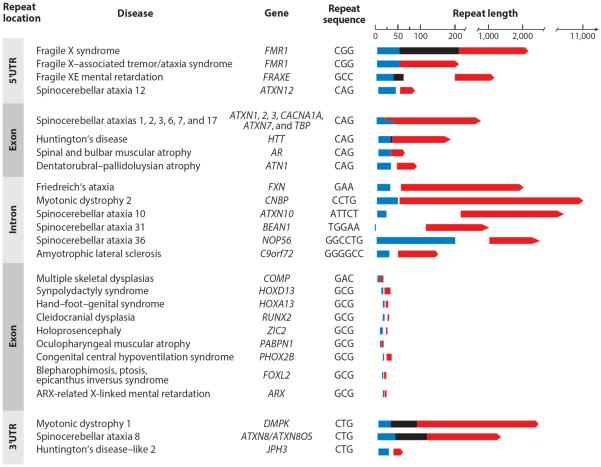
Figure 1
Figure 1
Unstable DNA repeats and human disease. Unstable DNA repeats cause 31 human diseases. In some cases of multiple skeletal dysplasia, repeat contraction is pathological. Unstable repeats can be located in either the coding or the noncoding region [untranslated regions (UTRs) and introns] of a gene. Typically, the repeat element is highly polymorphic even in unaffected individuals (blue bars). In some carrier individuals, premutation alleles (black bars) predispose the subsequent generation to full expansion when transmitted. Repeat lengths of disease-associated alleles (red bars) vary dramatically among the diseases, and in extreme cases can reach several thousand copies. For brevity, only the sequence of the top strand of the repeating unit is depicted.
Figure 2
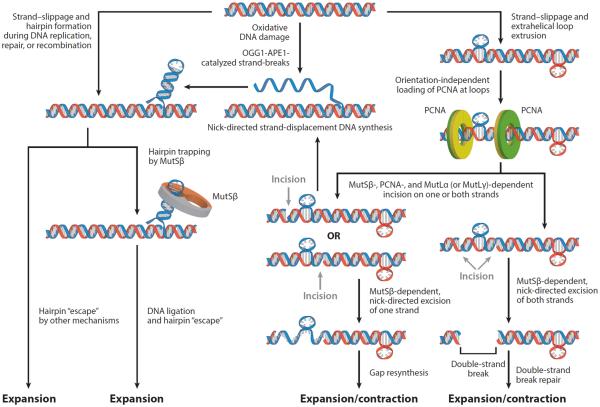
Figure 2
Proposed models for mismatch repair–mediated triplet repeat expansion. Strand slippage during DNA metabolic processes can result in the formation of hairpin loops (top left) or small extrahelical extrusions (top right). Hairpin loops may also be formed by strand-displacement DNA synthesis initiated at strand breaks caused by the concerted action of 7,8 dihydro-8-oxoguanine 1 (OGG1) and apurinic/apyrimidinic endonuclease 1 (APE1) on OGG1 lesions on the DNA (top middle). The MutSβ entrapment/hairpin escape model (left) posits that hairpin loops trapped by MutSβ are rendered refractory to removal by DNA repair processes and are thus incorporated into the primary structure of the DNA after the next round of replication, resulting in expansion. Hairpin loops may also escape repair by other unidentified mechanisms. However, per the dysregulated strand directionality model (right), extrahelical extrusions formed by strand slippage provide sites for proliferating cell nuclear antigen (PCNA) loading. However, loading of PCNA in this manner occurs without regard to orientation. Recognition of extrahelical extrusions by MutSβ provokes MutLα-catalyzed endonucleolytic cleavage on one or both DNA strands by MutLα. The ensuing strand breaks may serve as initiation sites for DNA synthesis–driven strand displacement. Alternatively, MutSβ-provoked strand excision is followed by gap resynthesis, causing expansion or contraction depending on which strand is the template for resynthesis. If the strand breaks generated by MutLα are in close proximity, excision on both DNA strands would lead to a double-strand break. Repair of the double-strand break could then lead to expansion or contraction of the triplet repeat tract. Also, MutSβ-dependent MutLγ endonuclease activation might occur without strand bias in the vicinity of triplet repeat extrahelical extrusions, leading to triplet repeat instability.

References

    1. Friedberg EC, Walker GC, Siede W, Wood RD, Schultz RA, Ellenberger T. DNA Repair and Mutagenesis. Am. Soc. Microbiol.; Washington, DC: 2006.
    1. Barnes DE, Lindahl T. Repair and genetic consequences of endogenous DNA base damage in mammalian cells. Annu. Rev. Genet. 2004;38:445–76. - PubMed
    1. Wells RD, Ashizawa T, editors. Genetic Instabilities and Neurological Diseases. 2nd ed. Elsevier; Boston: 2006. p. 766.
    1. Sinden RR. DNA Structure and Function. Academic; San Diego: 1994.
    1. Wells RD. Discovery of the role of non-B DNA structures in mutagenesis and human genomic disorders. J. Biol. Chem. 2009;284:8997–9009. - PMC - PubMed

Publication types