Relation between BMI and diabetes mellitus and its complications among US older adults
- PMID: 25580754
- PMCID: PMC4457375
- DOI: 10.14423/SMJ.0000000000000214
Relation between BMI and diabetes mellitus and its complications among US older adults
Abstract
Objectives: This study examined relations between elevated body mass index (BMI) and time to diagnosis with type 2 diabetes mellitus and its complications among older adults in the United States.
Methods: Data came from the Medicare Current Beneficiary Survey, 1991-2010. A Cox proportional hazard model was used to assess relations between excess BMI at the first Medicare Current Beneficiary Survey interview and time to diabetes mellitus diagnosis, complications, and insulin dependence among Medicare beneficiaries, older than 65 years of age with no prior diabetes mellitus diagnosis, and who were not enrolled in Medicare Advantage (N = 14,657).
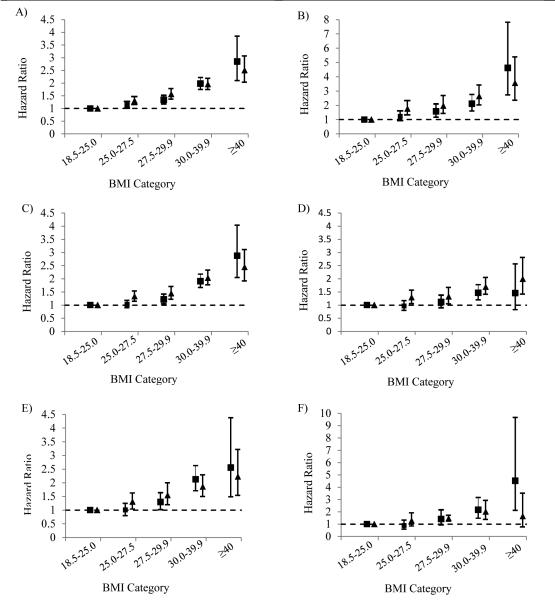
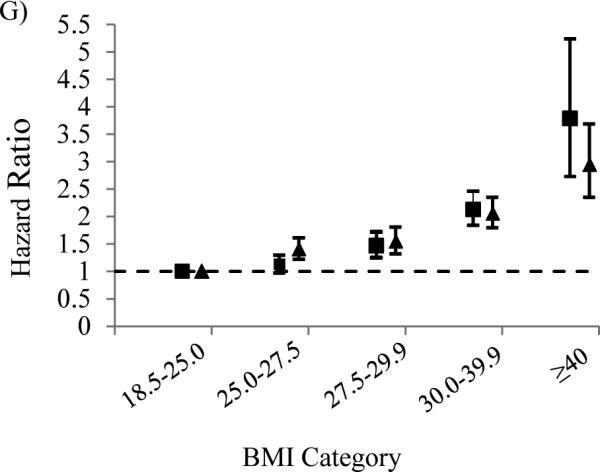
Results: Among individuals diagnosed as having diabetes mellitus, elevated BMIs were associated with a progressively higher risk of complications from diabetes mellitus. For women with a BMI ≥40, the risk of insulin dependence (hazard ratio [HR] 3.57; 95% confidence interval [CI] 2.36-5.39) was twice that for women with 25 ≤ BMI < 27.5 (HR 1.77; 95% CI 1.33-2.33). A similar pattern was observed in risk of cardiovascular (25 ≤ BMI < 27.5: HR 1.34; 95% CI 1.15-1.54; BMI ≥40: HR 2.45; 95% CI 1.92-3.11), cerebrovascular (25 ≤ BMI < 27.5: HR 1.30; 95% CI 1.06-1.57; BMI ≥40: HR 2.00; 95% CI 1.42-2.81), renal (25 ≤ BMI < 27.5: HR 1.31; 95% CI 1.04-1.63; BMI ≥40: HR 2.23; 95% CI 1.54-3.22), and lower extremity complications (25 ≤ BMI < 27.5: HR 1.41; 95% CI 1.22-1.61; BMI ≥40: HR 2.95; 95% CI 2.35-3.69).
Conclusions: Any increase in BMI above normal weight levels is associated with an increased risk of being diagnosed as having complications of diabetes mellitus. For men, the increased risk of these complications occurred at higher BMI levels than in women. Ocular complications occurred at higher BMI levels than other complication types in both men and women.
Figures
Comment in
-
Commentary on "Relation between BMI and Diabetes Mellitus and its complications among US older adults".South Med J. 2015 Jan;108(1):37-8. doi: 10.14423/SMJ.0000000000000215. South Med J. 2015. PMID: 25580755 No abstract available.
References
-
- Zimmet P, Alberti K, Shaw J. Global and societal implications of the diabetes epidemic. Nature. 2001;414:782–787. - PubMed
-
- Narayan KV, Boyle JP, Thompson TJ, Sorensen SW, Williamson DF. Lifetime risk for diabetes mellitus in the United States. JAMA. 2003;290:1884–1890. - PubMed
-
- Stein CJ, Colditz GA. The epidemic of obesity. J Clin Endocrinol Metab. 2004;89:2522–2525. - PubMed
-
- Ogden CL, Carroll MD, Curtin LR, McDowell MA, Tabak CJ, Flegal KM. Prevalence of overweight and obesity in the United States, 1999-2004. JAMA. 2006;295:1549–1555. - PubMed