. 2015 May;52(5):626-37.
doi: 10.1111/psyp.12390. Epub 2015 Jan 12.

Time-frequency theta and delta measures index separable components of feedback processing in a gambling task

Affiliations

Time-frequency theta and delta measures index separable components of feedback processing in a gambling task

Edward M Bernat et al. Psychophysiology. 2015 May.

Abstract

Previous work using gambling tasks indicate that the feedback negativity (FN) reflects primary or salient stimulus attributes (often gain vs. loss), whereas the feedback-P300 appears sensitive to secondary stimulus information. A recent time-frequency approach has characterized separable theta (3-7 Hz) and delta (0-3 Hz) feedback processes, independently sensitive to primary feedback attributes, specifically loss and gain outcomes, respectively. The current study extends this time-frequency work to evaluate both primary and secondary (relative outcome and outcome magnitude) feedback attributes. Consistent with previous reports, theta indexed an initial, lower-level response sensitive to the primary (most salient) feedback attributes (specifically losses), while delta was sensitive to both primary attributes (specifically gains) and assessed secondary stimulus features.

Keywords: Delta; ERP; Event-related potential; FN; Feedback negativity; Gambling; P300; Theta; Time-frequency analysis.


Figures

Figure 1
Figure 1
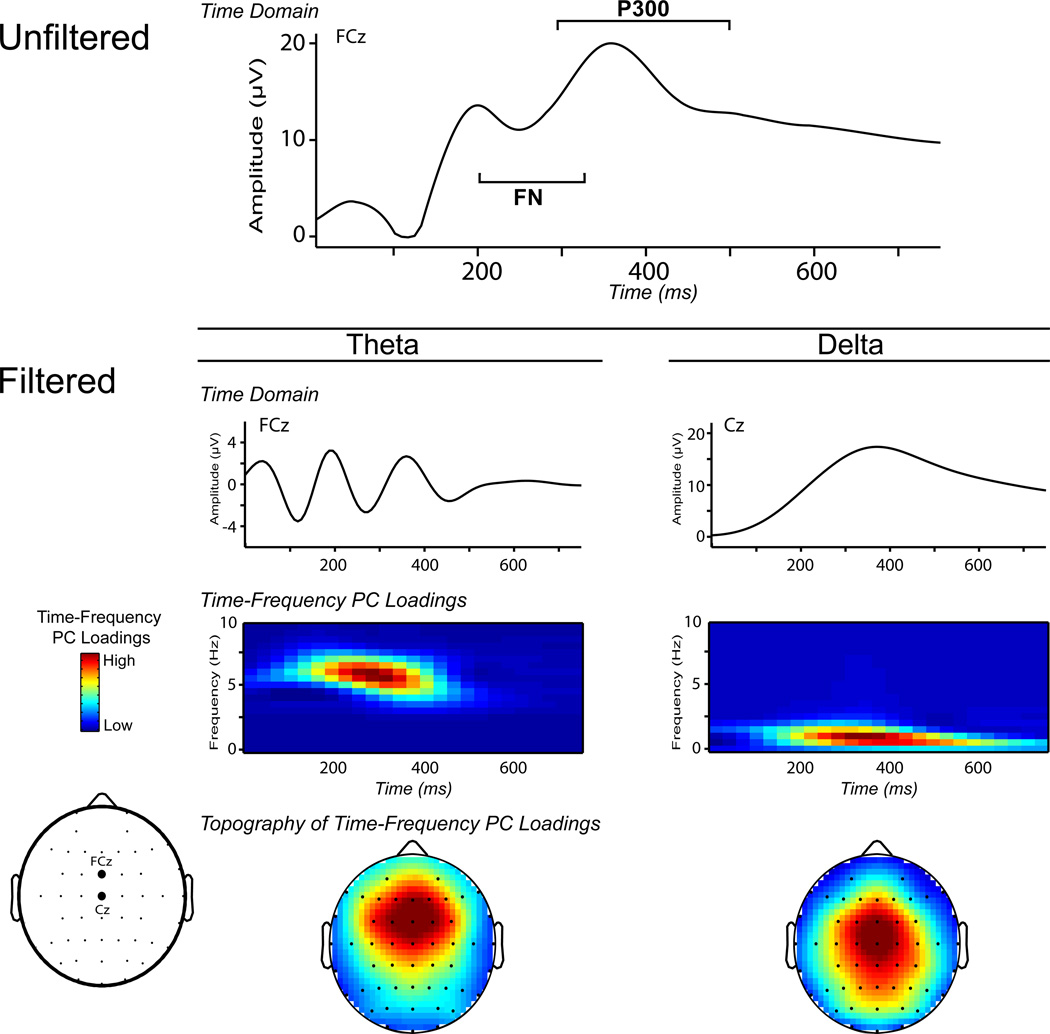
Time-frequency decomposition of the feedback-ERP. Theta’s frontocentral topographical distribution of the principal components (PC) loadings closely matches that of the FN, and delta’s more centroparietal distribution of the principal components (PC) loadings matches the P300. Adapted with permission from the American Psychological Association.
Figure 2
Figure 2
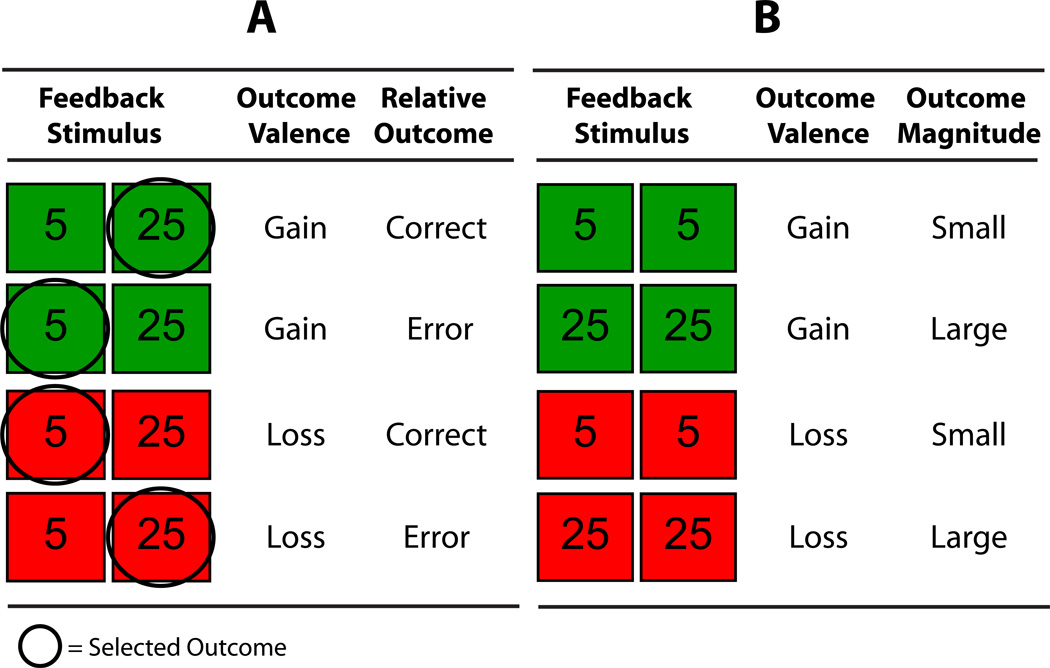
Gambling task feedback outcomes evaluated in the current study. Column A depicts the four conditions selected to evaluate outcome valence (loss vs. gain) × relative outcome (error vs. correct). Column B depicts the four conditions selected to evaluate valence × magnitude. Note that for the outcomes in B, actual and alternative outcomes are equivalent and thus there is no relative outcome effect possible.
Figure 3
Figure 3
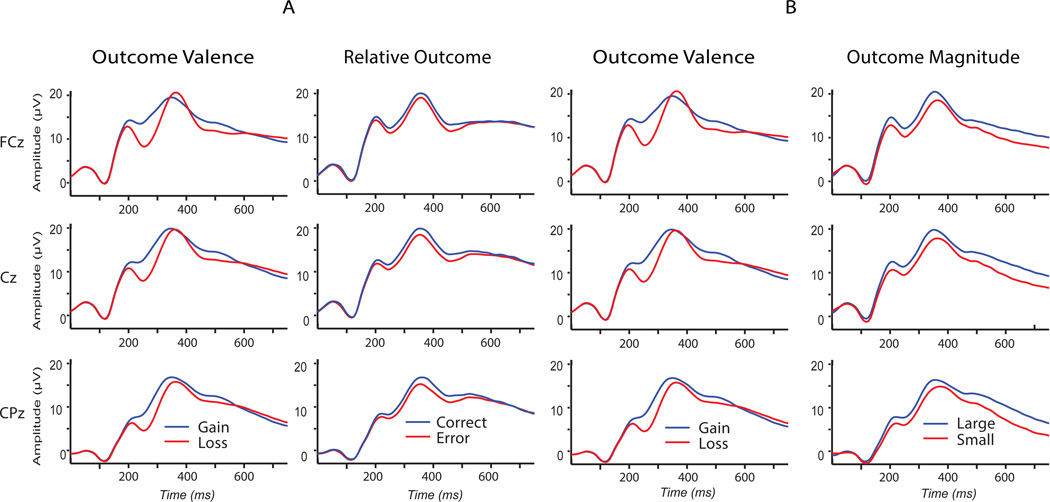
Unfiltered time-domain waveforms for the midline electrodes (FCz, Cz, and CPz). Grand averages by condition are presented -- including the primary Gain/Loss comparisons, as well as the secondary Error/Correct and Large/Small comparisons. These waveforms are presented for comparison with traditional plots depicting activity across the midline sensors. For example, the expected larger Gain-Loss difference at FCz, as compared to CPz, is readily apparent.
Figure 4
Figure 4
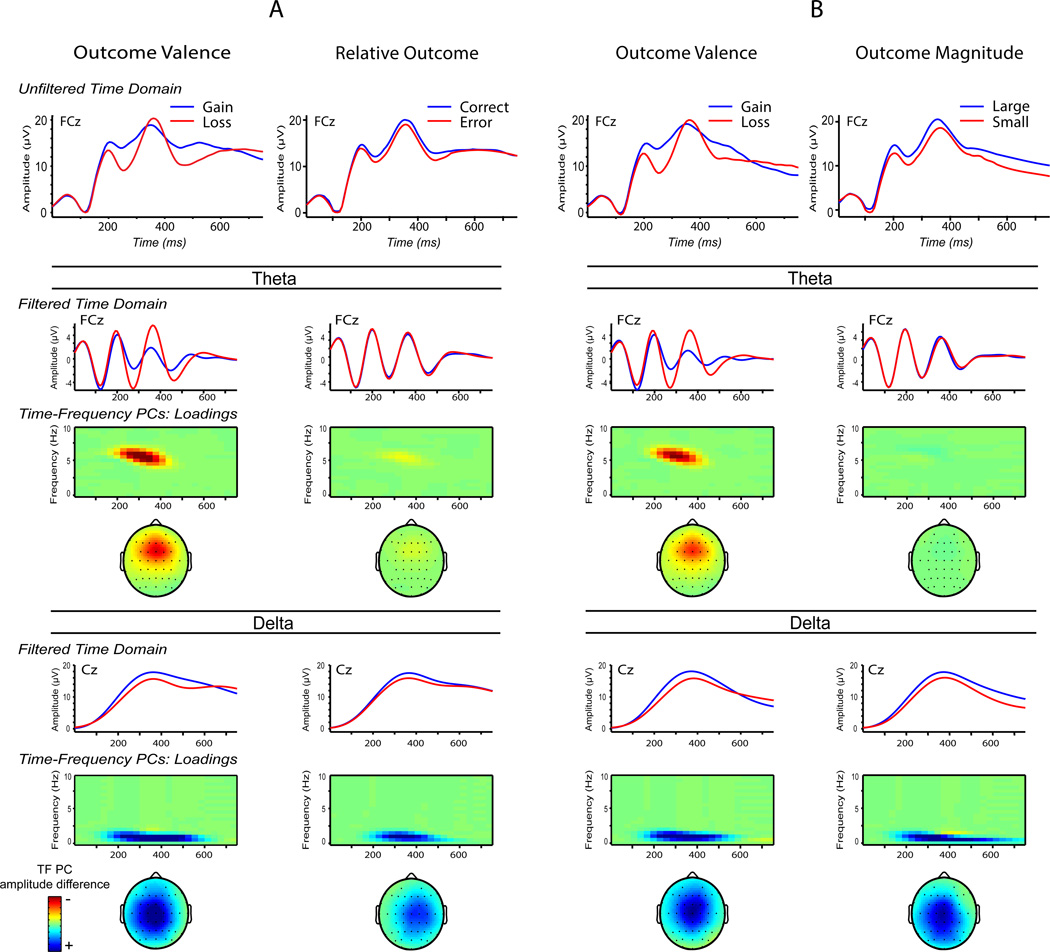
Time-domain waveforms and time-frequency surfaces are presented for the conditions. Portion A contains activity in response to the stimuli in Figure 2A, including Outcome Valence (loss vs. gain) and Relative Outcome (error vs. correct) stimulus attributes in the first and second labeled columns, respectively. Portion B contains activity in response to the stimuli in Figure 2B, including Outcome Valence and Outcome Magnitude (big vs. small, 25 vs. 5) stimulus attributes. For both A and B subsections, the upper row contains unfiltered time-domain waveforms for the conditions relevant to the corresponding column. The theta and delta sections just below the unfiltered waveforms contain filtered time-domain waveforms at the top, corresponding time-frequency condition difference surfaces in the middle, and topographical distribution of the condition differences in the lower part. Frontocentral theta activity corresponds most closely to time-domain FN and shows enhancement for loss outcomes relative to gains, in the Outcome Valence columns of analyses A and B, but qualitatively less for the secondary analyses (Relative Outcome in A and Outcome Magnitude in B). Centroparietal delta activity corresponds most to time-domain P300, but unlike theta, shows similar enhancements across all primary and secondary stimulus attributes – gain, correct, and large magnitude outcomes.
Figure 5
Figure 5
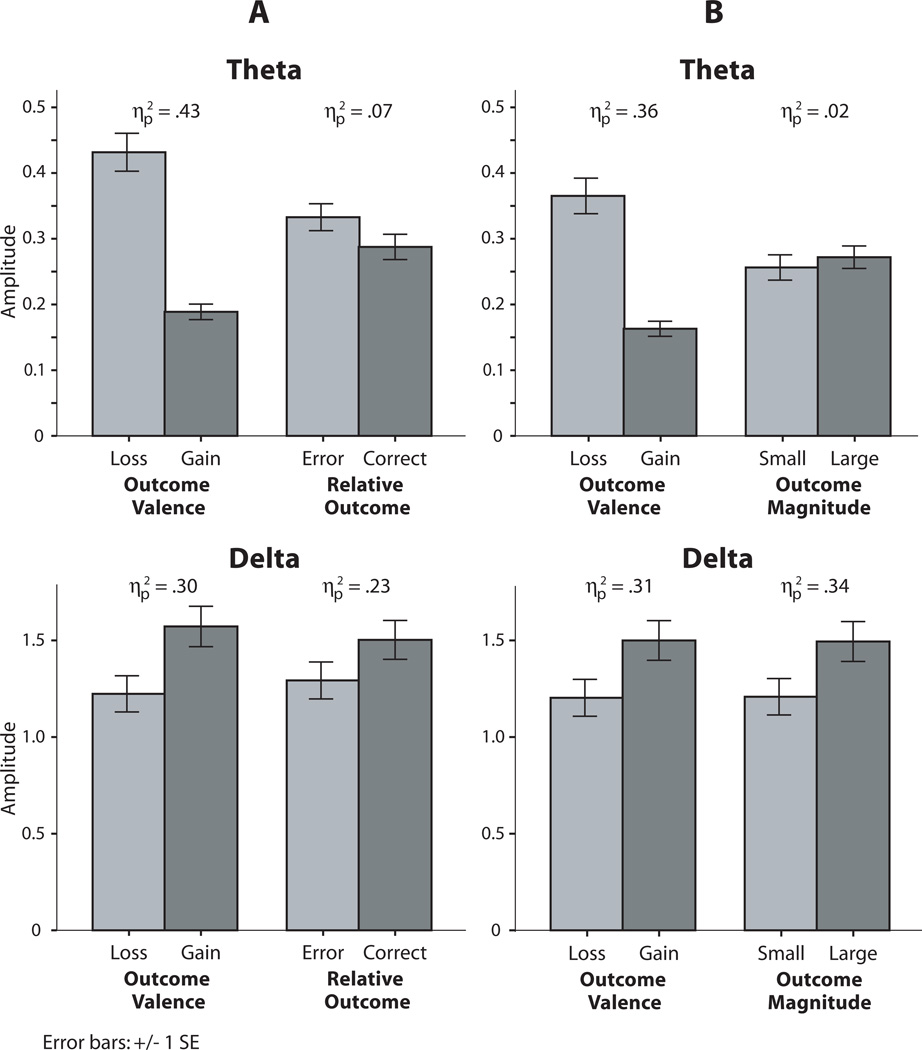
Bar charts depicting condition difference main effects for theta and delta from each RM-ANOVA model. Subsection A contains mean activity in response to the stimuli in Figure 2A, including Outcome Valence (loss vs. gain) and Relative Outcome (error vs. correct) stimulus attributes in the first and second columns, respectively. Subsection B contains mean activity in response to the stimuli in Figure 2B, including Outcome Valence and Outcome Magnitude (big vs. small, i.e., 25 vs. 5) stimulus attributes. It can be seen here that theta was modulated by the primary (salient) stimulus parameter (enhanced for loss), but not by the secondary stimulus attributes (Relative Outcome and Outcome Magnitude). Delta was more equally modulated across the comparison types – by the primary stimulus parameters (Outcome Valence, enhanced for gain) and by the secondary feedback characteristics (relative outcome, enhanced for correct, and outcome magnitude, enhanced for large).

References

    1. Alexander WH, Brown JW. Medial prefrontal cortex as an action-outcome predictor. Nature neuroscience. 2011;14(10):1338–1344. - PMC - PubMed
    1. Baker TE, Holroyd CB. Dissociated roles of the anterior cingulate cortex in reward and conflict processing as revealed by the feedback error-related negativity and N200. Biological Psychology. 2011;87(1):25–34. - PubMed
    1. Başar-Eroglu C, Başar E, Demiralp T, Schürmann M. P300-response: possible psychophysiological correlates in delta and theta frequency channels. A review. International Journal of Psychophysiology. 1992;13(2):161–179. - PubMed
    1. Başar-Eroglu C, Demiralp T, Schurmann M, Başar E. Topological distribution of oddball 'P300' responses. International Journal of Psychophysiology. 2001;39(2–3):213–220. - PubMed
    1. Bellebaum C, Daum I. Learning-related changes in reward expectancy are reflected in the feedback-related negativity. European Journal of Neuroscience. 2008;27(7):1823–1835. - PubMed

Publication types

LinkOut - more resources