


Evidence for brain glial activation in chronic pain patients
- PMID: 25582579
- PMCID: PMC4339770
- DOI: 10.1093/brain/awu377
Evidence for brain glial activation in chronic pain patients
Abstract
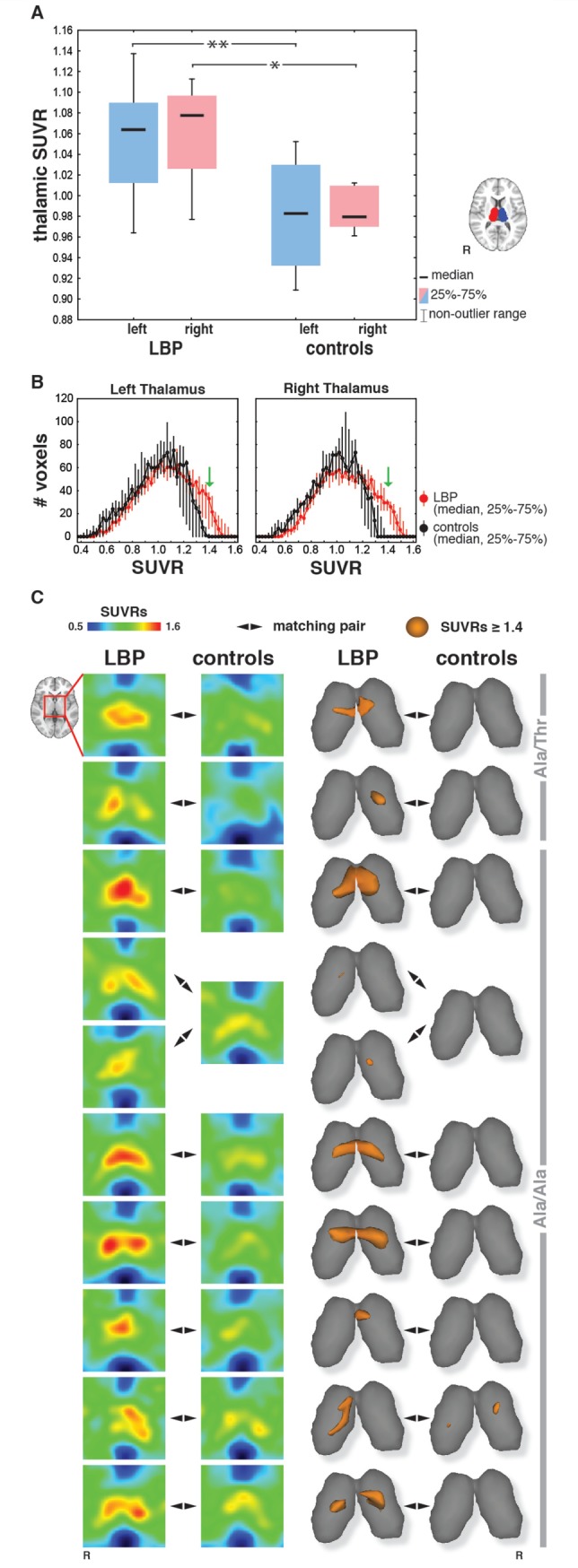
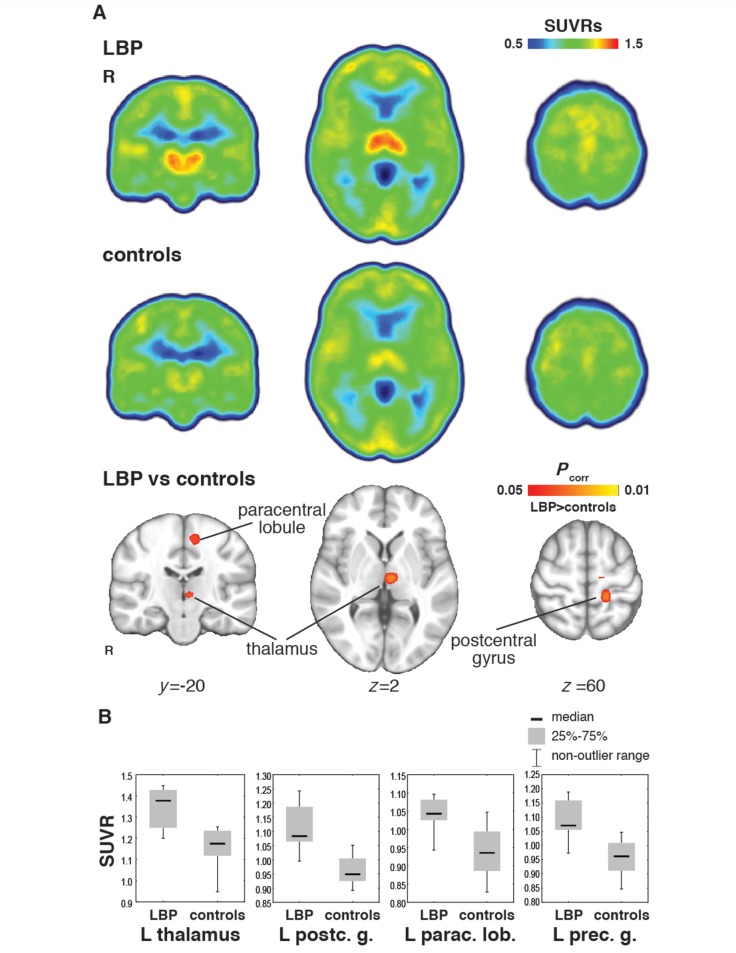
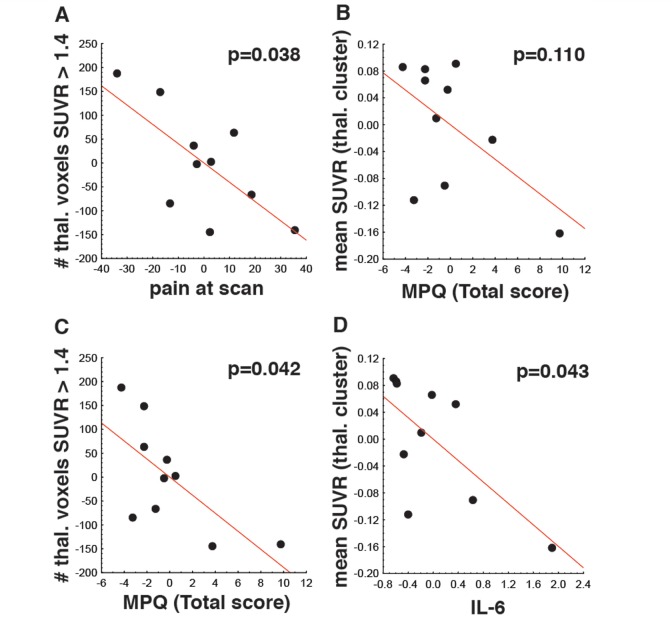
Although substantial evidence has established that microglia and astrocytes play a key role in the establishment and maintenance of persistent pain in animal models, the role of glial cells in human pain disorders remains unknown. Here, using the novel technology of integrated positron emission tomography-magnetic resonance imaging and the recently developed radioligand (11)C-PBR28, we show increased brain levels of the translocator protein (TSPO), a marker of glial activation, in patients with chronic low back pain. As the Ala147Thr polymorphism in the TSPO gene affects binding affinity for (11)C-PBR28, nine patient-control pairs were identified from a larger sample of subjects screened and genotyped, and compared in a matched-pairs design, in which each patient was matched to a TSPO polymorphism-, age- and sex-matched control subject (seven Ala/Ala and two Ala/Thr, five males and four females in each group; median age difference: 1 year; age range: 29-63 for patients and 28-65 for controls). Standardized uptake values normalized to whole brain were significantly higher in patients than controls in multiple brain regions, including thalamus and the putative somatosensory representations of the lumbar spine and leg. The thalamic levels of TSPO were negatively correlated with clinical pain and circulating levels of the proinflammatory citokine interleukin-6, suggesting that TSPO expression exerts pain-protective/anti-inflammatory effects in humans, as predicted by animal studies. Given the putative role of activated glia in the establishment and or maintenance of persistent pain, the present findings offer clinical implications that may serve to guide future studies of the pathophysiology and management of a variety of persistent pain conditions.
Keywords: 11C-PBR28; TSPO; chronic pain; glia; neuroinflammation; translocator protein (18kDa).
© The Author (2015). Published by Oxford University Press on behalf of the Guarantors of Brain. All rights reserved. For Permissions, please email: journals.permissions@oup.com.
Figures
References
-
- Abourbeh G, Theze B, Maroy R, Dubois A, Brulon V, Fontyn Y, et al. Imaging microglial/macrophage activation in spinal cords of experimental autoimmune encephalomyelitis rats by positron emission tomography using the mitochondrial 18 kDa translocator protein radioligand [(1)(8)F]DPA-714. J Neurosci. 2012 25; 32: 5728–36. - PMC - PubMed
-
- Bae KR, Shim HJ, Balu D, Kim SR, Yu SW. Translocator protein 18 kDa negatively regulates inflammation in microglia. J Neuroimmune Pharmacol. 2014;9:424–37. - PubMed
-
- Banati RB, Myers R, Kreutzberg GW. PK (‘peripheral benzodiazepine')—binding sites in the CNS indicate early and discrete brain lesions: microautoradiographic detection of [3H]PK11195 binding to activated microglia. J Neurocytol. 1997;26:77–82. - PubMed
-
- Banati RB, Newcombe J, Gunn RN, Cagnin A, Turkheimer F, Heppner F, et al. The peripheral benzodiazepine binding site in the brain in multiple sclerosis: quantitative in vivo imaging of microglia as a measure of disease activity. Brain. 2000;123(Pt 11):2321–37. - PubMed
-
- Banati RB. Neuropathological imaging: in vivo detection of glial activation as a measure of disease and adaptive change in the brain. Br Med Bull. 2003;65:121–31. - PubMed
Publication types
MeSH terms
Substances
Grants and funding
- S10 RR022976/RR/NCRR NIH HHS/United States
- 8UL1TR000170-05/TR/NCATS NIH HHS/United States
- 1UL1TR001102-01/TR/NCATS NIH HHS/United States
- R01 DE022743/DE/NIDCR NIH HHS/United States
- R21 NS087472/NS/NINDS NIH HHS/United States
- S10 RR026666/RR/NCRR NIH HHS/United States
- 1R21NS087472-01A1/NS/NINDS NIH HHS/United States
- S10 RR023385/RR/NCRR NIH HHS/United States
- UL1 TR000170/TR/NCATS NIH HHS/United States
- UL1 TR001102/TR/NCATS NIH HHS/United States
- UL1 RR025758/RR/NCRR NIH HHS/United States
- R01 EB014894/EB/NIBIB NIH HHS/United States
- T32 EB013180/EB/NIBIB NIH HHS/United States
- 1UL1RR025758-04/RR/NCRR NIH HHS/United States
LinkOut - more resources
Full Text Sources
Other Literature Sources
Medical
Research Materials
