


The role of continuous positive airway pressure in blood pressure control for patients with obstructive sleep apnea and hypertension: a meta-analysis of randomized controlled trials
- PMID: 25582849
- PMCID: PMC8032019
- DOI: 10.1111/jch.12472
The role of continuous positive airway pressure in blood pressure control for patients with obstructive sleep apnea and hypertension: a meta-analysis of randomized controlled trials
Abstract
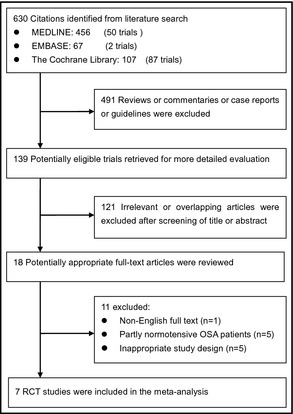
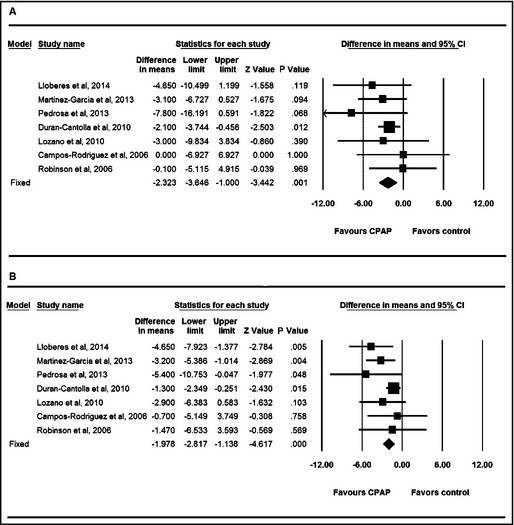
The aim of this study was to review the effect of continuous positive airway pressure (CPAP) on blood pressure (BP) in patients with obstructive sleep apnea (OSA) and hypertension. Biomedical databases were searched for randomized controlled trials (RCTs) comparing CPAP with control among these patients. Seven RCTs reporting 24-hour ambulatory BP were identified for meta-analysis. CPAP was associated with significant reductions in 24-hour ambulatory systolic blood pressure (SBP) (-2.32 mm Hg; 95% confidence interval [CI], -3.65 to -1.00) and diastolic blood pressure (DBP) (-1.98 mm Hg; 95% CI, -2.82 to -1.14). CPAP led to more significant improvement in nocturnal SBP than that in diurnal SBP. Subgroup analysis showed that patients with resistant hypertension or receiving antihypertensive drugs benefited most from CPAP. Meta-regression indicated that CPAP compliance, age, and baseline SBP were positively correlated with decrease in 24-hour DBP, but not reduction in 24-hour SBP.
© 2015 Wiley Periodicals, Inc.
Figures
References
-
- Young T, Peppard PE, Gottlieb DJ. Epidemiology of obstructive sleep apnea: a population health perspective. Am J Respir Crit Care Med. 2002;165:1217–1239. - PubMed
-
- Pack AI, Gislason T. Obstructive sleep apnea and cardiovascular disease: a perspective and future directions. Prog Cardiovasc Dis. 2009;51:434–451. - PubMed
-
- Duran J, Esnaola S, Rubio R, Iztueta A. Obstructive sleep apnea‐hypopnea and related clinical features in a population‐based sample of subjects aged 30 to 70 yr. Am J Respir Crit Care Med. 2001;163(3 Pt 1):685–689. - PubMed
-
- Pataka A, Riha RL. Continuous positive airway pressure and cardiovascular events in patients with obstructive sleep apnea. Curr Cardiol Rep. 2013;15:385. - PubMed
Publication types
MeSH terms
LinkOut - more resources
Full Text Sources
Medical
