


Review
doi: 10.1161/HYPERTENSIONAHA.114.03585.
Epub 2015 Jan 12.
Epoxyeicosatrienoic acids, hypertension, and kidney injury
Affiliations
- PMID: 25583156
- PMCID: PMC4326585
- DOI: 10.1161/HYPERTENSIONAHA.114.03585
Item in Clipboard
Review
Epoxyeicosatrienoic acids, hypertension, and kidney injury
Hypertension.
2015 Mar.
No abstract available
Keywords: chronic renal insufficiency; eicosanoids; hypertension; kidney.
Figures
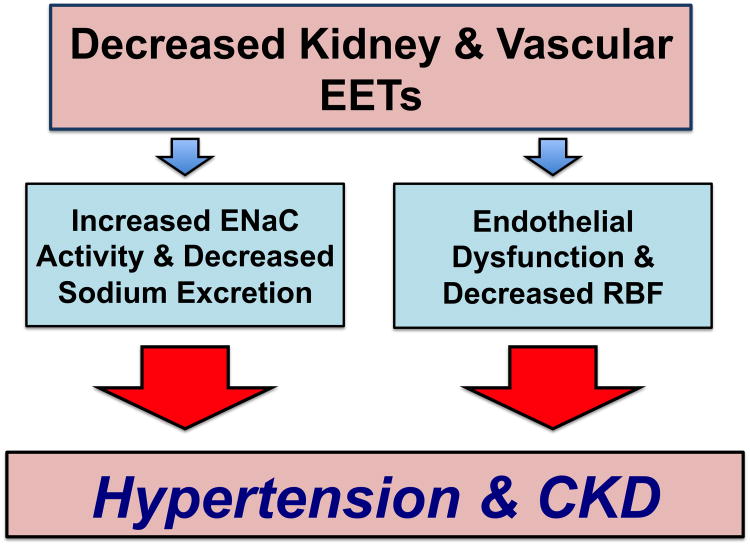
Decreased epoxyeicosatrienoic acids (EETS) contribute to enhanced epithelial sodium channel (ENaC) activity, endothelial dysfunction, and decreased renal blood flow (RBF). These changes in kidney and vascular function contribute to hypertension and CKD.
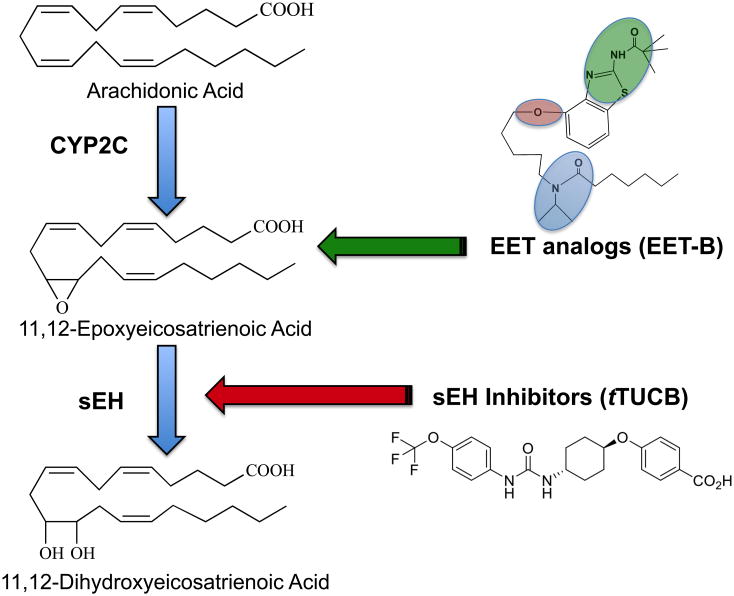
Arachidonic acid is converted to epoxyeicosatrienoic acids (EETs) by cytochrome P450 (CYP2C) epoxygenase enzymes. EETs primary metabolic fate is conversion to dihydroxyeicosatrienoic acids (DHETs) by the soluble epoxide hydrolase (sEH) enzyme. EET analogs and sEH inhibitors are two therapeutic approaches being tested to combat hypertension and kidney injury. EET-B has three structural attributes: (1) an acidic or hydrogen bonding replacement (green) for the C(1)-carboxylate to avoid esterification and β-oxidation; (2) a cis-Δ, -olefin or equivalent (red); (3) an epoxide isostere (mimetic) (blue) to obviate sEH metabolism.
References
-
- Coresh J, Selvin E, Stevens LA, Manzi J, Kusek JW, Eggers P, Van Lente F, Levey AS. Prevalence of chronic kidney disease in the United States. JAMA. 2007;298:2038–2047. - PubMed
-
- Foley RN, Collins AJ. End-stage renal disease in the United States: and update from the United States Renal Data System. J Am Soc Nephrol. 2007;18:2644–2648. - PubMed
-
- American Heart Association. High blood pressure statistics. Available at: http://www.americanheart.org/presenter.jhtml?identifier=4621.
-
- Crook ED. the role of hypertension, obesity, and diabetes in causing renal vascular disease. American Journal of Medical Sciences. 1999;317:183–188. - PubMed
-
- Barri YM. Hypertension and kidney diseases: a deadly connection. Curr Hypertens Rep. 2008;10:39–45. - PubMed
Publication types
MeSH terms
Substances
Grants and funding
LinkOut - more resources
Full Text Sources
Medical
