


Detection rates of premalignant polyps during screening colonoscopy: time to revise quality standards?
- PMID: 25583558
- PMCID: PMC4340745
- DOI: 10.1016/j.gie.2014.07.030
Detection rates of premalignant polyps during screening colonoscopy: time to revise quality standards?
Abstract
Background: Standards for the detection of adenomas during screening colonoscopy are widely used to measure examination quality. No such standards exist for sessile serrated adenomas (SSAs).
Objective: To measure both the adenoma detection rate (ADR) and SSA detection rate (SSADR) during screening colonoscopy before and after quality improvement/financial incentive measures.
Design: Retrospective determination of baseline ADR/SSADR by the endoscopist, followed by prospective collection of data after informing physicians of baseline detection rates.
Setting: Tertiary cancer center with a large cancer screening program.
Patients: A total of 2833 average-risk colorectal cancer screening patients 50 to 75 years of age undergoing initial colonoscopy.
Data collection: Electronic medical records for indication and demographics, endoscopy report, and pathology report.
Main outcome measurements: Detection rates of adenomas and SSAs by sex.
Results: The overall ADR in male and female patients was 50.6% and 36.6%, respectively. The overall detection rate of advanced adenomas in male and female patients was 12.4% and 6.5%, respectively. The overall SSADR in male and female patients was 10.1% and 7.1%, respectively. In 108 patients (3.8% of entire group), SSAs were the only premalignant lesions found. Detection rates of both types of premalignant polyps improved over time but did not reach statistical significance.
Limitations: Single-center experience with limited sample size and small group of endoscopists.
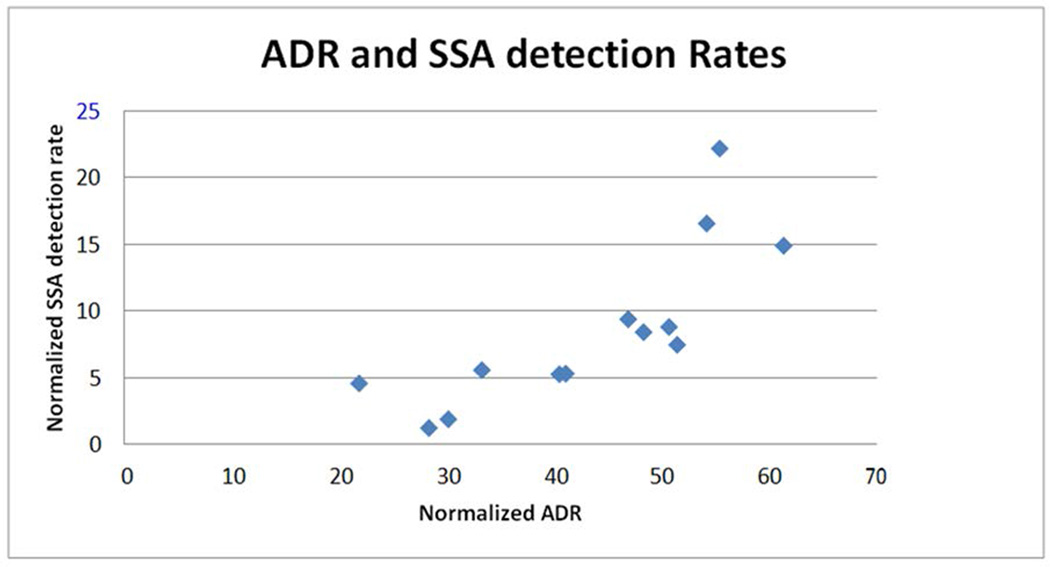
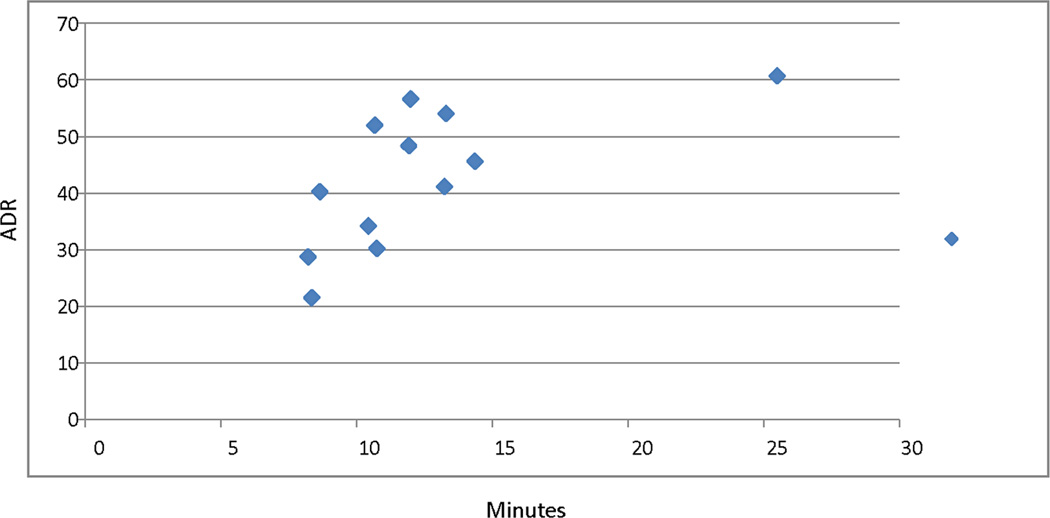
Conclusion: ADRs far in excess of current standards are achievable. Cecal withdrawal time is associated with the ADR. Prevalence of SSA rivals that of advanced adenomas and is greater than current medical literature suggests. The combination of monitoring and financial incentives did not result in statistically significant improvement in ADRs.
Copyright © 2015 American Society for Gastrointestinal Endoscopy. Published by Elsevier Inc. All rights reserved.
Figures
References
-
- Imperiale TF, Ransohoff DF, Itzkowitz SH, Turnbull BA, Ross ME Colorectal Cancer Study G. Fecal DNA versus fecal occult blood for colorectal-cancer screening in an average-risk population. The New England journal of medicine. 2004;351:2704–2714. - PubMed
-
- Johnson DA, Gurney MS, Volpe RJ, Jones DM, VanNess MM, Chobanian SJ, et al. A prospective study of the prevalence of colonic neoplasms in asymptomatic patients with an age-related risk. The American journal of gastroenterology. 1990;85:969–974. - PubMed
-
- Kadakia SC, Wrobleski CS, Kadakia AS, Meier NJ. Prevalence of proximal colonic polyps in average-risk asymptomatic patients with negative fecal occult blood tests and flexible sigmoidoscopy. Gastrointestinal endoscopy. 1996;44:112–117. - PubMed
-
- Lieberman DA, Weiss DG, Bond JH, Ahnen DJ, Garewal H, Chejfec G. Use of colonoscopy to screen asymptomatic adults for colorectal cancer. Veterans Affairs Cooperative Study Group 380. The New England journal of medicine. 2000;343:162–168. - PubMed
-
- Rex DK. Quality in colonoscopy: cecal intubation first, then what? The American journal of gastroenterology. 2006;101:732–734. - PubMed
Publication types
MeSH terms
Grants and funding
LinkOut - more resources
Full Text Sources
Other Literature Sources
Medical
Research Materials
