


The incidence and prevalence of psychiatric disorders in multiple sclerosis: a systematic review
- PMID: 25583845
- PMCID: PMC4429164
- DOI: 10.1177/1352458514564487
The incidence and prevalence of psychiatric disorders in multiple sclerosis: a systematic review
Abstract
Background: Psychiatric comorbidity is associated with lower quality of life, more fatigue, and reduced adherence to disease-modifying therapy in multiple sclerosis (MS).
Objectives: The objectives of this review are to estimate the incidence and prevalence of selected comorbid psychiatric disorders in MS and evaluate the quality of included studies.
Methods: We searched the PubMed, PsychInfo, SCOPUS, and Web of Knowledge databases and reference lists of retrieved articles. Abstracts were screened for relevance by two independent reviewers, followed by full-text review. Data were abstracted by one reviewer, and verified by a second reviewer. Study quality was evaluated using a standardized tool. For population-based studies we assessed heterogeneity quantitatively using the I² statistic, and conducted meta-analyses.
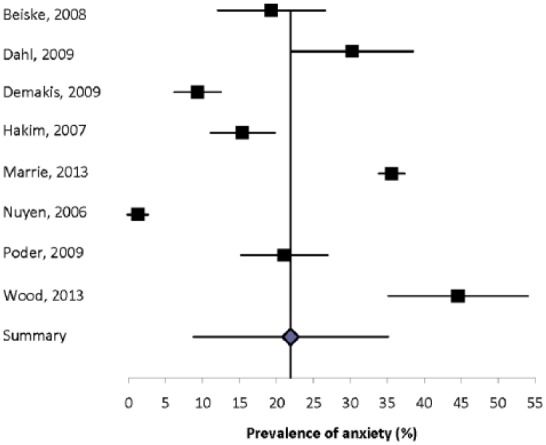
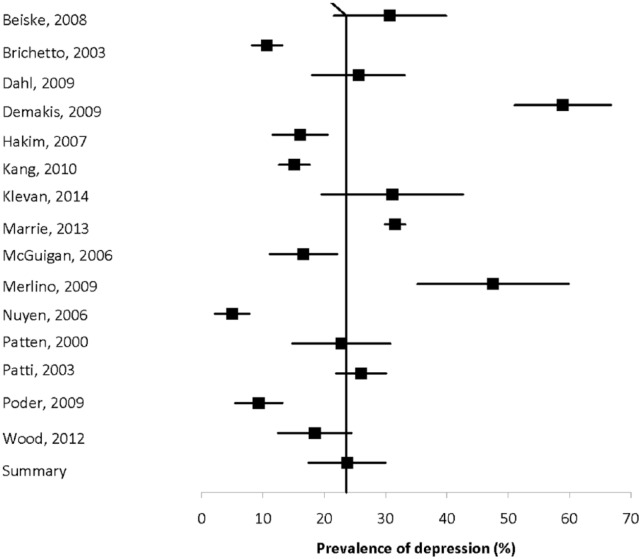
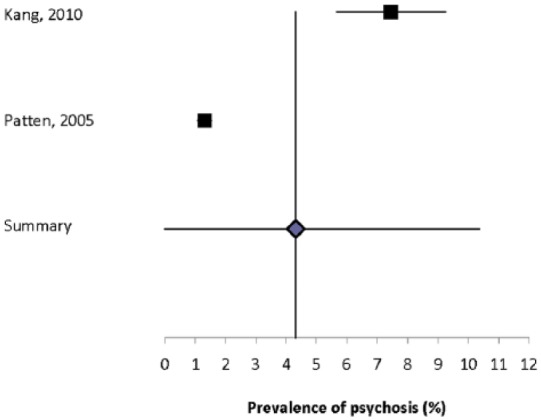
Results: We included 118 studies in this review. Among population-based studies, the prevalence of anxiety was 21.9% (95% CI: 8.76%-35.0%), while it was 14.8% for alcohol abuse, 5.83% for bipolar disorder, 23.7% (95% CI: 17.4%-30.0%) for depression, 2.5% for substance abuse, and 4.3% (95% CI: 0%-10.3%) for psychosis.
Conclusion: This review confirms that psychiatric comorbidity, particularly depression and anxiety, is common in MS. However, the incidence of psychiatric comorbidity remains understudied. Future comparisons across studies would be enhanced by developing a consistent approach to measuring psychiatric comorbidity, and reporting of age-, sex-, and ethnicity-specific estimates.
Keywords: Multiple sclerosis; anxiety; bipolar disorder; comorbidity; depression; incidence; prevalence; psychosis; systematic review.
© The Author(s), 2015.
Conflict of interest statement
Nadia Reider has nothing to declare.
Olaf Stuve is an associate editor of
Jeffrey Cohen reports personal compensation for consulting from EMD Serono, Genentech, Genzyme, Innate Immunotherapeutics, Novartis, and Vaccinex. He receives research support paid to his institution from Biogen Idec, Consortium of MS Centers, US Department of Defense, Genzyme, US National Institutes of Health, National MS Society, Novartis, Receptos, Synthon, Teva, and Vaccinex.
Per Soelberg Sørensen has received personal compensation for serving on scientific advisory boards, steering committees, independent data monitoring boards in clinical trials, or speaking at scientific meetings from Biogen Idec, Merck Serono, Novartis, Genmab, TEVA, GSK, Genzyme, Bayer Schering, Sanofi-aventis and MedDay Pharmaceuticals. His research unit has received research support from Biogen Idec, Merck Serono, Teva, Sanofi-Aventis, Novartis, RoFAR, Roche, and Genzyme.
Maria Trojano has served on scientific Advisory Boards for Biogen Idec, Novartis and Merck Serono; has received speaker honoraria from Biogen-Idec, Sanofi-Aventis, Merck-Serono, Teva and Novartis; has received research grants from Biogen-Idec, Merck-Serono, and Novartis.
Gary Cutter has served on scientific advisory boards for and/or received funding for travel from Innate immunity, Klein-Buendel Incorporated, Genzyme, Medimmune, Novartis, Nuron Biotech, Spiniflex Pharmaceuticals, Somahlution, Teva Pharmaceuticals; receives royalties from publishing
Stephen Reingold reports personal consulting fees from the National Multiple Sclerosis Society (NMSS) and the European Committee for Treatment and Research in Multiple Sclerosis (ECTRIMS), during the conduct of this work; and over the past three years, personal consulting fees from Bayer HealthCare, Biogen Idec, Coronado Biosciences Inc, the Cleveland Clinic Foundation, Eli Lilly & Company, from EMD Serono and Merck Serono, Genentech, F. Hoffmann-LaRoche, Ironwood Pharmaceuticals Inc, ISIS Pharmaceuticals Inc, Medimmune Inc, Novartis Pharmaceuticals Corporation, Observatoire Français de la Sclérosis en Plaques, Opexa Therapeutics, Sanofi-Aventis, SK Biopharmaceuticals, Synthon Pharmaceuticals Inc, Teva Pharmaceutical Industries, and Fondation pour l’aide à la Recherche sur la Sclérosis en Plaques, for activities outside of the submitted work.
Figures
References
-
- Mohr DC, Goodkin DE, Likosky W, et al. Treatment of depression improves adherence to interferon beta-1b therapy for multiple sclerosis. Arch Neurol 1997; 54: 531–533. - PubMed
-
- Rodgers J, Bland R. Psychiatric manifestations of multiple sclerosis: A review. Can J Psychiatry 1996; 41: 441–445. - PubMed
-
- Patten SB, Svenson LW, Metz LM. Psychotic disorders in MS: Population-based evidence of an association. Neurology 2005; 65: 1123–1125. - PubMed
Publication types
MeSH terms
LinkOut - more resources
Full Text Sources
Other Literature Sources
Medical
