


Of flies, mice, and men: evolutionarily conserved tissue damage responses and aging
- PMID: 25584795
- PMCID: PMC4450349
- DOI: 10.1016/j.devcel.2014.11.028
Of flies, mice, and men: evolutionarily conserved tissue damage responses and aging
Abstract
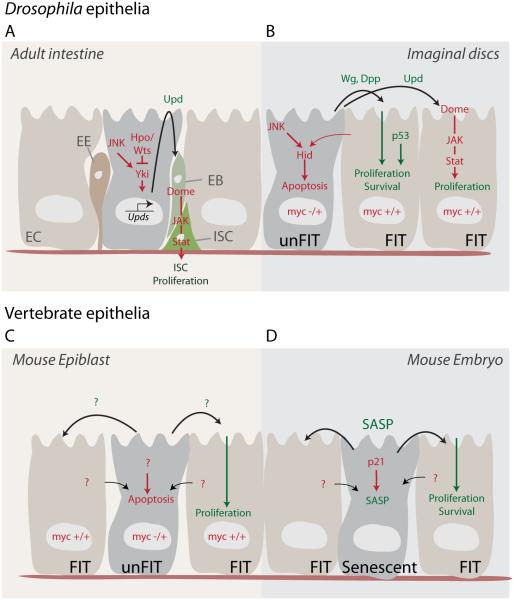
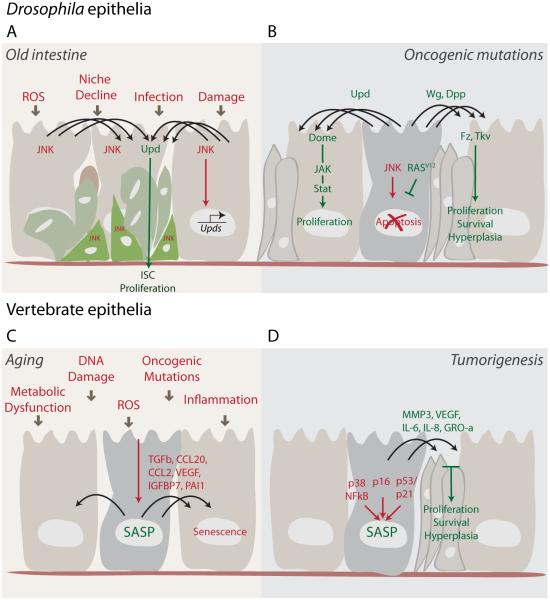
Studies in flies, mice, and human models have provided a conceptual framework for how paracrine interactions between damaged cells and the surrounding tissue control tissue repair. These studies have amassed evidence for an evolutionarily conserved secretory program that regulates tissue homeostasis. This program coordinates cell survival and proliferation during tissue regeneration and repair in young animals. By virtue of chronic engagement, however, it also contributes to the age-related decline of tissue homeostasis leading to degeneration, metabolic dysfunction, and cancer. Here, we review recent studies that shed light on the nature and regulation of this evolutionarily conserved secretory program.
Copyright © 2015 Elsevier Inc. All rights reserved.
Figures
References
-
- Acosta JC, O’Loghlen A, Banito A, Guijarro MV, Augert A, Raguz S, Furnagalli M, DaCosta M, Brown C, Popov N, et al. Chemokine signaling via the CXCR2 receptor reinforces senescence. Cell. 2008;133:1006–1018. - PubMed
-
- Adams PD. Healing and hurting: molecular mechanisms, functions and pathologies of cellular senescence. Molec Cell. 2009;36:2–14. - PubMed
-
- Adler PN, Bryant PJ. Participation of lethally irradiated imaginal disc tissue in pattern regulation in Drosophila. Developmental biology. 1977;60:298–304. - PubMed
-
- Agaisse H, Petersen UM, Boutros M, Mathey-Prevot B, Perrimon N. Signaling role of hemocytes in Drosophila JAK/STAT-dependent response to septic injury. Developmental cell. 2003;5:441–450. - PubMed
Publication types
MeSH terms
Grants and funding
- R01 EY018177/EY/NEI NIH HHS/United States
- GM100196/GM/NIGMS NIH HHS/United States
- AG041122/AG/NIA NIH HHS/United States
- AG028127/AG/NIA NIH HHS/United States
- R01 AG028127/AG/NIA NIH HHS/United States
- AG009909/AG/NIA NIH HHS/United States
- AG017242/AG/NIA NIH HHS/United States
- R37 AG009909/AG/NIA NIH HHS/United States
- R56 AG009909/AG/NIA NIH HHS/United States
- P01 AG041122/AG/NIA NIH HHS/United States
- R01 GM100196/GM/NIGMS NIH HHS/United States
- P01 AG017242/AG/NIA NIH HHS/United States
- EY018177/EY/NEI NIH HHS/United States
LinkOut - more resources
Full Text Sources
Other Literature Sources
Medical
