Neuropsychiatric symptoms as predictors of progression to severe Alzheimer's dementia and death: the Cache County Dementia Progression Study
- PMID: 25585033
- PMCID: PMC4416978
- DOI: 10.1176/appi.ajp.2014.14040480
Neuropsychiatric symptoms as predictors of progression to severe Alzheimer's dementia and death: the Cache County Dementia Progression Study
Abstract
Objective: Little is known about factors influencing the rate of progression of Alzheimer's dementia. Using data from the Cache County Dementia Progression Study, the authors examined the link between clinically significant neuropsychiatric symptoms in mild Alzheimer's dementia and progression to severe dementia or death.
Method: The Cache County Dementia Progression Study is a longitudinal study of dementia progression in incident cases of this condition. Survival analyses included unadjusted Kaplan-Meier plots and multivariate Cox proportional hazard models. Hazard ratio estimates controlled for age at dementia onset, dementia duration at baseline, gender, education level, General Medical Health Rating, and apolipoprotein E epsilon 4 genotype.
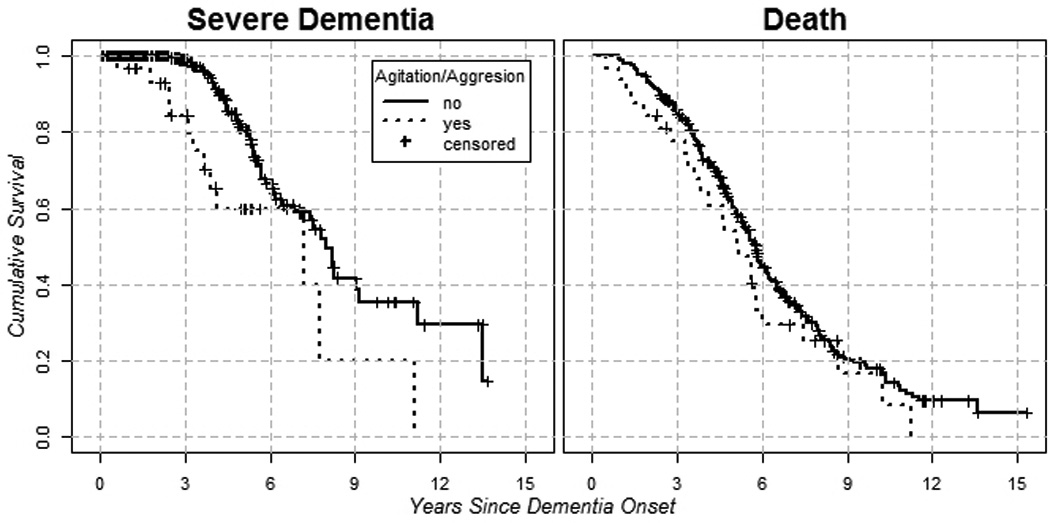
Results: Three hundred thirty-five patients with incident Alzheimer's dementia were studied. Sixty-eight (20%) developed severe dementia over the follow-up period. Psychosis (hazard ratio=2.007), agitation/aggression (hazard ratio=2.946), and any one clinically significant neuropsychiatric symptom (domain score ≥4, hazard ratio=2.682) were associated with more rapid progression to severe dementia. Psychosis (hazard ratio=1.537), affective symptoms (hazard ratio=1.510), agitation/aggression (hazard ratio=1.942), mildly symptomatic neuropsychiatric symptoms (domain score of 1-3, hazard ratio=1.448), and clinically significant neuropsychiatric symptoms (hazard ratio=1.951) were associated with earlier death.
Conclusions: Specific neuropsychiatric symptoms are associated with shorter survival time from mild Alzheimer's dementia to severe dementia and/or death. The treatment of specific neuropsychiatric symptoms in mild Alzheimer's dementia should be examined for its potential to delay time to severe dementia or death.
Figures
Comment in
-
Neuropsychiatric symptoms in dementia: a cause or consequence?Am J Psychiatry. 2015 May;172(5):410-1. doi: 10.1176/appi.ajp.2015.15030277. Am J Psychiatry. 2015. PMID: 25930129 No abstract available.
References
-
- Rabins P, Lyketsos C, Steele C. Practical Dementia Care. 2nd ed. New York: Oxford University Press; 2006.
-
- Alzheimer's Association. 2012 Alzheimer's Disease Facts and Figures. 2012. - PubMed
-
- Lopez OL, Schwam E, Cummings J, Gauthier S, Jones R, Wilkinson D, Waldemar G, Zhang R, Schindler R. Predicting cognitive decline in Alzheimer's disease: an integrated analysis. Alzheimers Dement. 2010 Nov;6(6):431–439. - PubMed
-
- Stern Y, Tang MX, Albert MS, Brandt J, Jacobs DM, Bell K, Marder K, Sano M, Devanand D, Albert SM, Bylsma F, Tsai WY. Predicting time to nursing home care and death in individuals with Alzheimer disease. JAMA. 1997 Mar 12;277(10):806–812. - PubMed
Publication types
MeSH terms
Grants and funding
LinkOut - more resources
Full Text Sources
Other Literature Sources
Medical