


Rapid automated microscopy for microbiological surveillance of ventilator-associated pneumonia
- PMID: 25585163
- PMCID: PMC4384769
- DOI: 10.1164/rccm.201408-1468OC
Rapid automated microscopy for microbiological surveillance of ventilator-associated pneumonia
Abstract
Rationale: Diagnosis of ventilator-associated pneumonia (VAP) is imprecise.
Objectives: To (1) determine whether alternate-day surveillance mini-bronchoalveolar lavage (mini-BAL) in ventilated adults could reduce time to initiation of targeted treatment and (2) evaluate the potential for automated microscopy to reduce analysis time.
Methods: Adult intensive care unit patients who were anticipated to require ventilation for at least a further 48 hours were included. Mini-BALs were processed for identification, quantitation, and antibiotic susceptibility, using (1) clinical culture (50 ± 7 h) and (2) automated microscopy (∼5 h plus offline analysis).
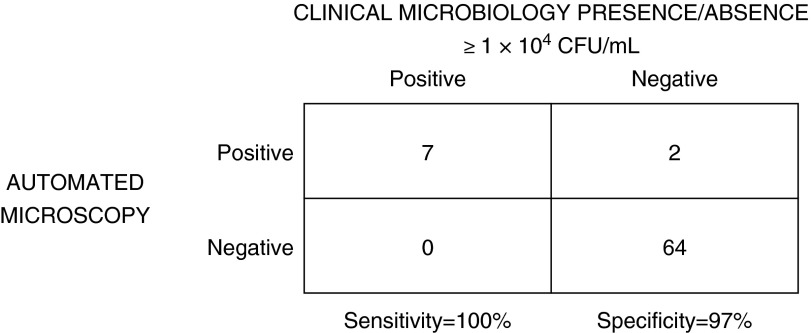
Measurements and main results: Seventy-seven mini-BALs were performed in 33 patients. One patient (3%) was clinically diagnosed with VAP. Of 73 paired samples, culture identified 7 containing pneumonia panel bacteria (>10(4) colony-forming units/ml) from five patients (15%) (4 Staphylococcus aureus [3 methicillin-resistant S. aureus], 2 Stenotrophomonas maltophilia, 1 Klebsiella pneumoniae) and resulted in antimicrobial changes/additions to two of five (40%) of those patients. Microscopy identified 7 of 7 microbiologically positive organisms and 64 of 66 negative samples compared with culture. Antimicrobial responses were concordant in four of five comparisons. Antimicrobial changes/additions would have occurred in three of seven microscopy-positive patients (43%) had those results been clinically available in 5 hours, including one patient diagnosed later with VAP despite negative mini-BAL cultures.
Conclusions: Microbiological surveillance detected infection in patients at risk for VAP independent of clinical signs, resulting in changes to antimicrobial therapy. Automated microscopy was 100% sensitive and 97% specific for high-risk pneumonia organisms compared with clinical culturing. Rapid microscopy-based surveillance may be informative for treatment and antimicrobial stewardship in patients at risk for VAP.
Keywords: microbiological techniques; nosocomial infections; ventilator-associated pneumonia.
Figures
References
-
- Skrupky LP, McConnell K, Dallas J, Kollef MH. A comparison of ventilator-associated pneumonia rates as identified according to the National Healthcare Safety Network and American College of Chest Physicians criteria. Crit Care Med. 2012;40:281–284. - PubMed
-
- Kollef MH. What is ventilator-associated pneumonia and why is it important? Respir Care. 2005;50:714–721, discussion 721–724. - PubMed
-
- Kollef MH, Shorr A, Tabak YP, Gupta V, Liu LZ, Johannes RS. Epidemiology and outcomes of health-care-associated pneumonia: results from a large US database of culture-positive pneumonia. Chest. 2005;128:3854–3862. - PubMed
-
- Cosgrove SE. The relationship between antimicrobial resistance and patient outcomes: mortality, length of hospital stay, and health care costs. Clin Infect Dis. 2006;42:S82–S89. - PubMed
Publication types
MeSH terms
Grants and funding
LinkOut - more resources
Full Text Sources
Other Literature Sources
