


Postoperative blood transfusion strategy in frail, anemic elderly patients with hip fracture: the TRIFE randomized controlled trial
- PMID: 25586270
- PMCID: PMC4443456
- DOI: 10.3109/17453674.2015.1006980
Postoperative blood transfusion strategy in frail, anemic elderly patients with hip fracture: the TRIFE randomized controlled trial
Abstract
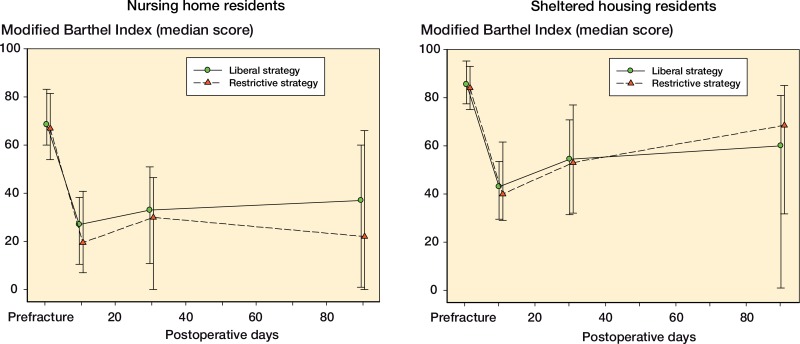
Background and purpose: Hip fracture (HF) in frail elderly patients is associated with poor physical recovery and death. There is often postoperative blood loss and the hemoglobin (Hb) threshold for red blood cell (RBC) transfusions in these patients is unknown. We investigated whether RBC transfusion strategies were associated with the degree of physical recovery or with reduced mortality after HF surgery.
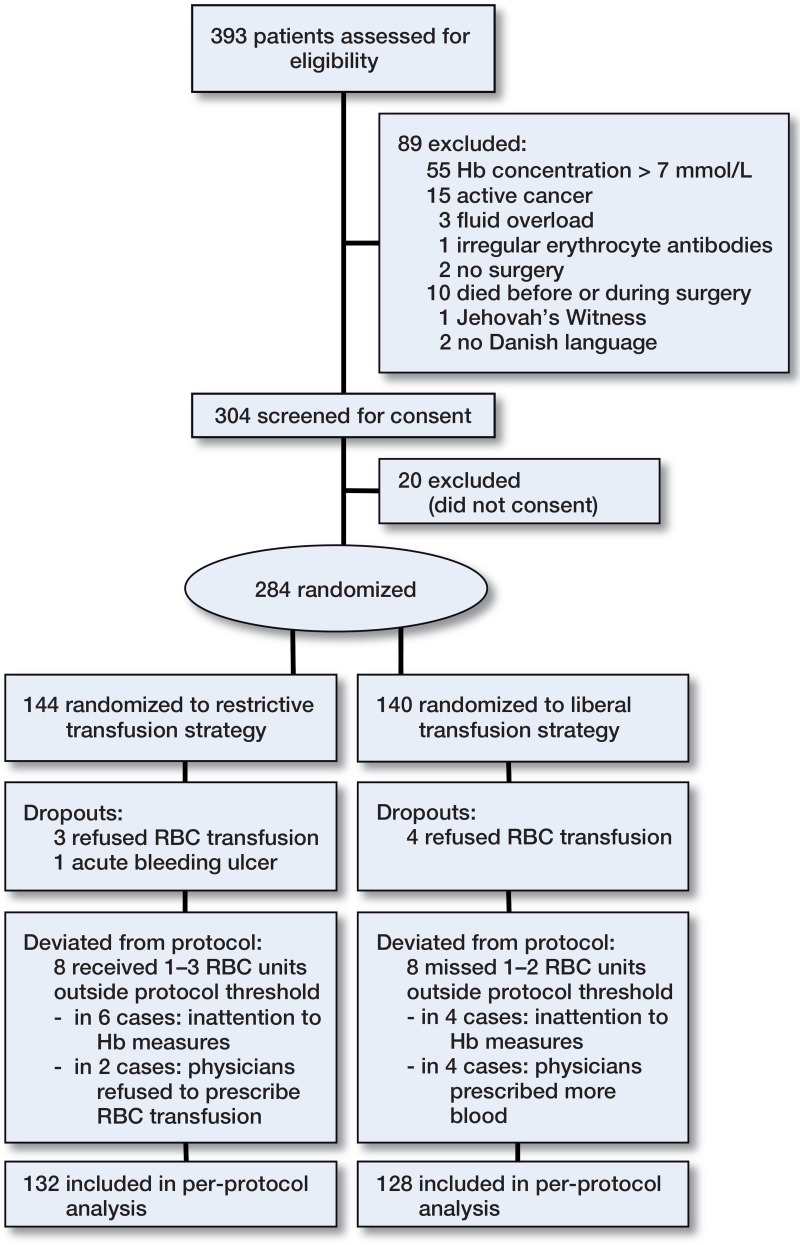
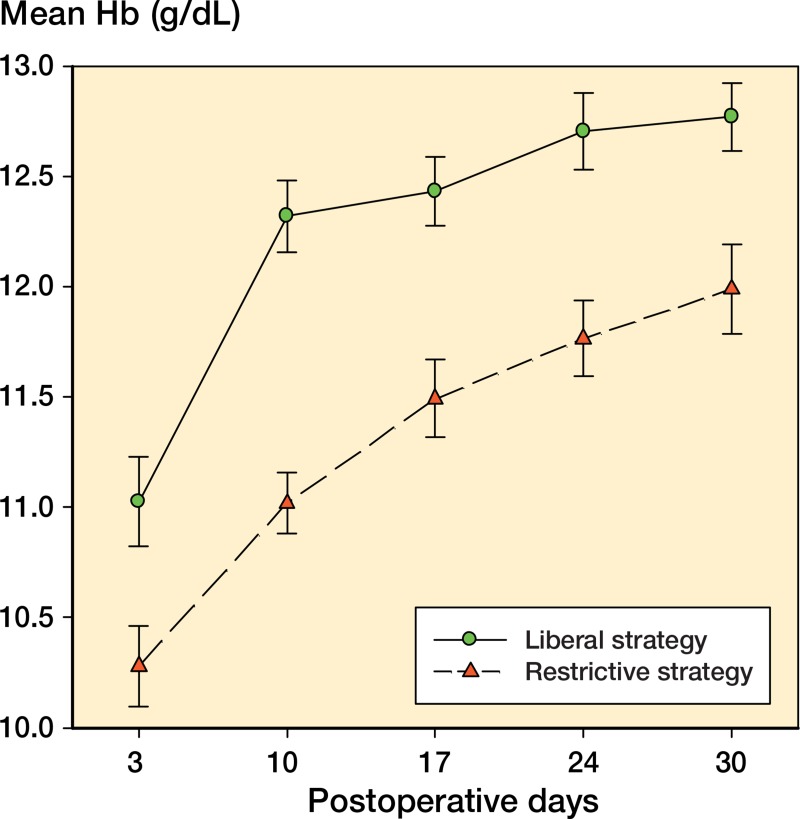
Patients and methods: We enrolled 284 consecutive post-surgical HF patients (aged ≥ 65 years) with Hb levels < 11.3 g/dL (7 mmol/L) who had been admitted from nursing homes or sheltered housing. Allocation was stratified by residence. The patients were randomly assigned to either restrictive (Hb < 9.7 g/dL; < 6 mmol/L) or liberal (Hb < 11.3 g/dL; < 7 mmol/L) RBC transfusions given within the first 30 days postoperatively. Follow-up was at 90 days.
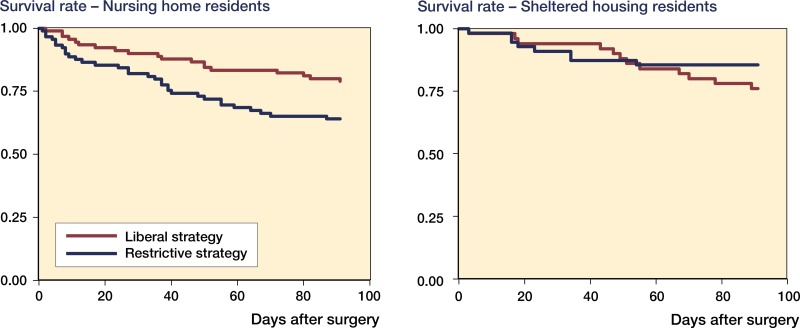
Results: No statistically significant differences were found in repeated measures of daily living activities or in 90-day mortality rate between the restrictive group (where 27% died) and the liberal group (where 21% died). Per-protocol 30-day mortality was higher with the restrictive strategy (hazard ratio (HR) = 2.4, 95% CI: 1.1-5.2; p = 0.03). The 90-day mortality rate was higher for nursing home residents in the restrictive transfusion group (36%) than for those in the liberal group (20%) (HR = 2.0, 95% CI: 1.1-3.6; p = 0.01).
Interpretation: According to our Hb thresholds, recovery from physical disabilities in frail elderly hip fracture patients was similar after a restrictive RBC transfusion strategy and after a liberal strategy. Implementation of a liberal RBC transfusion strategy in nursing home residents has the potential to increase survival.
Figures
References
-
- Bailey RA, Reardon G, Wasserman MR, McKenzie RS, Hord RS. Association of anemia with worsened activities of daily living and healt... . Health and Qual Life Outcomes. 2012;10:129. - PMC - PubMed
-
- Baker NL, Cook MN, Arrighi HM, Bullock R. Hip fracture risk and subsequent mortality among alzheimer’s disease pat... . Age Ageing. 2011;40(1):49–54. - PubMed
-
- Beaupre LA, Jones CA, Johnston DW, Wilson DM, Majumdar SR. Recovery of function following a hip fracture in geriatric ambulatory pe... . J Am Geriatr Soc. 2012;60(7):1268–73. - PubMed
-
- Berry SD, Samelson EJ, Bordes M, Broe K, Kiel DP. Survival of aged nursing home residents with hip fracture . J Gerontol A Biol Sci Med Sci. 2009;64(7):771–77. - PMC - PubMed
-
- Bjorkelund KB, Hommel A, Thorngren KG, Lundberg D, Larsson S. Factors at admission associated with 4 months outcome in elderly patient... . AANA J. 2009;77(1):49–58. - PubMed
Publication types
MeSH terms
Substances
LinkOut - more resources
Full Text Sources
Other Literature Sources
Medical
Research Materials
Miscellaneous