. 2015 Jan 13;6(1):e01681-14.
doi: 10.1128/mBio.01681-14.

Genomic avenue to avian colisepticemia

Affiliations

Genomic avenue to avian colisepticemia

Sagi Huja et al. mBio. .

Abstract

Here we present an extensive genomic and genetic analysis of Escherichia coli strains of serotype O78 that represent the major cause of avian colisepticemia, an invasive infection caused by avian pathogenic Escherichia coli (APEC) strains. It is associated with high mortality and morbidity, resulting in significant economic consequences for the poultry industry. To understand the genetic basis of the virulence of avian septicemic E. coli, we sequenced the entire genome of a clinical isolate of serotype O78-O78:H19 ST88 isolate 789 (O78-9)-and compared it with three publicly available APEC O78 sequences and one complete genome of APEC serotype O1 strain. Although there was a large variability in genome content between the APEC strains, several genes were conserved, which are potentially critical for colisepticemia. Some of these genes are present in multiple copies per genome or code for gene products with overlapping function, signifying their importance. A systematic deletion of each of these virulence-related genes identified three systems that are conserved in all septicemic strains examined and are critical for serum survival, a prerequisite for septicemia. These are the plasmid-encoded protein, the defective ETT2 (E. coli type 3 secretion system 2) type 3 secretion system ETT2sepsis, and iron uptake systems. Strain O78-9 is the only APEC O78 strain that also carried the regulon coding for yersiniabactin, the iron binding system of the Yersinia high-pathogenicity island. Interestingly, this system is the only one that cannot be complemented by other iron uptake systems under iron limitation and in serum.

Importance: Avian colisepticemia is a severe systemic disease of birds causing high morbidity and mortality and resulting in severe economic losses. The bacteria associated with avian colisepticemia are highly antibiotic resistant, making antibiotic treatment ineffective, and there is no effective vaccine due to the multitude of serotypes involved. To understand the disease and work out strategies to combat it, we performed an extensive genomic and genetic analysis of Escherichia coli strains of serotype O78, the major cause of the disease. We identified several potential virulence factors, conserved in all the colisepticemic strains examined, and determined their contribution to growth in serum, an absolute requirement for septicemia. These findings raise the possibility that specific vaccines or drugs can be developed against these critical virulence factors to help combat this economically important disease.


Figures

FIG 1
FIG 1
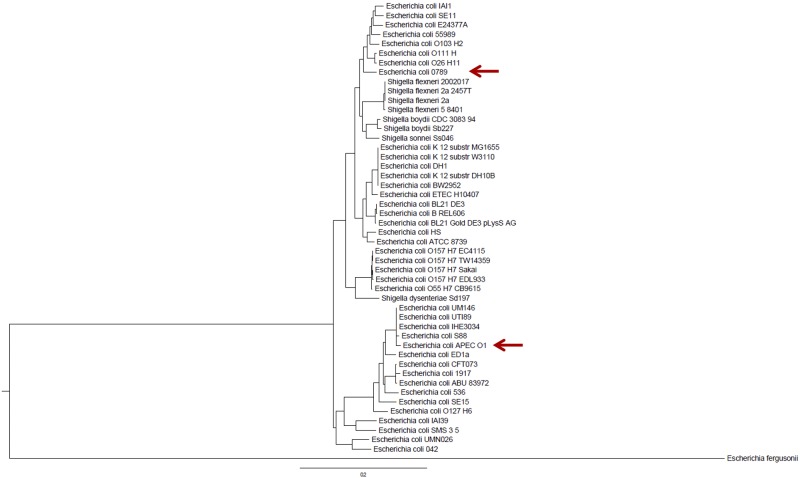
Phylogenetic tree of E. coli. The tree is based on 1,548 conserved core gene clusters of 47 E. coli genomes. For this analysis, only bacteria with whole-genome sequences were used. The tree was rooted using Escherichia fergusonii. Scale units are in nucleotide replacements per site. The arrows mark strain O78:H19 ST88 isolate 789 (O78-9) and strain O1 (22). substr, substrain.
FIG 2
FIG 2
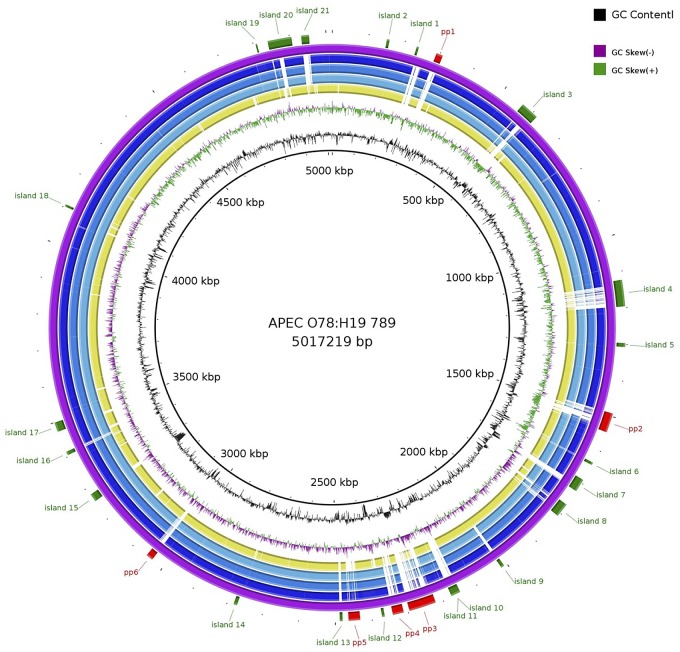
Genome comparison between E. coli O78-9, different APEC strains, and E. coli K-12 MG1655. The circles from outside to inside: O78-9; O78:H9-ST23 strains c7122, IMT 2125, and NC21063; and E. coli K-12 strain MG1655. Conserved and variable regions were detected in the genomes of the different APEC strains. E. coli O78-9 was used as a reference. The chromosomal localization of regions specific for APEC O78-9 (islands and prophages) have been indicated. The map was created using the BLAST Ring Image Generator (BRIG) (67).
FIG 3
FIG 3
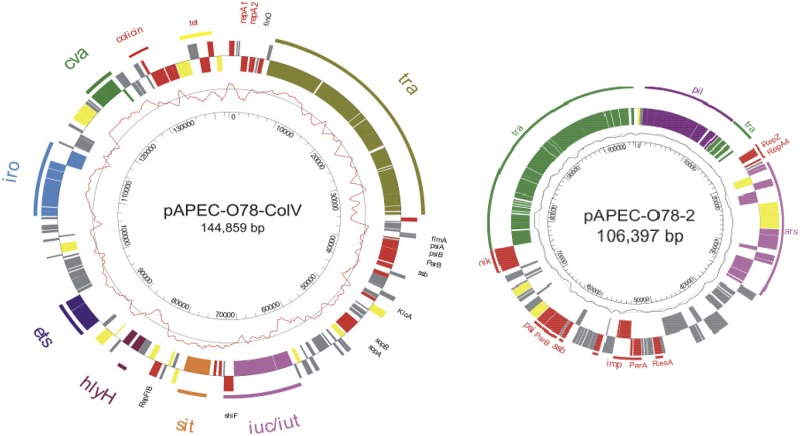
Map of the large virulence plasmids of APEC O78-9. The outer circle shows ORFs with functional classifications. The functional classifications are indicated by colors as follows: red, plasmid replication, stabilization, and maintenance; olive, plasmid transfer; yellow, mobile genetic elements; gray, unknown function. Virulence-associated operons cva (green), iro (blue), ets (dark blue), hlyF (brown), sit (orange), iuc or iut (pink) are indicated. The second and third circles show ORFs in the forward and reverse orientations, respectively. The fourth circle shows the G+C content plot. The innermost circle shows the scale. The map was created by using GenVision from DNASTAR.
FIG 4
FIG 4
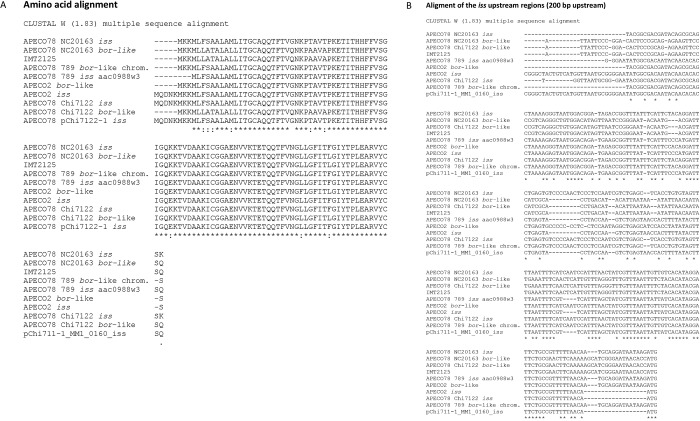
Comparison of Iss proteins and their upstream regions across different APEC strains. (A) Iss protein sequence. (B) iss regulatory sequence. Asterisks indicate positions which have a fully conserved residue. Colons indicate conservation between groups of strongly similar properties. chrom., chromosome.
FIG 5
FIG 5
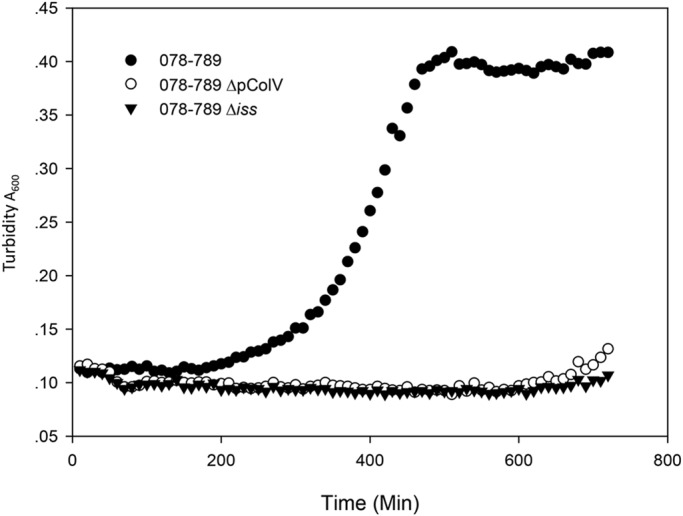
Growth of E. coli O78-9 and its iss mutants in 50% serum. For this experiment, we used E. coli strains O78-9, its mutant deleted for the iss gene (Δiss), and its derivative cured of the ColV plasmid (ΔpColV). Cultures were grown overnight in minimal MOPS medium and diluted into the same medium with or without 50% serum. Growth was monitored at an optical density or absorbance of 600 nm, and growth curves were generated on a Biotek Eon platform.
FIG 6
FIG 6
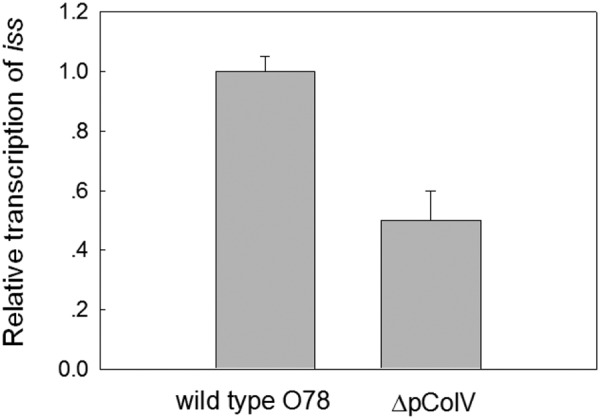
Levels of iss transcript. Cultures were grown in minimal MOPS medium. Transcript levels were determined by qRT-PCR as described in Materials and Methods.
FIG 7
FIG 7
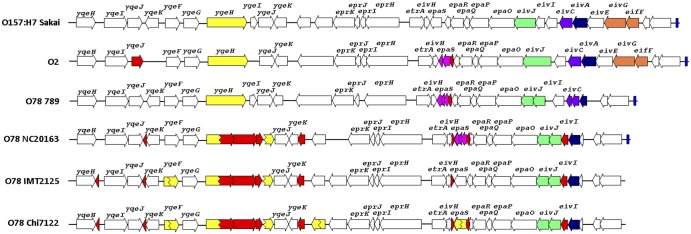
The operon coding for ETT2 (E. coli type 3 secretion system 2) in several E. coli. The genetic structure of the ETT2 determinants of APEC O2 and O78-9 isolates are compared with that of E. coli O157:H7 strain Sakai. Structural differences and ORFs with sequence alterations of the different ETT2 variants relative to the functional ETT2 gene cluster of E. coli O157:H7 strain Sakai have been highlighted. Different colors indicate ORFs affected by the genome plasticity. The ETT2 determinants of APEC O2 strain 1772, O78-9, and O78-H9-ST23 strains IMT2125 and χ7122 are compared.
FIG 8
FIG 8
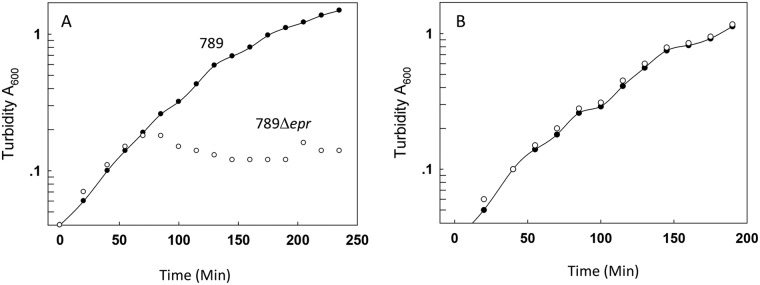
Effect of the ETT2 system on growth of E. coli O78-9 in serum. The experiment was conducted as described in the legend to Fig. 5. Cultures of E. coli O78-9 and its mutant deleted for the eprHIJK gene cluster of the ETT2 system were grown in minimal MOPS medium alone (B) or supplemented with 50% serum (A).
FIG 9
FIG 9
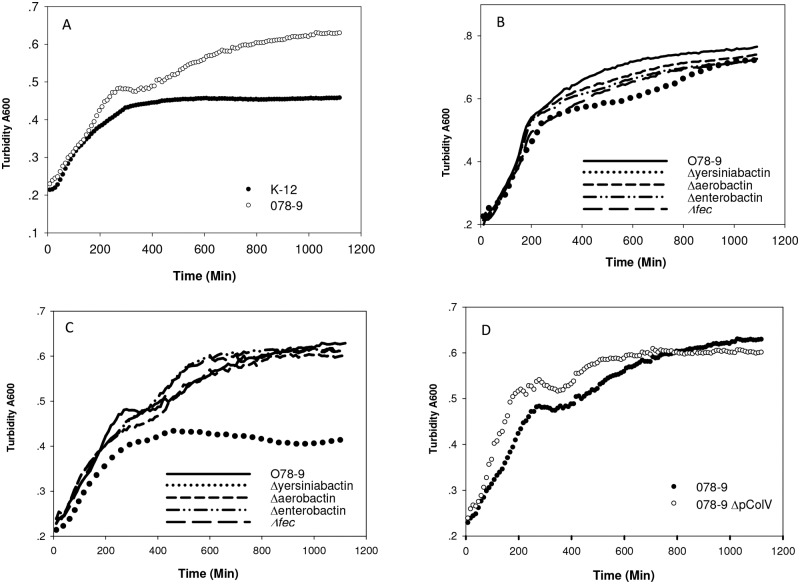
Growth of E. coli O78-9 and mutants in which genes coding for iron acquisition systems under iron limitation were deleted. Cultures were grown exponentially in LB medium as described in Materials and Methods. Iron depletion was with 0.4 mM 2,2′-dipyridyl. The bacteria tested were E. coli K-12 MG1655, O78-9 and its deletion mutants Δaerobactin, Δenterobactin, Δfec, and Δyersiniabactin cured of the ColV plasmid. (A) Growth of E. coli O78-9 and K-12 in the presence of Dipyridyl; (B) growth of O78-9 and its mutants in LB medium; (C) growth of O78-9 and its deletion strains in the presence of Dipyridyl; (D) growth of O78-9 and ΔColV in the presence of Dipyridyl.
FIG 10
FIG 10
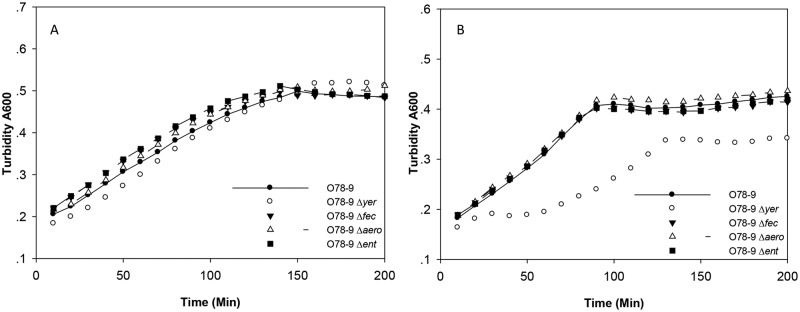
Serum survival of E. coli O78-9 and mutants in which the genes coding for iron acquisition systems were deleted. The culture conditions and bacterial strains and mutants were as described in the legend to Fig. 9. (A) Growth in LB medium alone; (B) growth of O78-9 in the presence of 50% serum.

References

    1. Kabir SML. 2010. Avian colibacillosis and salmonellosis: a closer look at epidemiology, pathogenesis, diagnosis, control and public health concerns. Int. J. Environ. Res. Public Health 7:89–114. doi: 10.3390/ijerph7010089. - DOI - PMC - PubMed
    1. Dho-Moulin M, Fairbrother JM. 1999. Avian pathogenic Escherichia coli (APEC). Vet. Res. 30:299–316. - PubMed
    1. Mellata M, Dho-Moulin M, Dozois CM, Curtiss R, Brown PK, Arné P, Brée A, Desautels C, Fairbrother JM. 2003. Role of virulence factors in resistance of avian pathogenic Escherichia coli to serum and in pathogenicity. Infect. Immun. 71:536–540. doi: 10.1128/IAI.71.1.536-540.2003. - DOI - PMC - PubMed
    1. Adiri RS, Gophna U, Ron EZ. 2003. Multilocus sequence typing (MLST) of Escherichia coli O78 strains. FEMS Microbiol. Lett. 222:199–203. doi: 10.1016/S0378-1097(03)00295-7. - DOI - PubMed
    1. Mokady D, Gophna U, Ron EZ. 2005. Extensive gene diversity in septicemic Escherichia coli strains. J. Clin. Microbiol. 43:66–73. doi: 10.1128/JCM.43.1.66-73.2005. - DOI - PMC - PubMed

Publication types

MeSH terms

Substances

Associated data