


Use of non-benzodiazepine sedative hypnotics and risk of falls in older men
- PMID: 25587493
- PMCID: PMC4289612
- DOI: 10.4172/2167-7182.1000158
Use of non-benzodiazepine sedative hypnotics and risk of falls in older men
Abstract
Background: To ascertain whether use of non-benzodiazepine sedative-hypnotics is associated with risk of falls and compare this to risk of falls associated with use of benzodiazepines.
Methods: Among 4450 community-dwelling men, aged 71 years and older, enrolled in the population-based prospective cohort study, Osteoporotic Fractures in Men (MrOS), use of nonbenzodiazepine sedative-hypnotics and benzodiazepines was assessed by interview and verified from medication containers at the third annual visit of the MrOS study. Falls in the subsequent one-year period were ascertained by tri-annual questionnaires and a computerized dictionary used to categorize type of medication.
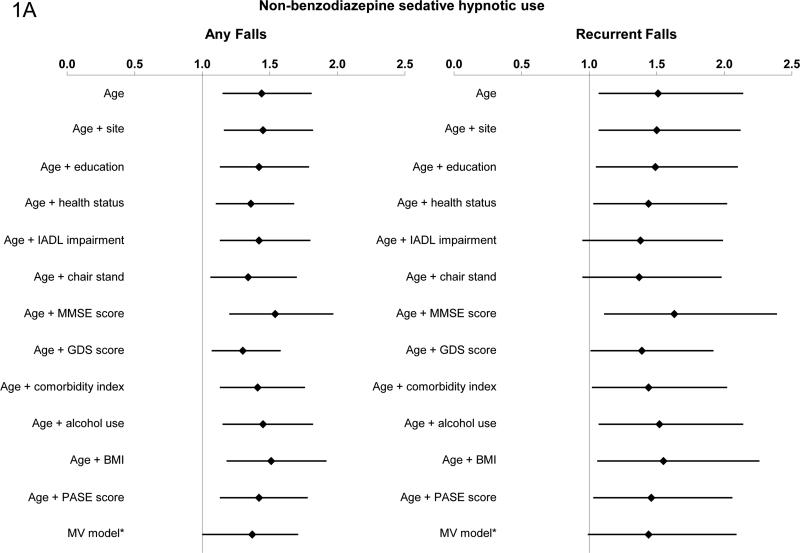
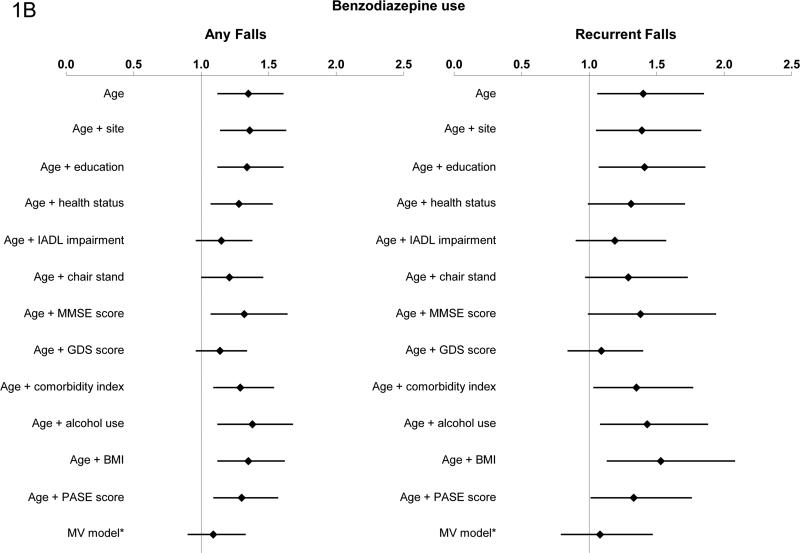
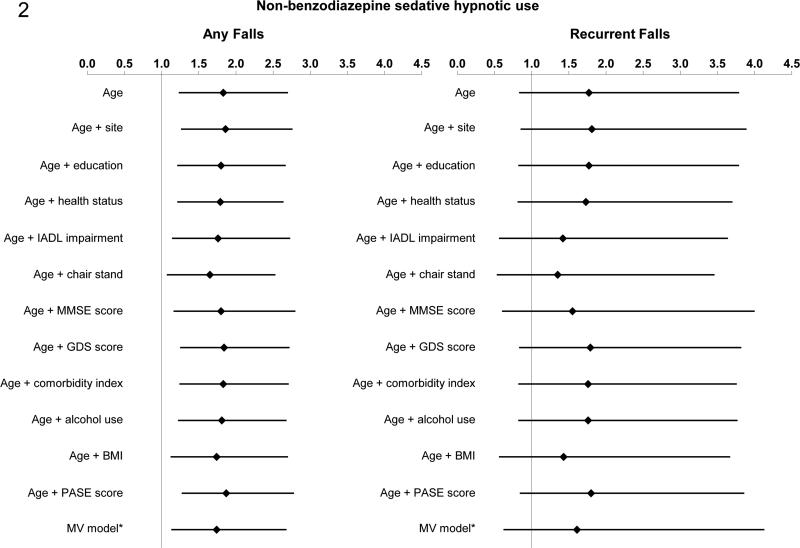
Results: In age-adjusted models, non-benzodiazepine sedative hypnotic use was associated with an increased risk of any falls (one or more falls) (RR 1.44, 95% CI 1.15, 1.81) and recurrent falls (2 or more falls) (RR 1.51, 95% CI 1.07, 2.14). Use of benzodiazepines was associated with a similar increase in age-adjusted risk of falling. Depressive symptoms, inability to stand from a chair, and instrumental activities of daily living (IADL) impairment modestly attenuated these associations. The association between non-benzodiazepine sedative-hypnotic use and falls was most pronounced among men without a history of falls in the previous year: in a multivariable model controlling for multiple potential confounders, the RR of any falls was 1.74 (95% CI 1.13, 2.68) in this subgroup.
Conclusions: Use of non-benzodiazepine sedative-hypnotics is associated with an increased risk of falls. Non-pharmacologic approaches to sleep disturbances may represent the safest approach to sleep difficulties in older adults.
Keywords: adverse drug effects; benzodiazepines; falls; men; sedative hypnotics; zolpidem.
Figures
References
-
- Darcourt G, Pringuey D, Salliere D, Lavoisy J. The safety and tolerability of zolpidem--an update. J Psychopharmacol. 1999;13:81–93. PMID:10221362. - PubMed
-
- Allain H, Bentue-Ferrer D, Polard E, Akwa Y, Patat A. Postural instability and consequent falls and hip fractures associated with use of hypnotics in the elderly: a comparative review. Drugs Aging. 2005;22:749–765. PMID:16156679. - PubMed
-
- Parrino L, Terzano MG. Polysomnographic effects of hypnotic drugs. A review. Psychopharmacology (Berl) 1996;126:1–16. PMID:8853211. - PubMed
-
- Terzano MG, Rossi M, Palomba V, Smerieri A, Parrino L. New drugs for insomnia: comparative tolerability of zopiclone, zolpidem and zaleplon. Drug Saf. 2003;26:261–282. PMID:12608888. - PubMed
-
- Scott MA, Stigleman S, Cravens D. Clinical inquiries. What is the best hypnotic for use in the elderly? J Fam Pract. 2003;52:976–978. PMID:14653987. - PubMed
Grants and funding
- R01 HL070848/HL/NHLBI NIH HHS/United States
- R01 HL071194/HL/NHLBI NIH HHS/United States
- R01 HL070847/HL/NHLBI NIH HHS/United States
- R01 HL070842/HL/NHLBI NIH HHS/United States
- U01 AG042145/AG/NIA NIH HHS/United States
- U01 AR045614/AR/NIAMS NIH HHS/United States
- U01 AR045654/AR/NIAMS NIH HHS/United States
- U01 AR045583/AR/NIAMS NIH HHS/United States
- R01 HL070841/HL/NHLBI NIH HHS/United States
- R01 HL070838/HL/NHLBI NIH HHS/United States
- R01 HL070839/HL/NHLBI NIH HHS/United States
- U01 AR045647/AR/NIAMS NIH HHS/United States
- U01 AG027810/AG/NIA NIH HHS/United States
- UL1 RR024140/RR/NCRR NIH HHS/United States
- R01 HL070837/HL/NHLBI NIH HHS/United States
- U01 AR045580/AR/NIAMS NIH HHS/United States
- U01 AG018197/AG/NIA NIH HHS/United States
- U01 AR066160/AR/NIAMS NIH HHS/United States
- U01 AR045632/AR/NIAMS NIH HHS/United States
LinkOut - more resources
Full Text Sources
Other Literature Sources