. 2015 Mar;66(5):1463-76.
doi: 10.1093/jxb/eru504. Epub 2015 Jan 14.

Functional characterization and developmental expression profiling of gibberellin signalling components in Vitis vinifera

Affiliations

Functional characterization and developmental expression profiling of gibberellin signalling components in Vitis vinifera

Atiako Kwame Acheampong et al. J Exp Bot. 2015 Mar.

Abstract

Gibberellins (GAs) regulate numerous developmental processes in grapevine (Vitis vinifera) such as rachis elongation, fruit set, and fruitlet abscission. The ability of GA to promote berry enlargement has led to its indispensable use in the sternospermocarpic ('seedless') table grape industry worldwide. However, apart from VvGAI1 (VvDELLA1), which regulates internode elongation and fruitfulness, but not berry size of seeded cultivars, little was known about GA signalling in grapevine. We have identified and characterized two additional DELLAs (VvDELLA2 and VvDELLA3), two GA receptors (VvGID1a and VvGID1b), and two GA-specific F-box proteins (VvSLY1a and VvSLY1b), in cv. Thompson seedless. With the exception of VvDELLA3-VvGID1b, all VvDELLAs interacted with the VvGID1s in a GA-dependent manner in yeast two-hybrid assays. Additionally, expression of these grape genes in corresponding Arabidopsis mutants confirmed their functions in planta. Spatiotemporal analysis of VvDELLAs showed that both VvDELLA1 and VvDELLA2 are abundant in most tissues, except in developing fruit where VvDELLA2 is uniquely expressed at high levels, suggesting a key role in fruit development. Our results further suggest that differential organ responses to exogenous GA depend on the levels of VvDELLA proteins and endogenous bioactive GAs. Understanding this interaction will allow better manipulation of GA signalling in grapevine.

Keywords: F-box proteins; GA receptors; VvDELLA proteins.; gibberellin signalling; gibberellins (GAs); grapevine (Vitis vinifera).


Figures

Fig. 1.
Fig. 1.
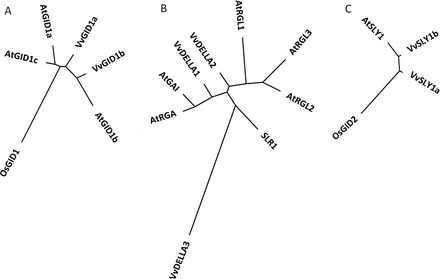
Neighbour-joining tree from the amino acid sequence alignment of GA signalling components isolated from V. vinifera. The tree was created by web-based Phylogeny.fr software (http://www.phylogeny.fr/version2_cgi/simple_phylogeny.cgi?tab_index=1). Sequence alignments were performed using the CLUSTALW2 program of MUltiple Sequence Comparison by Log-Expectation (MUSCLE), and phylogeny by PhyML programs. (A) A phylogentic tree containing VvGID1 paralogues (VvGID1a, VvGID1b), and orthologues from Arabidopsis (AtGID1a, AtGID1b, AtGID1c) and rice (OsGID1) (B) A phylogenetic tree containing VvDELLA paralogues (VvDELLA1, VvDELLA2, and VvDELLA3), and orthologues from Arabidopsis (AtGAI, AtRGA, AtRGL1, AtRGL2, AtRGL3), and the solitary rice orthologue, SLR1. (C) A phylogentic tree containing VvSLY1 paralogues (VvSLY1a and VvSLY1b), and orthologues from Arabidopsis (AtSLY1) and rice (OsGID2).
Fig. 2.
Fig. 2.
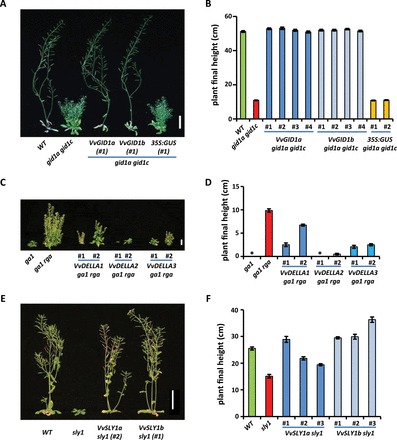
Grapevine GA signalling genes rescue the phenotype of corresponding Arabidopsis mutants. (A, C, E) Gross morphology of gid1a-2 gid1c-2, ga1-3 rga-24, and sly1-10 Arabidopsis mutants and representative transgenic plants transformed with VvGID1s, VvDELLLAs, and VvSLY1s, respectively. Bar: 5cm in (A), (E); 1cm in (C). Whole-plant pictures of VvGID1, VvDELLA, and VvSLY1 transformants were taken at 51, 70, and 60 days, respectively. (B, D, F) Average final plant heights of wild type (WT), mutant, and transgenic plants of (A), (C), and (E). The height of each individual transformant is significantly different from the corresponding mutant (n ≥ 8; P < 0.01). In contrast, the height of 35S:GUS gid1a gid1c lines was not significantly different from gid1a gid1c (n ≥ 15). Parameters for VvGID1, VvDELLA, and VvSLY1 transformants were measured at 51, 81, and 87 days, respectively. Asterisk: zero plant height due to the lack of inflorescence stem elongation.
Fig. 3.
Fig. 3.
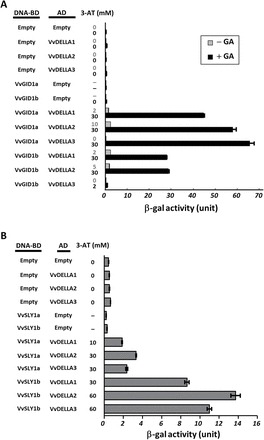
VvDELLAs interact with VvGID1s and VvSLY1s in Y2H assays. (A) Interaction between VvDELLAs and VvGID1s proceed in a GA-dependent manner. The addition of 100 µM GA3 to the medium enhanced GID1–DELLA interactions. (B) Interaction between VvDELLAs and VvSLY1s.
Fig. 4.
Fig. 4.
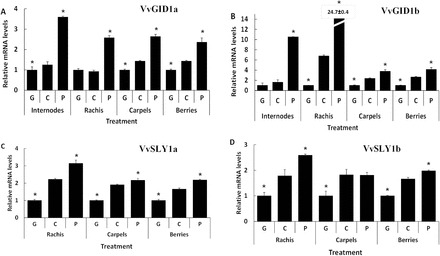
GA regulation of expression of VvGID1a (A), VvGID1b (B), VvSLY1a (C), and VvSLY1b (D) in selected tissues/organs of V. vinifera cv. Thompson Seedless. Tissues/organs were treated and sampled 6h after GA treatment and 102h after PAC treatment. Organs were dipped or sprayed until run-off with a single GA3 application (G), paclobutrazol (P), or Triton X-100 (C) treatment. The absolute mRNA levels of each gene were determined by qRT-PCR and normalized against VvGAPDH. Absolute gene expression in any organs/tissues are shown relative to the values for the GA treatment. The bars represent the mean ± SE of three biological repeats with two technical repeats each. Asterisks indicate values statistically different from their respective control (C) at P ≤ 0.05. Results were reproducible in successive growing seasons.
Fig. 5.
Fig. 5.
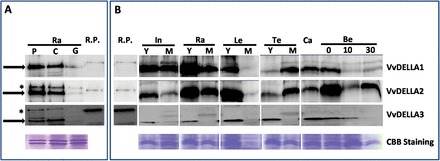
GA-induced degradation, and temporal and spatial profiles of VvDELLA proteins in V. vinifera cv. Thompson Seedless. Western blot analyses are shown of VvDELLA proteins in organs using affinity-purified, anti-VvDELLA polyclonal antibodies. Total protein extracted from organs across different developmental stages (full description given in Materials and Methods) was incubated with anti-VvDELLA polyclonal antibodies from rabbit. Recombinant full-length proteins (R.P.) (3.75ng each of VvDELLA1 and VvDELLA2, and 37.5ng of VvDELLA3) were used as controls. Coomassie Brilliant Blue (CBB)-stained proteins were used as loading controls. In all lanes except R.P., solid black arrows show the band of interest, and asterisked-bands indicate non-specific proteins detected by the anti-VvDELLA antibodies. Differences in sizes of R.P. and endogenous VvDELLA proteins result from V5 and 6xHis tags on the R.P. (A) The blot for GA-induced degradation of VvDELLA proteins contained total proteins extracted from young rachis (E-L 15) treated with 121 µM GA3 (G) for 6h, or 0.025% Triton X-100 (C) for 6h, or 0.8mM paclobutrazol (P) for 102h. (B) Temporal and spatial profiles of VvDELLA1, VvDELLA2, and VvDELLA3 in organs of cv. Thompson seedless. In, internodes; Ra, rachis; Le, leaves; Te, tendrils; Ca, carpels; Be, berries; 0, berries sampled at 2–3mm diameter (E-L 27); 10, berries sampled 10 day after E-L 27; 30, berries sampled 30 days after E-L 27; Y, young; M, mature. This figure is available in colour at JXB online.
Fig. 6.
Fig. 6.
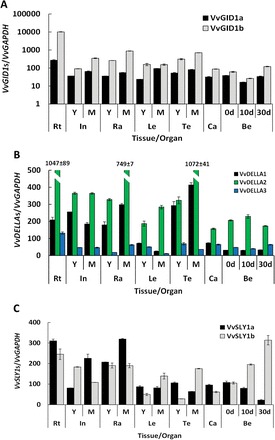
Spatial and temporal expression profiles in V. vinifera cv. Thompson seedless of VvGID1a and VvGID1b (A); VvDELLA1, VvDELLA2, and VvDELLA3 (B); and VvSLY1a and VvSLY1b (C). Total RNA was extracted from pooled samples, and the absolute mRNA levels of each gene were determined by qRT-PCR and normalized against VvGAPDH. To ensure accurate quantitation of transcript levels, primers of similar efficiencies were used, and calibration curves determined from known copy numbers of single plasmids containing all qRT-PCR amplicons. The bars represent the mean ± SE of three biological repeats with two technical repeats each. In, internodes; Ra, rachis; Le, leaves; Te, tendrils; Ca, carpels; Be, berries; 0 d, berries sampled at 2–3mm diameter (E-L 27); 10 d, berries sampled 10 day after E-L 27; 30 d, berries sampled 30 days after E-L 27; Y, young; M, mature. The y-axis (expression) of panel (A) is presented with log values. This figure is available in colour at JXB online.
Fig. 7.
Fig. 7.
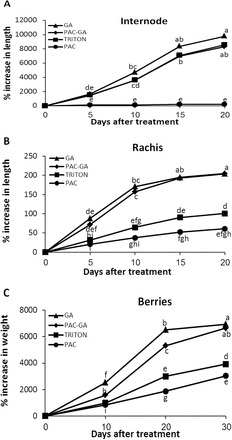
Altered response of organs of V. vinifera cv. Thompson seedless to GA3 and GA biosynthesis inhibitor (PAC) treatments. GA3 and PAC (0.8mM) were formulated in Triton X-100 (0.025%). Internodes and rachises were treated with 121 µM GA3, while berries were treated with 90 µM GA3. Tissues/organs were dipped or sprayed until run-off. Increase in size was monitored at specific time intervals. Young shoots and inflorescences with tightly packed flowers (stage 15, E-L 15, on the Modified Eichhorn and Lorenz system) were selected for internode and rachis experiments, respectively. Clusters with berries of 2–3mm diameter (E-L 27) were selected for berry experiments. (A) Lengths of new internodes arising after treating shoots. An increase in length of internode is expressed as per cent increase of initial length, which was assumed to be 0.5mm. (B) Changes in length of treated rachises, expressed as per cent increase of initial length. (C) Per cent increase in berry weight relative to mean weight at time of treatment (0 d). Data points with different letters indicate significantly different values according to the Tukey HSD LSMean test at α = 0.05 and 25 measurements, except for berries with 150 measurements.

References

    1. Acheampong AK, Rotman A, Zaheng C, Keren A, Halaly T, Crane O, Ogrodovitch A, Or E. 2010. A method for isolating total RNA from mature buds and other woody tissues of Vitis Vinifera. In: Delrot S, Or E, Babaresco L, Grando S, eds. Methodologies and results in grapevine research. The Netherlands: Springer, 301–307.
    1. Agüero C, Vigliocco A, Abdala G, Tizio R. 2000. Effect of gibberellic acid and uniconazol on embryo abortion in the stenospermocarpic grape cultivars Emperatriz and Perlon. Plant Growth Regulation 30, 9–16.
    1. Ben-Tal Y. 1990. Effects of gibberellin treatments on ripening and berry drop from Thompson Seedless grapes. American Journal of Enology and Viticulture 41, 142–146.
    1. Boll S, Lange T, Hofmann H, Schwappach P. 2009. Correspondence between gibberellin-sensitivity and pollen tube abundance in different seeded vine varieties. Mitteilungen Klosterneuburg 59, 129–133.
    1. Boss PK, Thomas MR. 2002. Association of dwarfism and floral induction with a grape ‘green revolution’ mutation. Nature 416, 847–850. - PubMed

Publication types

MeSH terms

LinkOut - more resources