


Skilled forelimb movements and internal copy motor circuits
- PMID: 25588912
- PMCID: PMC4497943
- DOI: 10.1016/j.conb.2014.12.009
Skilled forelimb movements and internal copy motor circuits
Abstract
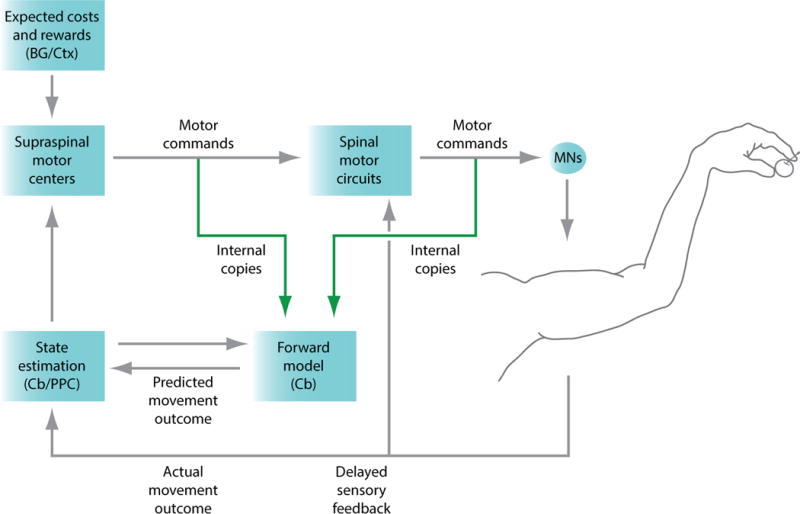
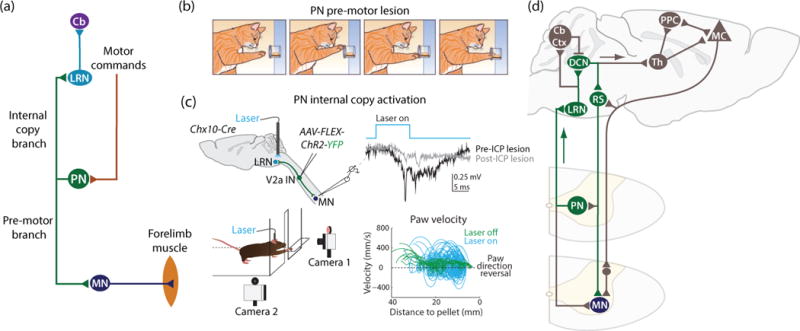
Mammalian skilled forelimb movements are remarkable in their precision, a feature that emerges from the continuous adjustment of motor output. Here we discuss recent progress in bridging the gap between theory and neural implementation in understanding the basis of forelimb motor refinement. One influential theory is that feedback from internal copy motor pathways enables fast prediction, through a forward model of the limb, an idea supported by behavioral studies that have explored how forelimb movements are corrected online and can adapt to changing conditions. In parallel, neural substrates of forelimb internal copy pathways are coming into clearer focus, in part through the use of genetically tractable animal models to isolate spinal and cerebellar circuits and explore their contributions to movement.
Copyright © 2014 Elsevier Ltd. All rights reserved.
Figures
References
-
- Morasso P. Spatial control of arm movements. Exp Brain Res. 1981;42:223–227. - PubMed
-
- Bernstein NA. The co-ordination and regulation of movements. Oxford, New York: Pergamon Press; 1967. ed 1st English.
-
- Harris CM, Wolpert DM. Signal-dependent noise determines motor planning. Nature. 1998;394:780–784. - PubMed
Publication types
MeSH terms
Grants and funding
LinkOut - more resources
Full Text Sources
Other Literature Sources
Miscellaneous
