. 2015 Feb 22;282(1801):20141912.
doi: 10.1098/rspb.2014.1912.

The oldest parareptile and the early diversification of reptiles

Affiliations

The oldest parareptile and the early diversification of reptiles

Sean P Modesto et al. Proc Biol Sci. .

Abstract

Amniotes, tetrapods that evolved the cleidoic egg and thus independence from aquatic larval stages, appeared ca 314 Ma during the Coal Age. The rapid diversification of amniotes and other tetrapods over the course of the Late Carboniferous period was recently attributed to the fragmentation of coal-swamp rainforests ca 307 Ma. However, the amniote fossil record during the Carboniferous is relatively sparse, with ca 33% of the diversity represented by single specimens for each species. We describe here a new species of reptilian amniote that was collected from uppermost Carboniferous rocks of Prince Edward Island, Canada. Erpetonyx arsenaultorum gen. et sp. nov. is a new parareptile distinguished by 29 presacral vertebrae and autapomorphies of the carpus. Phylogenetic analyses of parareptiles reveal E. arsenaultorum as the closest relative of bolosaurids. Stratigraphic calibration of our results indicates that parareptiles began their evolutionary radiation before the close of the Carboniferous Period, and that the diversity of end-Carboniferous reptiles is 80% greater than suggested by previous work. Latest Carboniferous reptiles were still half as diverse as synapsid amniotes, a disparity that may be attributable to preservational biases, to collecting biases, to the origin of herbivory in tetrapods or any combination of these factors.

Keywords: carboniferous; diversification; evolution; parareptile.


Figures

Figure 1.
Figure 1.
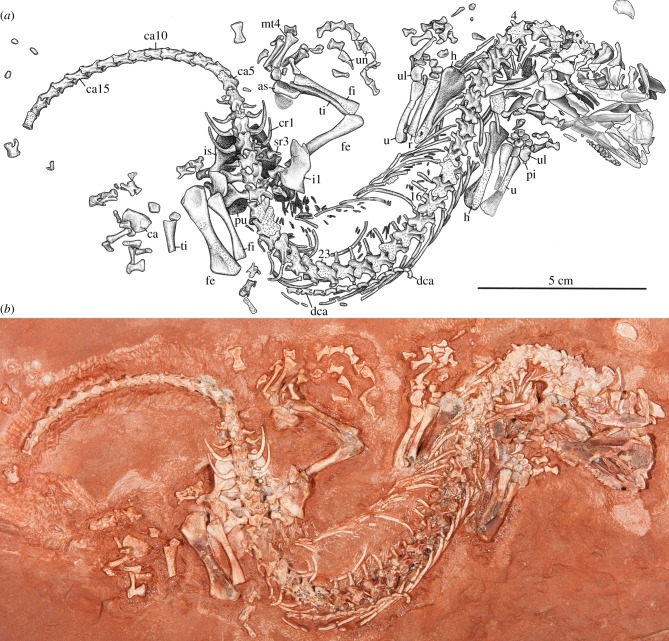
Erpetonyx arsenaultorum n. gen. et sp., ROM 55402, holotype. (a) Interpretive drawing of skeleton in dorsal aspect. (b) Photograph of skeleton in dorsal aspect. as, astragalus; ca, calcaneum; ca5, caudal vertebra 5; ca15, caudal vertebra 15; cr1, caudal rib 1; dca, distal caudal vertebra; fe, femur; fi, fibula; h, humerus; il, ilium; is, ischium; mt, metatarsal; pi, pisiform; pu, pubis; r, radius; sr3, sacral rib 3; ti, tibia; u, ulna; ul, ulnare; un, unguals. Arabic numerals identify cervical vertebrae. (Online version in colour.)
Figure 2.
Figure 2.
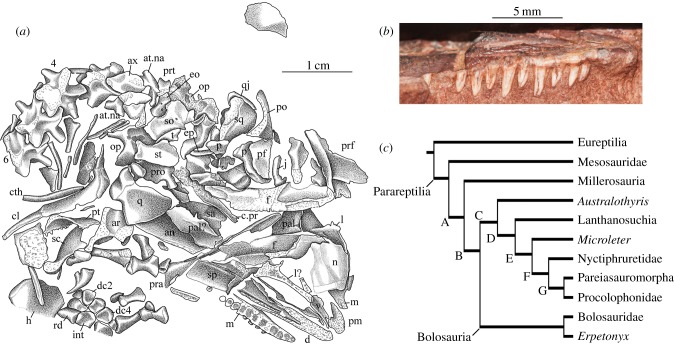
Erpetonyx arsenaultorum n. gen. et sp., ROM 55402, holotype. (a) Interpretive drawing of skull. (b) Photograph of right maxillary dentition in lateral view. (c) Results of phylogenetic analysis; tree length = 557, consistency index (CI) = 0.3429, CI excluding informative characters = 0.3405, retention index = 0.6355, rescaled CI = 0.2179. Bootstrap/Bremer support values: Bolosauria: 39/3; Parareptilia: 13/1; clade A: 33/2; clade B (Procolophonomorpha): 32/2; clade C: 11/2; clade D (Ankyramorpha): 12/2; clade E: 19/2; clade F: 44/1; clade G: 15/1. Bolosauria is diagnosed by the following unambiguous synapomorphies: postparietal small (character 9, state 1); transverse flange of pterygoid dentition present (character 70, state 1); anterior caudal ribs elongate and extend posteriorly to end of next vertebra (character 132, state 0); greater trochanter of femur present (character 156, state 1); maxillary tooth positions number 15 or fewer (character 167, state 0). Anatomical abbreviations: an, angular; ar, articular; at.na, atlantal neural arch; ax, axis; cl, clavicle; cth, cleithrum; d, dentary; dc2, distal carpal 2; dc4, distal carpal 4; c.pr, cultriform process of parasphenoid; eo, exoccipital; ep, epipterygoid; f, frontal; int, intermedium; j, jugal; l, lacrimal; m, maxilla; n, nasal; op, opisthotic; p, parietal; pal, palatine; pf, postfrontal; pm, premaxilla; po, postorbital; pra, prearticular; pro, prootic; prf, prefrontal; prt, proatlas; pt, pterygoid; q, quadrate; qj, quadratojugal; rd, radiale; sa, surangular; sc, scapula; so, supraoccipital; sp, splenial; sq, squamosal; st, supratemporal; t, tabular; v, vomer. Arabic numerals identify cervical vertebrae. (Online version in colour.)
Figure 3.
Figure 3.
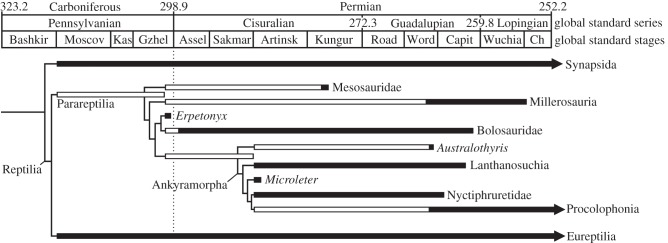
Temporal calibration of Reptilia composed of parareptilian phylogeny shown in figure 2c. Black bars are known ranges, open bars are ghost taxa and ghost lineages. Timescale from International Commission on Stratigraphy [22].

References

    1. Gauthier J, Kluge AG, Rowe T. 1988. The early evolution of the Amniota. In The phylogeny and classification of the tetrapods (ed. Benton MJ.), pp. 103–155. Oxford, UK: Clarendon Press.
    1. Laurin M, Reisz RR. 1995. A reevaluation of early amniote phylogeny. Zool. J. Linn. Soc. 113, 165–223. ( 10.1111/j.1096-3642.1995.tb00932.x) - DOI
    1. Müller J, Reisz RR. 2006. The phylogeny of early eureptiles: comparing parsimony and Bayesian approaches in the investigation of a basal fossil clade. Syst. Biol. 55, 503–511. ( 10.1080/10635150600755396) - DOI - PubMed
    1. Reisz RR, Müller J. 2004. Molecular timescales and the fossil record: a paleontological perspective. Trends Genet. 20, 237–241. ( 10.1016/j.tig.2004.03.007) - DOI - PubMed
    1. Müller J, Reisz RR. 2005. Four well-constrained calibration points from the vertebrate fossil record for molecular clock estimates. Bioessays 27, 1069–1075. ( 10.1002/bies.20286) - DOI - PubMed

Publication types

LinkOut - more resources