Clinical review: Drugs commonly associated with weight change: a systematic review and meta-analysis
- PMID: 25590213
- PMCID: PMC5393509
- DOI: 10.1210/jc.2014-3421
Clinical review: Drugs commonly associated with weight change: a systematic review and meta-analysis
Abstract
Context: Various drugs affect body weight as a side effect.
Objective: We conducted this systematic review and meta-analysis to summarize the evidence about commonly prescribed drugs and their association with weight change.
Data sources: MEDLINE, DARE, and the Cochrane Database of Systematic Reviews were searched to identify published systematic reviews as a source for trials.
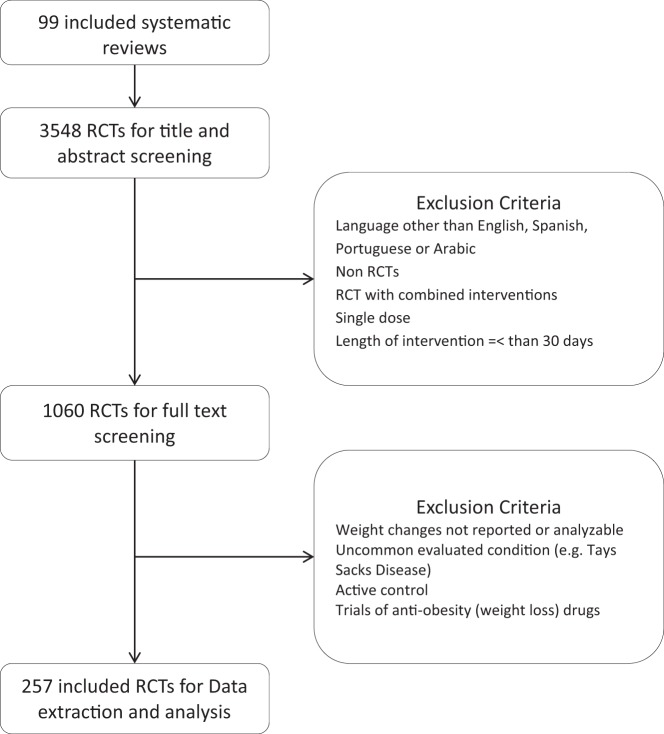
Study selection: We included randomized trials that compared an a priori selected list of drugs to placebo and measured weight change.
Data extraction: We extracted data in duplicate and assessed the methodological quality using the Cochrane risk of bias tool.
Results: We included 257 randomized trials (54 different drugs; 84 696 patients enrolled). Weight gain was associated with the use of amitriptyline (1.8 kg), mirtazapine (1.5 kg), olanzapine (2.4 kg), quetiapine (1.1 kg), risperidone (0.8 kg), gabapentin (2.2 kg), tolbutamide (2.8 kg), pioglitazone (2.6 kg), glimepiride (2.1 kg), gliclazide (1.8 kg), glyburide (2.6 kg), glipizide (2.2 kg), sitagliptin (0.55 kg), and nateglinide (0.3 kg). Weight loss was associated with the use of metformin (1.1 kg), acarbose (0.4 kg), miglitol (0.7 kg), pramlintide (2.3 kg), liraglutide (1.7 kg), exenatide (1.2 kg), zonisamide (7.7 kg), topiramate (3.8 kg), bupropion (1.3 kg), and fluoxetine (1.3 kg). For many other remaining drugs (including antihypertensives and antihistamines), the weight change was either statistically nonsignificant or supported by very low-quality evidence.
Conclusions: Several drugs are associated with weight change of varying magnitude. Data are provided to guide the choice of drug when several options exist and institute preemptive weight loss strategies when obesogenic drugs are prescribed.
Comment in
-
[Drugs that make gain weight or make lose weight].Rev Prat. 2015 Apr;65(4):474. Rev Prat. 2015. PMID: 26058187 French. No abstract available.
References
-
- Barness LA, Opitz JM, Gilbert-Barness E. Obesity: genetic, molecular, and environmental aspects. Am J Med Genet A. 2007;143A:3016–3034. - PubMed
-
- World Health Organization. Fact Sheet: Obesity and Overweight. Geneva, Switzerland: World Health Organization; 2011.
-
- Vasan RS, Pencina MJ, Cobain M, Freiberg MS, D'Agostino RB. Estimated risks for developing obesity in the Framingham Heart Study. Ann Intern Med. 2005;143:473–480. - PubMed
-
- Flegal KM, Graubard BI, Williamson DF, Gail MH. Cause-specific excess deaths associated with underweight, overweight, and obesity. JAMA. 2007;298:2028–2037. - PubMed
Publication types
MeSH terms
Substances
Grants and funding
LinkOut - more resources
Full Text Sources
Other Literature Sources
Medical