


BMI as a mediator of the relationship between muscular fitness and cardiometabolic risk in children: a mediation analysis
- PMID: 25590619
- PMCID: PMC4295865
- DOI: 10.1371/journal.pone.0116506
BMI as a mediator of the relationship between muscular fitness and cardiometabolic risk in children: a mediation analysis
Abstract
Objective: Muscular fitness levels have been associated with cardiometabolic risk in children, although whether body weight acts as a confounder or as an intermediate variable in this relationship remains controversial. The aim of this study was to examine whether the association between muscular fitness and cardiometabolic risk factors is mediated by body mass index (BMI).
Design and methods: Cross-sectional study using a sample of 1158 schoolchildren aged 8-11 years from the province of Cuenca, Spain. We measured anthropometrics and biochemical variables and we calculated a muscular fitness index as the sum of z-scores of handgrip dynamometry/weight and standing long jump, and we estimated a previously validated cardiometabolic risk index (CMRI). Linear regression models were fitted for mediation analysis to assess whether the association between muscular fitness and cardiometabolic risk was mediated by BMI.
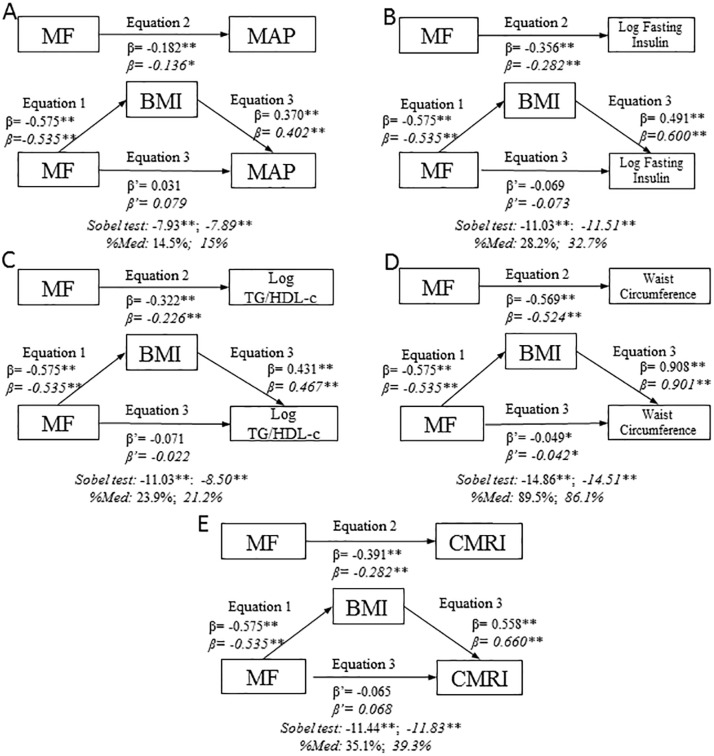
Results: Children with normal weight (NW) had a better cardiometabolic risk profile than their overweight (OW) or obese (OB) peers after controlling for muscular fitness. Marginal estimated mean ± SE values for NW, OW and OB categories of CMRI were -0.75 ± 0.06 < 0.84 ± 0.10 < 2.18 ± 0.16 in boys and -0.73 ± 0.06 < 0.96 ± 0.10 < 2.71 ± 0.17 in girls, both p < 0.001. Children with higher levels of muscular fitness had a better cardiometabolic risk profile (CMRI marginal estimated mean ± SE 1.04 ± 0.13 > 0.05 ± 0.09 >-1.16 ± 0.13 for lower, middle and upper quartiles of muscular fitness in boys and 1.01 ± 0.16 > 0.10 ± 0.09 > -1.02 ± 0.15 in girls, both p < 0.001), but differences disappeared when controlling for BMI. BMI acted as a full mediator between muscular fitness and most cardiometabolic risk factors (Sobel test z = -11.44 for boys; z = -11.83 for girls; p < 0.001 in CMRI mediation model) and as a partial mediator in the case of waist circumference (Sobel test z=-14.86 for boys; z=-14.51 for girls; p<0.001).
Conclusions: BMI mediates the association between muscular fitness and cardiometabolic risk in schoolchildren. Overall, good muscular fitness is associated with lower cardiometabolic risk, but particularly when accompanied by normal weight.
Conflict of interest statement
Figures
References
-
- Alberti KG, Eckel RH, Grundy SM, Zimmet PZ, Cleeman JI, et al. (2009) Harmonizing the metabolic syndrome: a joint interim statement of the International Diabetes Federation Task Force on Epidemiology and Prevention; National Heart, Lung, and Blood Institute; American Heart Association; World Heart Federation; International Atherosclerosis Society; and International Association for the Study of Obesity. Circulation 120: 1640–1645. - PubMed
-
- Bao W, Srinivasan SR, Wattigney WA, Berenson GS (1994) Persistence of multiple cardiovascular risk clustering related to syndrome X from childhood to young adulthood. The Bogalusa Heart Study. Arch Intern Med 154: 1842–1847. - PubMed
-
- Sinaiko AR, Donahue RP, Jacobs DR, Prineas RJ (1999) Relation of weight and rate of increase in weight during childhood and adolescence to body size, blood pressure, fasting insulin, and lipids in young adults. The Minneapolis Children’s Blood Pressure Study. Circulation 99: 1471–1476. - PubMed
Publication types
MeSH terms
LinkOut - more resources
Full Text Sources
Other Literature Sources
Medical
Miscellaneous
